

How to Assess Business Security Risks and Protect Assets
TL;DR:
- Security risks encompass physical, digital, and procedural threats affecting assets and operations.
- Conducting a systematic risk assessment helps identify vulnerabilities, prioritize risks, and build effective protections.
- Continuous monitoring and staff engagement are essential to maintain security effectiveness and adapt to evolving threats.
Security breaches are not just an IT problem. The global average breach cost reached $4.44 million in 2025, and US businesses averaged a staggering $10.22 million per incident. For business owners and property managers, those numbers represent payroll, equipment, reputation, and years of hard work. The good news is that a structured security risk assessment gives you a clear roadmap to find your weaknesses before someone else does. This guide walks you through every stage of that process, from identifying your most valuable assets to building a monitoring routine that keeps your protection current.
Table of Contents
- Understanding business security risks
- Setting the groundwork: Assets, threats, and vulnerabilities
- Step-by-step security risk assessment process
- Prioritizing, mitigating, and monitoring risks
- Why most security risk assessments fail (and how to get it right)
- Ready to take the next step in protecting your business?
- Frequently asked questions
Key Takeaways
| Point | Details |
|---|---|
| Know your assets | List every valuable asset and match it to specific threats and vulnerabilities. |
| Follow a structured process | Use proven frameworks such as NIST RMF or ISO 27001 to guide each assessment step. |
| Prioritize for impact | Rank risks by likelihood and consequence to focus on what matters most. |
| Take ongoing action | Mitigation and monitoring must be continuous, not just a one-time exercise. |
Understanding business security risks
A business security risk is any condition, event, or gap that could cause harm to your people, property, data, or operations. That definition sounds broad because it is. Security risks do not live in just one department or one type of threat.
The three main categories you need to think about are:
- Physical risks: Theft, vandalism, unauthorized access, and workplace violence. These are the most visible threats and often the easiest to overlook because they feel unlikely until they happen.
- Digital risks: Data breaches, ransomware, phishing, and insider threats. Even businesses with no customer-facing technology hold sensitive payroll, vendor, and operational data that criminals want.
- Procedural risks: Fraud, regulatory non-compliance, and poor access controls. These often originate from within the organization and can be harder to detect than external attacks.
Unmanaged risks in any of these categories translate directly into lost revenue, legal liability, and reputational damage that takes years to repair. A single compliance violation can trigger regulatory fines that dwarf the cost of prevention.
“A disciplined security assessment requires defining scope and objectives, inventorying assets, and identifying threats before any solution is considered.” This sequence matters because jumping to solutions without a full picture almost always leaves critical gaps.
The corporate security risk steps confirm that structured assessment is the foundation of any effective security program. Before you spend a dollar on cameras, locks, or software, you need to know exactly what you are protecting and from what. Understanding why investing in high security pays off starts with knowing which risks are actually present in your environment.
The practical takeaway here is simple. Security is not a product you buy. It is a process you build, and that process starts with honest, systematic assessment.
Setting the groundwork: Assets, threats, and vulnerabilities
To start assessing risk, you first need to know what could be at stake and what could go wrong. This preparation stage is where most businesses either get it right or waste time on the wrong problems.
Start by listing every asset that matters to your operation. Assets are not just physical objects. They include:
- Tangible assets: Cash, inventory, equipment, vehicles, and server hardware
- Intangible assets: Customer data, intellectual property, contracts, and brand reputation
- Human assets: Employees, contractors, and the specialized knowledge they carry
Once your asset list is solid, map each asset to the threats that could realistically affect it. Threats fall into four broad categories: natural (floods, fires), human (theft, sabotage), environmental (power failures, infrastructure outages), and digital (malware, credential theft).
The ISO 27001 assessment steps establish that identifying assets, threats, and vulnerabilities is the required starting point for any credible risk assessment. Vulnerabilities are the specific weaknesses that make a threat possible, such as an unlocked server room or an employee who reuses passwords.
| Asset | Threat | Vulnerability |
|---|---|---|
| Cash register | Robbery | No surveillance coverage |
| Customer database | Data breach | Weak password policy |
| Warehouse inventory | Theft | Single-point access control |
| Company vehicles | Vandalism | Unlit parking area |
This kind of mapping exercise makes abstract risk feel concrete and actionable. A solid security setup workflow guide can help you structure this inventory process efficiently.

Pro Tip: Do not complete this exercise alone. Front-line staff often know about vulnerabilities that never make it into management reports. A warehouse worker knows which door is propped open every afternoon. A receptionist knows who walks in unchallenged. Their input makes your asset inventory far more accurate.
Step-by-step security risk assessment process
With your assets and vulnerabilities outlined, it is time to work through a formal risk assessment process. Several frameworks exist to guide this work, and knowing the differences helps you choose the right approach.
The NIST RMF process provides a 7-step framework used widely by government agencies and large enterprises. NIST SP 800-30 focuses specifically on risk assessment methodology. ISO 27001 is the international standard most commonly adopted by businesses of all sizes.
| Framework | Primary focus | Steps | Best for |
|---|---|---|---|
| NIST RMF | System authorization | 7 | Federal, enterprise |
| NIST SP 800-30 | Risk assessment methodology | 4 phases | Technical environments |
| ISO 27001 | Information security management | Asset-based | All business sizes |
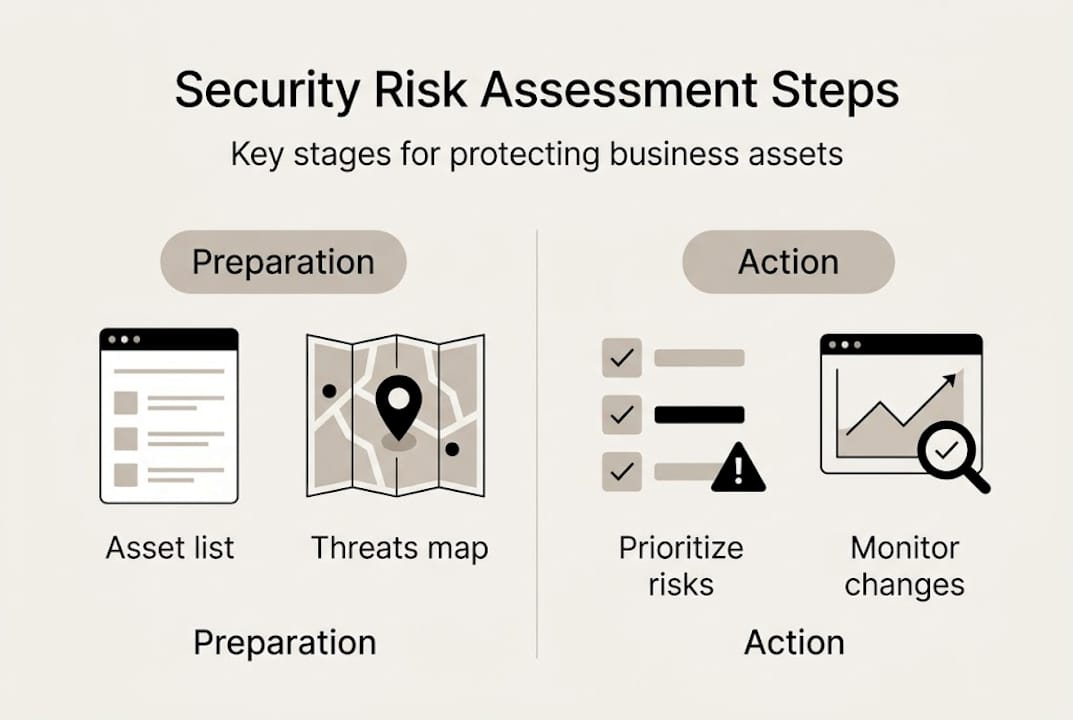
For most property managers and business owners, a practical NIST CSF 2.0 steps approach works well because it is flexible and scalable. Here is the process broken into plain steps:
- Define scope and objectives. Decide which locations, systems, and operations this assessment covers.
- Inventory all assets. Use the table exercise from the previous section.
- Identify threats. List every realistic threat for each asset category.
- Assess vulnerabilities. For each threat, identify the specific weakness that enables it.
- Evaluate existing controls. What protections are already in place, and how effective are they?
- Rate and prioritize risks. Use a Likelihood x Impact matrix to score each risk.
- Build a mitigation plan. Assign owners, timelines, and resources to each high-priority risk.
- Document everything. Your documentation supports compliance, insurance claims, and future reviews.
- Implement controls. Execute the plan with clear accountability.
- Monitor continuously. Set review dates and trigger points for reassessment.
The 10-step corporate process confirms this sequence as industry standard. Understanding security standards for protection and the role of security systems in your control environment will help you evaluate step five more accurately.
Pro Tip: Download or create a simple worksheet with columns for asset, threat, vulnerability, likelihood score, impact score, and risk score. Even a basic spreadsheet makes the process far more manageable and gives you a document you can update each year.
Prioritizing, mitigating, and monitoring risks
After completing your risk assessment, turn those insights into action by prioritizing and managing what matters most. Not every risk deserves the same response, and trying to fix everything at once usually means fixing nothing well.
Rate each identified risk by multiplying its likelihood score by its impact score. A risk that is very likely but low impact may rank lower than a rare but catastrophic event. This matrix approach, confirmed by ISO 27001 risk treatment standards, gives you an objective basis for deciding where to act first.
Once risks are ranked, choose a treatment strategy for each:
- Avoid: Eliminate the activity or condition that creates the risk entirely
- Mitigate: Reduce likelihood or impact through controls, training, or physical security upgrades
- Transfer: Shift financial exposure through insurance or contractual agreements
- Accept: Acknowledge low-priority risks and document the decision formally
Practical mitigation examples include installing surveillance cameras in high-risk zones, implementing multi-factor authentication on all accounts, restricting physical access to server rooms and cash storage, training staff on social engineering and fraud recognition, and conducting regular access audits to remove former employees.
Continuous monitoring is not optional. Threats evolve, staff changes, and new vulnerabilities emerge constantly. A risk assessment completed once and filed away offers false confidence.
The AI and automation benefits for security are significant. According to the data breach report, organizations using AI and automation in security reduced their breach lifecycle by 80 days and saved an average of $1.9 million per incident. For securing business premises effectively, integrating smart monitoring tools into your ongoing risk management routine is no longer a luxury.
Document every decision, including risks you choose to accept. That paper trail protects you during audits, insurance reviews, and any regulatory inquiries.
Why most security risk assessments fail (and how to get it right)
Here is the uncomfortable truth most consultants will not tell you: the majority of security risk assessments fail not because the methodology is wrong, but because they are treated as a report rather than a process.
Businesses invest time in a thorough assessment, produce a polished document, and then file it until the next audit cycle. Nothing changes. The same vulnerabilities that existed before the assessment exist a year later, now with the added illusion of having been addressed.
The second common failure is over-engineering the process. Teams get lost in framework comparisons, scoring debates, and documentation formatting while real risks go unmanaged. A simple, consistent assessment done quarterly beats a perfect one done every three years.
Human factors matter more than any checklist. Staff who understand why security procedures exist are your strongest control. Staff who see security as bureaucratic overhead will find workarounds every time. Investing in commercial security best practices means investing in culture, not just equipment.
You do not need perfect data to act. Start with what you know, assign ownership to every risk item, and review progress on a fixed schedule. Momentum and accountability matter far more than methodological perfection.
Ready to take the next step in protecting your business?
You now have a practical framework for identifying, assessing, and managing the security risks that matter most to your operation. Knowing the process is a strong start, but the right tools and products make execution far more effective.
At Safes and Security Direct, we offer professional-grade surveillance cameras, access control systems, fire-resistant safes, and business security solutions built to support every stage of your risk management plan. Whether you are addressing physical vulnerabilities or securing sensitive documents, our product range is designed for real-world business needs. Explore solutions for business security and find the right fit for your risk profile today.
Frequently asked questions
What is the first step in a business security risk assessment?
Start by defining the scope of your assessment and listing your critical assets, then identify all potential threats to each one. The structured assessment process confirms this sequence as the correct starting point before any controls or solutions are considered.
How often should my business conduct a security risk assessment?
Conduct a full review at least once per year and repeat the process after any major operational change such as a new location, system upgrade, or significant staff turnover. Continuous monitoring and updating your risk profile after changes is considered best practice under ISO 27001.
What is a risk matrix and why is it useful?
A risk matrix scores each threat by multiplying its likelihood by its potential impact, giving you an objective way to rank risks when perfect data is not available. Qualitative risk matrices are the preferred approach for most businesses because they are practical and easy to apply across different risk types.
How can automation help my security risk management?
Automated monitoring tools detect threats faster and reduce the time it takes to respond, which directly lowers the cost and severity of incidents. Organizations using AI-driven security reduced their breach lifecycle by 80 days and saved an average of $1.9 million compared to those without automation.
Recommended
- Asset Protection Strategies 2026: Safeguard Your Business Assets – Safes and Security Direct
- Business Security Needs: Protecting Assets in 2026 – Safes and Security Direct
- Business security checklist 2026: protect your SME assets – Safes and Security Direct
- Asset Protection Workflow Guide for Maximum Security – Safes and Security Direct