

How to secure business premises effectively in 2026
Protecting your business from theft and damage shouldn’t feel overwhelming. Many small and medium business owners struggle to know where to start when securing their premises. This guide walks you through practical, cost-effective measures including physical barriers, surveillance, employee training, and routine audits. You’ll learn to implement a multi-layered security approach tailored to your specific business needs and risks.
Table of Contents
- Prerequisites: Assess Your Business Premises And Risks
- Step 1: Implement Physical Barriers And Locks
- Step 2: Install Surveillance Cameras And Alarm Systems
- Step 3: Train Employees And Control Access
- Step 4: Utilize Safes For Valuable Asset Protection
- Troubleshooting Common Security Mistakes
- Expected Results And Measuring Security Success
- Budgeting Your Security Investment
- Enhance Your Business Security With Expert Solutions
Key takeaways
| Point | Details |
|---|---|
| Conduct risk assessments | Identify vulnerabilities and prioritize security investments based on your business type and location. |
| Install quality physical barriers | Use professional-grade locks, fences, and lighting on all access points to deter intruders. |
| Deploy integrated surveillance | Combine HD cameras with alarm systems for real-time alerts and coordinated response. |
| Train employees consistently | Implement access controls and security protocols to prevent internal and external breaches. |
| Schedule routine audits | Perform biannual reviews and budget for ongoing maintenance to sustain protection levels. |
Prerequisites: assess your business premises and risks
Before installing security equipment, you need to understand exactly what you’re protecting and where your weakest points exist. A thorough risk assessment forms the foundation of effective security strategy.
Start by conducting a comprehensive security risk assessment before implementing measures. Walk through your entire property and document every door, window, loading dock, and side entrance. Note which areas lack visibility from the street or neighboring buildings.
Identify your most valuable assets:
- Cash registers, safes, and petty cash locations
- Inventory storage areas and stockrooms
- Computer equipment and data servers
- Customer information and sensitive documents
- Specialized equipment unique to your industry
Your business type and location create specific threat profiles. A retail store faces different risks than a warehouse or professional office. High-crime neighborhoods require more robust measures than suburban business parks. Research local crime statistics and talk to neighboring businesses about their experiences.
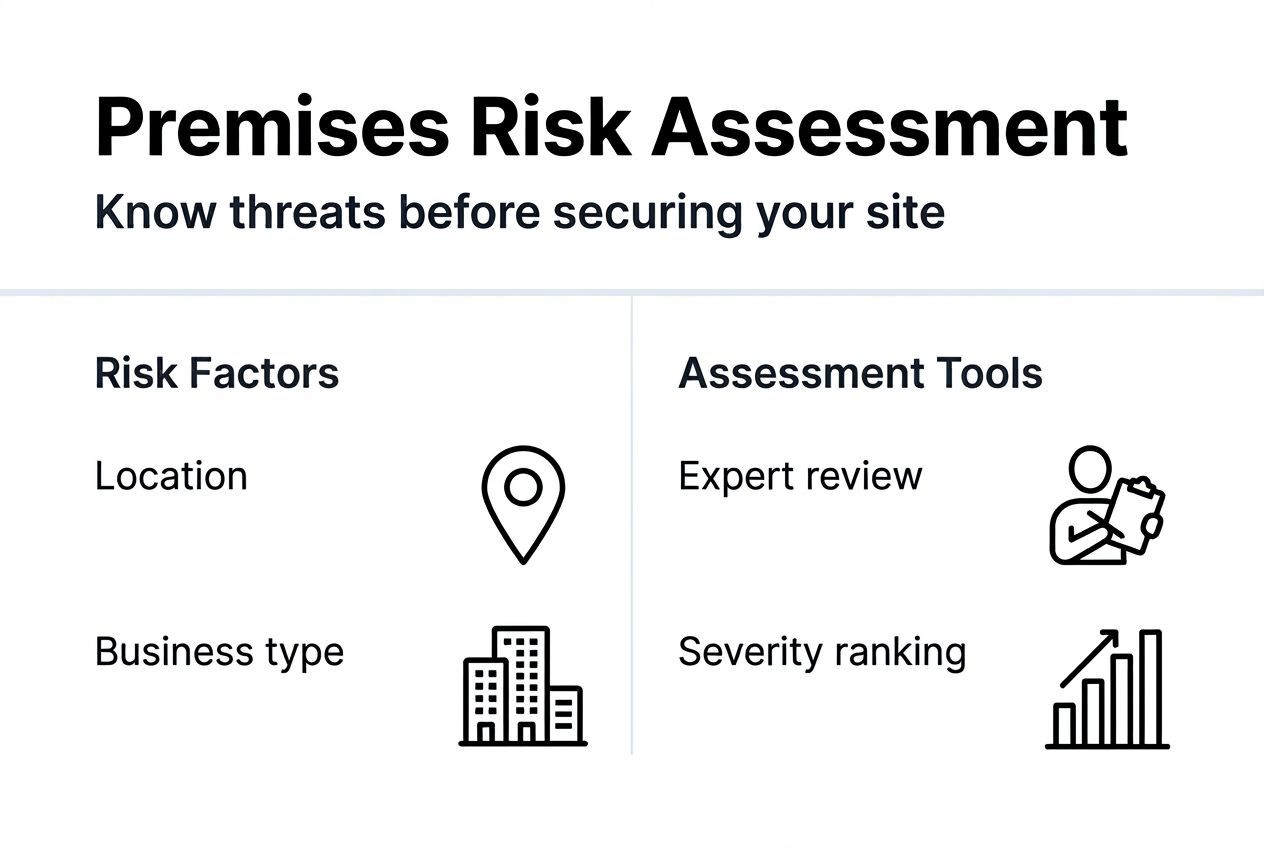
Engaging security professionals for initial assessments often reveals vulnerabilities you’d miss on your own. They bring expertise in identifying blind spots, evaluating lighting adequacy, and assessing structural weaknesses. The investment typically pays for itself by preventing misallocated security spending.
Use assessment findings to rank vulnerabilities by severity and likelihood. A poorly lit back entrance with a cheap lock ranks higher priority than a well-monitored front door. This prioritization ensures your budget tackles the most critical risks first.
Step 1: implement physical barriers and locks
Physical security forms your first line of defense against unauthorized entry. Quality hardware deters opportunistic criminals and slows down determined intruders, buying time for alarm response.
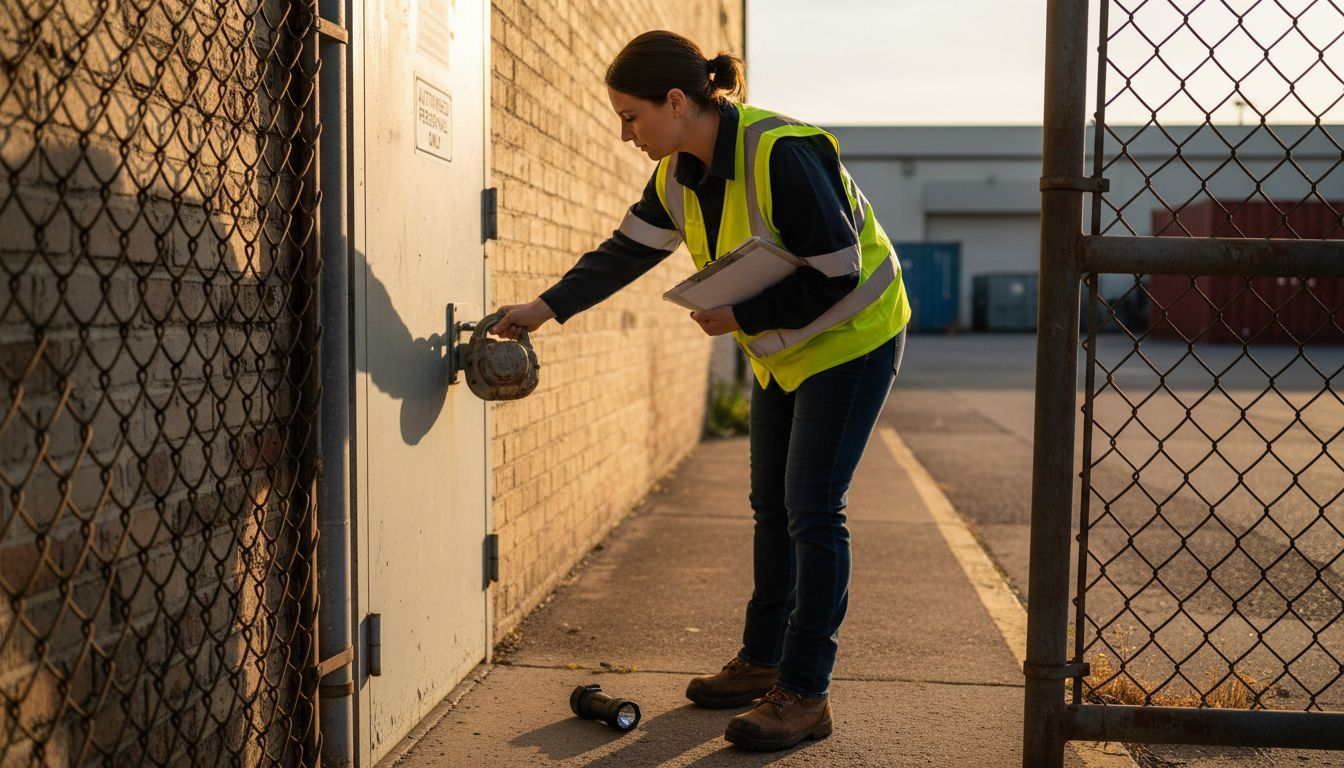
Install professionally rated locks on every access point. Deadbolts should extend at least one inch into the door frame. Window locks must prevent forced opening from outside. Poor-quality locks increase vulnerability by up to 30%, making this upgrade essential.
Essential physical security measures:
- Grade 1 deadbolt locks on all exterior doors
- Reinforced strike plates with three-inch screws
- Security film on ground-level windows
- Perimeter fencing with controlled access gates
- Motion-sensor lighting covering all approaches
- Security doors for high-risk entry points
| Lock Type | Security Level | Cost Range | Best For |
|---|---|---|---|
| Traditional deadbolt | High | $50-$200 | Standard doors with basic access |
| Electronic keypad | Very High | $150-$400 | Multiple user access tracking |
| Biometric lock | Highest | $300-$800 | Restricted areas requiring audit trails |
| Smart lock | High | $200-$500 | Remote management and monitoring |
Outdoor lighting eliminates hiding spots and makes surveillance footage usable at night. Motion-activated lights startle intruders while conserving energy. Position fixtures to illuminate all doors, windows, and parking areas without creating harsh shadows.
Pro Tip: Test your perimeter security after dark. Walk the property as an intruder would, noting any dark corners or easy access points you hadn’t considered during daylight inspections.
Inspect all physical security hardware quarterly. Locks wear out, hinges loosen, and fencing develops gaps. Regular maintenance prevents failures during actual security events. Replace any component showing wear before it fails completely.
Step 2: install surveillance cameras and alarm systems
Technology multiplies your security effectiveness by providing 24/7 monitoring and documented evidence of incidents. Modern systems integrate cameras, alarms, and access controls into coordinated defense networks.
Choose cameras with specifications matching your needs. HD cameras with motion detection increase incident capture rates by over 50% compared to older analog systems. Night vision capabilities ensure coverage during closed hours when most break-ins occur.
Critical surveillance system features:
- 1080p minimum resolution for facial recognition
- 30-day cloud or local storage capacity
- Wide-angle lenses covering entry points completely
- Weather-resistant housing for outdoor cameras
- Remote viewing via smartphone apps
- Infrared night vision with 30-foot range minimum
Alarm integration transforms passive monitoring into active response. Systems connected to professional monitoring services or local law enforcement cut response times dramatically. Sensors on doors and windows detect forced entry immediately, triggering alerts before intruders access valuable areas.
Position cameras strategically to eliminate blind spots while respecting employee privacy. Cover all exterior doors, cash handling areas, and valuable inventory zones. Avoid bathrooms and break rooms where recording creates legal complications. Optimize your CCTV installation by planning camera placement before running cables.
Network integration allows all security devices to communicate. When a door sensor trips, cameras automatically focus on that location and begin recording. Lights activate to improve footage quality. This coordination dramatically improves incident documentation and response effectiveness.
Pro Tip: Schedule monthly system tests where you trigger sensors deliberately and verify that all components respond correctly. Update firmware quarterly to patch security vulnerabilities in the software.
Step 3: train employees and control access
Your staff represents either your strongest security asset or your weakest link. Proper training and access management determine which role they play in protecting your premises.
Implement these employee security protocols:
- Conduct security orientation for every new hire covering alarm codes, lock procedures, and emergency contacts
- Schedule quarterly refresher training on recognizing suspicious behavior and reporting protocols
- Establish clear procedures for opening and closing the business, including buddy system requirements
- Create visitor management policies requiring sign-in, escort, and badge visibility
- Review security footage periodically with staff to reinforce awareness and improve vigilance
Electronic access controls provide accountability that traditional keys cannot match. Biometric scanners or key cards create audit trails showing exactly who entered which areas and when. When employees leave, you deactivate their credentials instantly instead of rekeying locks.
Maintain detailed access logs and review them weekly for irregularities. After-hours entries, repeated failed access attempts, or unusual patterns often indicate security issues before they escalate. Cross-reference logs with work schedules to identify unauthorized access immediately.
Building a security-conscious culture requires consistent reinforcement. Recognize employees who report concerns or follow protocols correctly. Make security part of regular team meetings rather than an annual afterthought. When staff understand their role in protection, compliance rates exceed 90%.
Temporary staff and contractors need special protocols. Issue limited-access badges that expire automatically. Require escorts in sensitive areas. Never share alarm codes or master key access with non-permanent personnel.
Step 4: utilize safes for valuable asset protection
Even with excellent perimeter security, critical assets need dedicated protection. Safes provide the final barrier between criminals and your most valuable items.
Select safes with dual ratings for fire and burglary resistance matching your specific risks. Cash and documents need different protection levels than computer backups or precious metals. UL ratings provide standardized benchmarks for comparing safe quality objectively.
Safe selection considerations:
- TL-15 or TL-30 ratings for high-value cash and jewelry
- Fire ratings of 1-2 hours for irreplaceable documents
- Sufficient capacity for current needs plus 25% growth
- Bolt-down capability to prevent safe removal
- Electronic locks with audit trail features for accountability
Position safes in concealed locations away from customer view. Back offices, storage closets, or dedicated safe rooms work better than front counters. Bolt safes to floor joists or concrete to prevent removal. A 500-pound safe becomes portable if not properly anchored.
Understanding types of business safes helps match features to needs. Drop safes protect daily cash receipts without giving employees access to accumulated funds. Data safes maintain specific humidity and temperature for electronic media. Wall safes offer concealment but less fire protection than floor models.
The benefits of commercial safes extend beyond theft prevention. Insurance premiums often decrease when you demonstrate proper asset protection. Employee theft becomes much harder when access requires two-person procedures and electronic logging.
Train authorized staff on proper safe usage including combination security and closing procedures. Never write combinations down or share them via insecure channels like email. Change combinations immediately when employees with access leave your organization.
Troubleshooting common security mistakes
Even well-intentioned security programs fail when businesses make predictable errors. Recognizing and correcting these mistakes strengthens your overall protection significantly.
Neglecting perimeter security creates easy entry points that undermine expensive interior systems. Dark parking lots, overgrown landscaping providing cover, and unmonitored side entrances invite trouble. Common security mistakes elevate vulnerability by 20-30% according to security professionals.
Frequent security program failures:
- Installing cheap locks that defeat easily with basic tools
- Running fragmented systems where cameras, alarms, and access controls don’t communicate
- Skipping employee training and relying solely on technology
- Failing to schedule regular equipment maintenance and software updates
- Positioning cameras incorrectly, creating blind spots at critical areas
- Using obvious hiding spots for keys or writing alarm codes on visible surfaces
Fragmented security systems miss incidents because components don’t coordinate responses. A door sensor might trigger without activating cameras or lights, losing crucial evidence. Integration costs more initially but dramatically improves effectiveness.
“Routine security audits increase vulnerability detection by 40% compared to reactive-only approaches. Schedule professional reviews every six months rather than waiting for incidents to reveal weaknesses.”
Outdated equipment becomes a liability rather than an asset. Analog cameras produce footage too grainy for identification. Old alarm systems false-trigger so often that responses get delayed. Budget for replacement cycles, not just initial installation.
Address these issues immediately by upgrading to quality hardware, integrating all security components into unified systems, implementing mandatory training schedules, and contracting for biannual professional audits. The investment prevents much costlier losses from successful breaches.
Expected results and measuring security success
Effective security programs produce measurable improvements within the first year. Understanding realistic timelines and metrics helps you evaluate whether your investment delivers expected protection.
| Metric | Before Security Upgrade | After 12 Months | Improvement |
|---|---|---|---|
| Break-in attempts | 8 per year | 2 per year | 75% reduction |
| Theft incidents | 12 per year | 4 per year | 67% reduction |
| Average response time | 18 minutes | 11 minutes | 39% faster |
| Employee protocol compliance | 65% | 92% | 42% increase |
| Insurance premium | $5,000 annually | $3,750 annually | 25% savings |
Expect theft and break-in rates to drop by 30% or more within twelve months of implementing comprehensive security measures. The combination of deterrence from visible cameras and physical barriers plus faster response from integrated alarms produces dramatic results.
Alarm integration typically speeds police response times by approximately 40% compared to after-the-fact reporting. Verified alarms receive higher priority than silent break-ins discovered hours later. This faster response often means catching perpetrators on-site.
Employee compliance should exceed 90% in routine audits once training becomes standard practice. Lower compliance indicates inadequate training frequency or overly complex procedures needing simplification. Survey staff anonymously to identify procedural obstacles.
Routine audits identify and help mitigate 80% of new vulnerabilities before exploitation. As your business evolves with new equipment, layout changes, or additional locations, fresh weak points emerge. Quarterly reviews catch these issues early.
Track security incidents in detail including date, time, location, response effectiveness, and outcomes. This data reveals patterns guiding future improvements and justifies ongoing security investment to stakeholders.
Budgeting your security investment
Security requires both initial capital and ongoing operational expenses. Proper budgeting ensures sustainable protection without financial strain.
Typical security budgets consume 3-7% of annual revenue depending on business size and risk exposure. Retail businesses in high-crime areas trend toward the upper range. Professional offices in secure buildings need less. Calculate your percentage based on asset value and local threat levels.
Balance spending across three categories:
- Physical security (locks, barriers, lighting): 30-40% of budget
- Technology systems (cameras, alarms, access control): 40-50% of budget
- Personnel and training (security staff, employee education): 10-20% of budget
Plan for ongoing costs beyond initial installation. System monitoring typically runs $30-60 monthly per location. Software updates, equipment maintenance, and periodic hardware replacement add 15-20% of initial costs annually. Employee training requires both time and materials budget.
Phased implementation works when budget constraints prevent comprehensive upgrades immediately. Prioritize based on risk assessment findings, starting with highest-vulnerability areas. Year one might cover physical barriers and basic cameras, year two adds alarm integration and access controls, year three implements advanced features like analytics and expanded coverage.
Under-investing creates false security that fails during actual incidents. A $500 camera system without professional installation or monitoring provides minimal protection. Budget adequately for quality components, proper installation, and ongoing support rather than accepting cheap shortcuts.
Consider financing options for major security investments. Many vendors offer payment plans spreading costs over 24-36 months. This approach makes comprehensive security accessible without depleting working capital needed for operations.
Enhance your business security with expert solutions
Implementing the layered security approach outlined in this guide requires quality equipment from trusted sources. Choosing the right products makes the difference between effective protection and wasted investment.
Safes and Security Direct offers comprehensive business security solutions including professional-grade safes, advanced surveillance cameras, and integrated alarm systems. Our specialists help small and medium-sized businesses select equipment matching their specific risk profiles and budgets. Every product meets rigorous industry standards for reliability and durability.
From fire-resistant safes protecting critical documents to HD surveillance systems with remote monitoring, we provide the tools needed to execute your security strategy effectively. Expert guidance ensures you avoid common mistakes and maximize your protection investment.
FAQ
What is the first step in securing my business premises?
Conduct a comprehensive risk assessment identifying all vulnerabilities and valuable assets requiring protection. This evaluation guides your security investments toward the highest-priority risks rather than generic solutions.
How often should I update and maintain my security systems?
Review and update security equipment and protocols every 6 to 12 months minimum. Regular audits detect emerging vulnerabilities from business changes, new threats, or equipment degradation before they compromise protection.
Are expensive security systems necessary for small businesses?
Not always. Effective security balances cost with protection based on your specific size and risk exposure. Prioritize high-impact measures like quality locks and strategic camera placement first, then scale up as budget allows and threats require.
Can employee training really prevent security breaches?
Yes, trained employees spot suspicious activity early and follow protocols that deter both internal and external threats. Access control combined with security-conscious culture forms essential components of comprehensive premises protection.
How long before I see results from security improvements?
Most businesses experience measurable theft reduction within 3-6 months of implementing comprehensive security measures. Full benefits including improved insurance rates and optimized protocols typically materialize within the first year.
Recommended
- How to Secure Commercial Premises for Maximum Protection – Safes and Security Direct
- Business Security Needs: Protecting Assets in 2026 – Safes and Security Direct
- Top Asset Protection Methods 2026 for Secure Homes – Safes and Security Direct
- Asset Protection Strategies 2026: Safeguard Your Business Assets – Safes and Security Direct