

Top Security Trends Transforming Safety in 2026
TL;DR:
- AI, cloud, and convergence define the standard for advanced security in 2026.
- AI reduces false alarms by up to 75% and improves threat verification efficiency.
- Integrating physical and cyber security is crucial to prevent exploitable gaps.
Security technology is moving faster than most property owners and business managers can track. Threats that didn’t exist three years ago are now driving real losses, while new tools are shifting the balance back toward protection. The gap between organizations that adapt quickly and those that lag is growing wider. Whether you’re installing systems for clients, managing risk for a business, or securing your home, 2026 is demanding more than cameras on a wall. This article breaks down the key trends shaping security right now, what actually separates good systems from great ones, and where to focus your investment.
Table of Contents
- What defines ‘cutting-edge’ security in 2026?
- AI-powered video analytics and smart verification
- Cloud-first and hybrid security architectures
- Physical meets cyber: convergence, access, and perimeter innovations
- What most security pros overlook about 2026’s trends
- Get ready for security’s next big leap
- Frequently asked questions
Key Takeaways
| Point | Details |
|---|---|
| AI revolutionizes alerts | Smarter analytics now cut false alarms by up to 75% and speed up real threat response. |
| Cloud adoption is surging | Cloud and hybrid architectures deliver better resilience, remote access, and seamless updates. |
| Integration is essential | Security in 2026 means blending physical and cybersecurity to address both device and network risks. |
| Smart investments pay off | Switching to advanced systems can yield ROI in 3–7 years through insurance savings and fewer incidents. |
What defines ‘cutting-edge’ security in 2026?
The term “cutting-edge” gets thrown around loosely in this industry. Manufacturers slap it on anything with a mobile app. So before you chase the latest product launch, it’s worth pinning down what genuinely modern security looks like in 2026.
Three forces define the new standard:
- AI integration: Not just smart cameras, but systems that learn patterns, flag anomalies, and reduce the noise of false alerts before a human ever gets involved.
- Cloud and remote management: Full visibility and control without being on-site, with automatic firmware updates and centralized dashboards.
- Convergence of physical and cyber protection: Networks, endpoints, and physical infrastructure treated as one unified attack surface, not separate problems.
These aren’t optional upgrades. They’re quickly becoming baseline expectations for anyone serious about security priorities for 2026. According to the SDM 2026 Industry Forecast, video surveillance and access control dominate market segments, with 71% of integrators predicting revenue growth specifically from video analytics and AI.
Beyond AI and cloud, three criteria separate solutions worth investing in from those that sound impressive in a brochure:
- Effectiveness under real conditions: Does it work during a power outage? Does it still record and alert when your internet drops?
- User-friendliness: A system your team avoids using is worse than no system. Adoption is everything.
- False alarm resilience: Systems that cry wolf constantly erode trust and create compliance fatigue faster than you’d expect.
“The best security platform isn’t the one with the most features. It’s the one your team actually uses correctly every day.”
Pro Tip: Before signing any contract or buying a new platform, ask specifically how the system handles power outages, connectivity loss, and firmware updates. These scenarios expose the real quality of a solution faster than any spec sheet.
Scalability also matters more than most buyers realize. A system that works perfectly for 10 cameras today but requires a full overhaul to handle 30 cameras in two years is an expensive trap. Prioritize platforms built with open APIs and modular architecture so updates don’t mean starting over.
AI-powered video analytics and smart verification
Artificial intelligence is no longer a premium add-on reserved for enterprise clients. In 2026, it’s the core mechanism driving smarter, faster, and more cost-effective security at every scale.
Here’s what matters most:
- Real-time detection: AI models can distinguish a person from a shadow, a dog, or a blowing branch in milliseconds, eliminating most nuisance alerts before they ever reach your phone.
- Video verification: When an alert fires, AI-assisted verification confirms whether the event is real before dispatching a response team or waking up a homeowner.
- Object and face recognition: Advanced systems track specific individuals, detect abandoned packages, or flag recognized license plates automatically.
- Behavioral analytics: Instead of reacting to an event, smart systems identify patterns that predict incidents, like someone loitering near a restricted zone.
The numbers behind this shift are hard to ignore. Research shows AI cuts false alarms 75% while edge computing reduces bandwidth requirements by up to 80%, making intelligent video monitoring affordable even for small businesses. That bandwidth saving alone can eliminate the need for expensive dedicated network infrastructure on multi-camera installations.
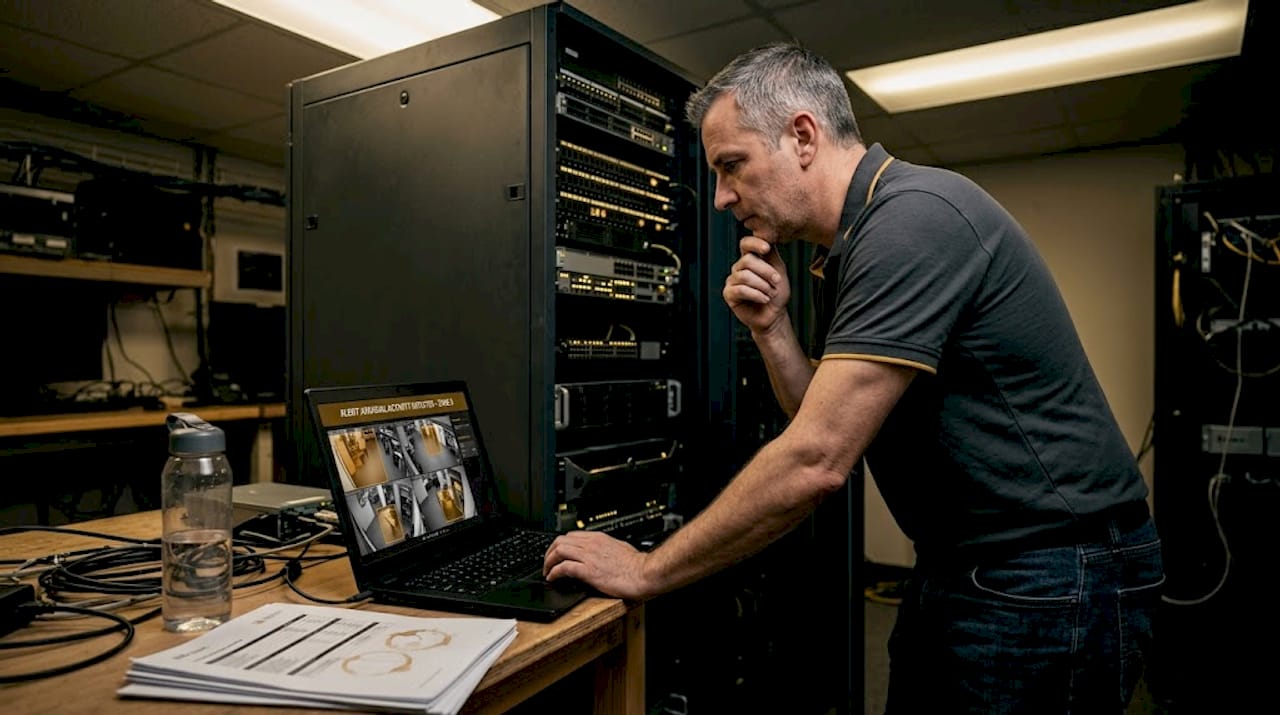
False alarms are genuinely one of the biggest operational problems in the industry. Roughly 95% of alarms that trigger a monitoring center response turn out to be false, creating enormous strain on emergency services and eroding client confidence fast. AI verification is the most direct solution to this systemic problem.
| Feature | Traditional systems | AI-powered systems |
|---|---|---|
| False alarm rate | Very high (~95%) | Reduced by up to 75% |
| Bandwidth usage | High | Up to 80% lower (edge computing) |
| Threat verification | Manual review | Automated with escalation |
| Response time | Minutes to hours | Seconds |
| Cost over time | High (operator hours) | Lower (automated triage) |
For businesses, the ROI becomes clear quickly. Fewer false dispatches, lower monitoring fees, and faster real-threat response translate directly to reduced liability and loss. For homeowners, the benefit is simpler: alerts you can actually trust.
Pro Tip: Pair any AI analytics platform with professional monitoring services that support video verification protocols. The combination of machine verification and human confirmation is the gold standard for best practices for smart monitoring and delivers the strongest response outcomes.
Edge computing deserves special attention here. Instead of sending every video frame to a cloud server for analysis, edge devices process data locally at the camera level. This means faster decisions, less bandwidth cost, and continued operation even when internet connectivity is disrupted. For remote properties or businesses with bandwidth limitations, edge computing often makes AI analytics viable for the first time.
Cloud-first and hybrid security architectures
Smart analytics need the right infrastructure behind them. That’s where cloud-first and hybrid edge-cloud architectures come in, and they’re rapidly becoming the dominant model for new installations.
The smart home security market is growing from $37.84 billion in 2025 to $44.2 billion in 2026, representing a 16.8% CAGR, driven significantly by cloud adoption. This isn’t speculative growth. It reflects real demand from homeowners and businesses who want remote access, automatic updates, and centralized management without expensive on-site infrastructure.
Here’s how the three main architecture types compare:
| Architecture | Best for | Key advantage | Key limitation |
|---|---|---|---|
| Traditional on-premises | Legacy environments | Full local control | No remote management, manual updates |
| Cloud-first | Small to mid-size sites | Easy access, low hardware cost | Dependent on internet connection |
| Hybrid edge-cloud | Large or critical sites | Resilient, flexible, scalable | More complex to configure |
According to recent industry data, cloud management and biometrics have been adopted by 51% and 41% of integrators respectively, with hybrid edge-cloud architectures now considered standard practice for efficiency and resilience. These numbers signal that the industry has moved past the experimentation phase.
If you’re transitioning from a legacy system, a structured approach reduces risk significantly:
- Audit your current setup: Catalog every device, access point, and vulnerability before making changes.
- Identify connectivity dependencies: Know which functions require internet and which can operate locally during an outage.
- Pilot with a non-critical area: Test your cloud or hybrid configuration on a secondary location before committing to a full rollout.
- Choose open-platform vendors: Avoid proprietary systems that lock you into a single manufacturer’s ecosystem.
- Schedule a 90-day review: After deployment, evaluate performance data and adjust configurations based on real usage.
The benefits of smart home security extend well beyond convenience. Many insurers offer premium reductions for verified smart security systems, and cloud-connected platforms often qualify more easily because they provide audit trails and remote monitoring capabilities that traditional systems can’t.
One often overlooked advantage of cloud-first platforms is update management. Firmware vulnerabilities are a real attack vector in physical security systems. Cloud-connected devices receive patches automatically and consistently, while air-gapped or locally managed systems often go months without updates because nobody scheduled the maintenance.
For properties with defined boundaries, combining cloud-managed cameras with smart perimeter security improvements creates the kind of layered defense that genuinely deters sophisticated threats.
Physical meets cyber: convergence, access, and perimeter innovations
The clearest gap in most security programs isn’t hardware quality. It’s the assumption that physical security and cybersecurity are separate disciplines managed by separate teams.
In 2026, that separation is a liability. Physical and cyber convergence is now considered essential, particularly as organized crime becomes more sophisticated. Business robbery rates have climbed sharply, with a reported 50% increase in organized business robberies, making the case for integrated defense strategies impossible to ignore.
Zero-trust device security is central to this convergence. In a zero-trust model, no device on your network is automatically trusted, even cameras and access control panels you installed yourself. Every device must authenticate continuously, and access is granted based on verified identity rather than assumed credentials. This matters because attackers increasingly target the physical security infrastructure itself as a way into broader network access.
Key access control trends shaping 2026:
- Mobile credentials: Replacing physical key cards with encrypted smartphone-based credentials that are harder to clone and easier to revoke remotely.
- Biometric authentication: Fingerprint, iris, and facial recognition eliminating password and card vulnerabilities at entry points.
- Automated access scheduling: Permissions that adjust automatically based on time of day, user role, or alert status without manual administration.
- Audit trail integration: Every access event logged and searchable, creating accountability and forensic value when incidents occur.
Biometric entry is no longer limited to high-security government facilities. Today’s biometric entry solutions are accessible for retail businesses, residential buildings, and even individual homeowners looking for keyless entry that actually resists defeat.
On the perimeter side, layered physical barriers working alongside detection technology create friction that most opportunistic criminals won’t push through. Research into impact of physical barriers confirms that visible deterrents significantly reduce the likelihood of attempted entry. For businesses, rolling shutters, reinforced frames, and smart perimeter sensors working together create a defensible boundary that pure digital security cannot replicate.
“When physical and cyber defenses operate independently, attackers simply exploit whichever side has the weaker posture. Integration removes that gap.”
The practical path to cyber and physical security integration starts with a unified risk assessment. Treat your cameras, access panels, and network routers as part of one system with one attack surface. From there, apply consistent update policies, segment your security devices onto a dedicated VLAN (a separate network partition), and enforce strong authentication across every access point.
Smart advanced perimeter protection now includes thermal imaging, vibration sensors, and automated lighting that reacts to movement, all manageable through the same cloud dashboard as your indoor cameras. The value of a unified management interface cannot be overstated for organizations with limited security staff.
What most security pros overlook about 2026’s trends
Here’s what the trend reports don’t emphasize enough: technology alone doesn’t create security. Adoption and maintenance do.
The security industry has a persistent problem with deployment theater. A business installs the latest AI-powered camera system, puts together an impressive network diagram, and then never trains staff on alert protocols. Cameras go unchecked. Firmware sits unpatched for 18 months. The technology was real, but the security wasn’t.
Plug-and-play solutions are particularly risky for businesses with evolving layouts, staff turnover, or changing risk profiles. A system configured perfectly for your operation in January often has real gaps by October if nobody reviews it. The platforms worth investing in are those built on open, scalable architectures with vendor support that includes regular configuration reviews, not just installation and departure.
The most honest advice we can offer: before you buy the next shiny tool, check whether your current systems are fully configured, updated, and understood by the people using them. Realistic home security upgrades often matter more than cutting-edge additions. Resilience and ROI come from disciplined maintenance and user training far more than from feature count.
Focus on scalable platforms, ongoing support relationships, and staff accountability. That’s what separates organizations that stay protected from those that learn expensive lessons.
Get ready for security’s next big leap
The trends covered in this article aren’t future speculation. They’re reshaping purchasing decisions, installation standards, and risk assessments right now. If you’re planning an upgrade or building a security strategy from scratch, the right products and expert guidance make a significant difference in outcomes.
At Safes and Security Direct, we carry professional-grade surveillance cameras, smart access systems, and certified safes designed to match the demands of 2026’s security landscape. Our product range covers everything from AI-capable cameras to fire-resistant and burglary-rated safes that protect what no digital system can recover. Browse our full catalog to find solutions matched to your specific risk profile, whether you’re securing a single-family home or a multi-site commercial operation. Our team is ready to help you make confident, informed decisions.
Frequently asked questions
Which security trend will impact homes most in 2026?
AI-powered video analytics will have the biggest impact by cutting false alarms 75% and enabling real-time threat verification that traditional motion sensors simply cannot match.
Does cloud security really offer better protection than traditional systems?
Cloud and hybrid models deliver superior flexibility and resilience, and hybrid edge-cloud architectures are now considered standard for balancing efficiency with reliable local operation during outages.
How are false alarms being reduced in 2026?
AI verification and video analytics combined with professional monitoring address the core problem: currently 95% of alarms that reach monitoring centers are false, and AI-assisted review cuts that number dramatically.
Is there an ROI for investing in smart security upgrades?
Yes. Typical ROI arrives within 3 to 7 years through insurance discounts of 10 to 20%, reduced incident-related losses, and lower monitoring costs from fewer false dispatches.
What’s the biggest mistake security decision-makers make in 2026?
Treating cyber and physical security as separate concerns is the most common and costly error, since convergence of both disciplines is now essential for closing the gaps that organized criminals actively exploit.
Recommended
- How to Improve Home Security: Proven Steps for 2026 – Safes and Security Direct
- Home security best practices: protect property in 2026 – Safes and Security Direct
- Top commercial security best practices to protect your business in 202 – Safes and Security Direct
- How to create security protocols that protect your business in 2026 – Safes and Security Direct