

How to Improve Home Security: Proven Steps for 2026
TL;DR:
- Proper assessment of vulnerabilities helps focus on effective security upgrades.
- Modern technologies like AI cameras and smart locks enhance home protection.
- Consistent maintenance and habits are essential for lasting security effectiveness.
Burglars are not random. They scout, they test, and they move fast. Homes without security systems are 300% more likely to be burglarized, which means the gap between a protected home and an easy target is enormous. Whether you own your home or rent, the good news is that modern security tools and smart habits can dramatically reduce your risk. This guide walks you through a clear, step-by-step approach: assessing your vulnerabilities, choosing the right technology, layering your defenses, and keeping everything working long-term.
Table of Contents
- Assess your home’s security needs
- Choose modern security technologies for 2026
- Layer physical and digital defenses
- Maintain and update your security for lasting protection
- Why real protection demands more than just gadgets
- Ready to secure your home? Start with trusted solutions
- Frequently asked questions
Key Takeaways
| Point | Details |
|---|---|
| Assess unique risks | Identify specific entry points and vulnerabilities around your home before choosing solutions. |
| Embrace layered security | Combine physical barriers, smart technology, and strong habits for maximum safety. |
| Regular maintenance is key | Test alarms and update software monthly to stay protected from evolving threats. |
| Visible security deters crime | Display alarms and cameras prominently, as most burglars avoid homes with obvious security. |
| Consider insurance benefits | Many homeowners save on insurance by installing and monitoring modern security systems. |
Assess your home’s security needs
Before you buy a single camera or install one lock, take an honest look at your home through a burglar’s eyes. Most people skip this step and end up with security that looks good but leaves real gaps. Understanding the home security basics of risk assessment is where lasting protection actually starts.
The numbers tell a clear story. US burglaries hit roughly 780,000 in 2024, with 66% targeting residential properties and 34% of intruders entering through the front door. That last stat surprises most people. It is not the back window or the garage side door in most cases. It is the front entrance, often because the door frame is weak or the lock is outdated.
Here are the most common entry points burglars use, ranked by frequency:
- Front door (34% of entries)
- First-floor windows (23%)
- Back door (22%)
- Garage doors (9%)
- Basement windows and unlocked entries (remaining %)
Burglars also prefer specific times. Most residential break-ins happen between 10 a.m. and 3 p.m. on weekdays, when homes are most likely to be empty. Evening burglaries are less common but do happen, especially in less visible properties.
Use this self-assessment checklist to identify your weak spots:
- Are your exterior doors solid wood or metal core?
- Do your door frames have reinforced strike plates with 3-inch screws?
- Are ground-floor windows visible from the street or hidden by shrubs?
- Do you have exterior lighting that covers all entry points?
- Is your garage door secured with a secondary lock?
- Are your valuables visible through windows?
- Do you have any security signage or visible deterrents?
Here is a quick comparison to help you prioritize your risk level:
| Risk factor | Lower risk | Higher risk |
|---|---|---|
| Door material | Solid core metal | Hollow wood |
| Lock type | Deadbolt with reinforced frame | Standard knob lock |
| Window visibility | Street-facing, well-lit | Hidden by hedges |
| Neighborhood watch | Active program | No organized watch |
| Exterior lighting | Motion-activated, full coverage | Minimal or none |
This kind of structured assessment helps you spend money where it matters most instead of guessing.
Choose modern security technologies for 2026
Once you know your home’s weak points, you can match the right tools to each vulnerability. The security technology market in 2026 is more capable and more affordable than ever, but not every product is worth your money. Here is what actually works.
Alarm systems remain the foundation. A monitored alarm system signals a response center when triggered, while a self-monitored system sends alerts to your phone. Both have real value. The key is choosing one you will actually use consistently. Reviewing security system essentials before buying helps you avoid overpaying for features you do not need.
Security cameras have evolved significantly. Modern cameras offer 4K resolution, color night vision, two-way audio, and AI-powered person detection that filters out cars, animals, and shadows. This matters because false alerts are one of the top reasons people stop using their systems. Cameras with AI detection only notify you when a human is detected, which keeps alert fatigue from setting in.
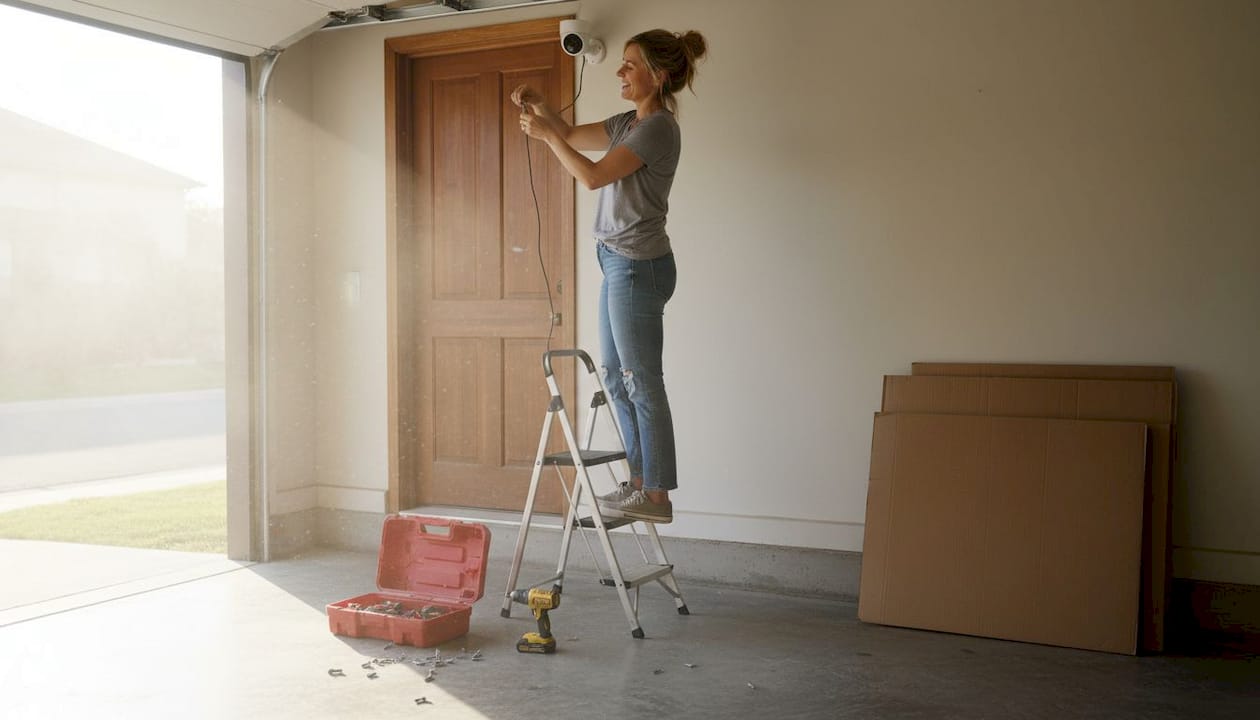
Smart locks let you control access remotely, set temporary codes for guests or service workers, and receive entry logs on your phone. They eliminate the risk of lost keys and make it easy to lock up if you forget.
Motion sensors have also improved. Pet-immune sensors use weight thresholds or infrared technology to ignore animals under 80 pounds, so your dog does not trigger a false alarm at 2 a.m.
Here is a side-by-side look at your main monitoring options:
| Monitoring type | Monthly cost | Response time | Best for |
|---|---|---|---|
| Professional monitoring | $10 to $50 | Seconds to minutes | Families, larger homes |
| Self-monitoring | $0 to $15 | Depends on you | Budget-conscious renters |
| No monitoring (local alarm) | $0 | Immediate noise only | Low-risk areas, secondary layer |
One strong financial reason to invest in monitored systems: insurance discounts for monitored systems range from 5% to 20% annually, which can offset the subscription cost over time.
Pro Tip: Look for systems that offer local storage as a backup option alongside cloud storage. If your internet goes down during a break-in, local storage means footage is still captured.
Exploring top security products designed for 2026 homes gives you a solid starting point for comparing camera specs, sensor types, and system compatibility before you commit.
Layer physical and digital defenses
Technology is only part of the equation. The most effective home security strategies combine physical barriers with digital safeguards, and they reinforce consistent daily habits. Think of it as building concentric rings of protection around your home.
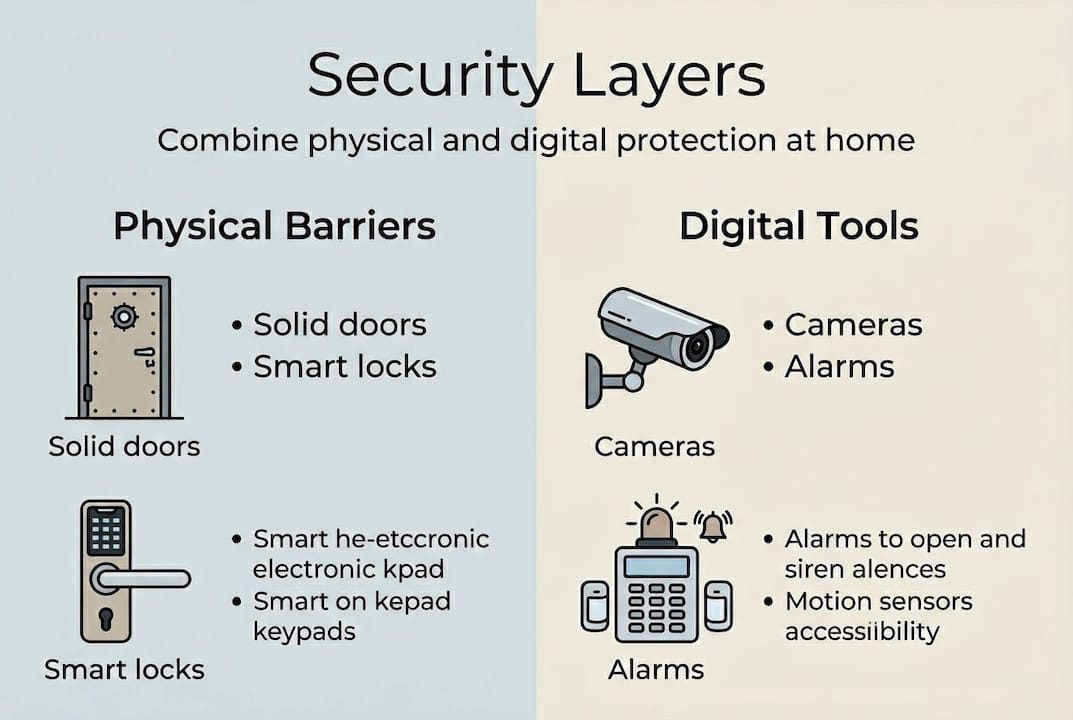
Start with physical reinforcement. Motion lights deter 44% of potential intruders who rely on darkness and concealment. Install them at every entry point, including the driveway, side gates, and back porch. Reinforce door frames with heavy-duty strike plates. Add a door barricade bar for sliding glass doors. These upgrades cost very little but close major vulnerabilities.
Here is a numbered approach to layering your physical defenses:
- Reinforce all exterior doors with deadbolts and 3-inch strike plate screws
- Add window locks and security film to all ground-floor windows
- Install motion-activated lighting at every entry point
- Use a quality safe for valuables, documents, and firearms
- Set random light timers indoors to simulate occupancy when you are away
- Join or form a neighborhood watch to extend your awareness network
Pro Tip: Smart plugs with scheduling features let you randomize when indoor lights turn on and off. A home that looks occupied is a home burglars skip.
Now for the digital side. Smart home devices, including cameras, locks, and alarm hubs, are connected to your network. That connection is a potential entry point for hackers. Physical and digital security are both essential as cybercrime increasingly targets home networks alongside physical theft.
“A smart lock with a weak password is not a security upgrade. It is a vulnerability with a better-looking interface.”
Protect your digital layer by enabling multi-factor authentication (MFA) on all security apps and your router admin panel. Update firmware on every connected device as soon as updates are available. Use a strong, unique password for your home network and a separate guest network for smart devices. These steps take less than an hour and close serious gaps.
Looking into insurance discounts tied to smart home security upgrades is also worth your time, as many providers now reward layered protection. For a broader view, reviewing property security tips that apply to both homes and businesses can surface ideas you might not have considered.
Maintain and update your security for lasting protection
Installing a security system is not a one-time task. It is the beginning of an ongoing practice. Systems that are not maintained drift toward failure, and that failure often happens at the worst possible time.
The most alarming maintenance statistic in home security: 50% of burglarized homes are targeted again within four weeks of the original break-in. Burglars return because they know the layout, they know what was replaced, and they often know the homeowner has not upgraded their security in response. Consistent maintenance and visible upgrades after an incident are critical.
Here is a maintenance routine that keeps your system reliable:
- Monthly: Test all alarm sensors and motion detectors manually. Walk the perimeter and check for new blind spots caused by overgrown shrubs or moved objects.
- Monthly: Review camera footage quality and clean lenses if needed. Check that cloud or local storage is functioning correctly.
- Quarterly: Update firmware on all connected devices. Change passwords on your security apps and router.
- Annually: Replace alarm batteries and test backup power systems. Review your overall setup and consider whether new vulnerabilities have emerged.
- After any incident: Immediately upgrade the weakest point that was exploited. Alert neighbors and document everything for insurance.
Backup power deserves special attention. Internet outages, power cuts, and cellular jamming are all tactics that sophisticated burglars use to disable connected systems. A system with cellular backup and local storage keeps recording and alerting even when your broadband is down. Understanding the benefits of battery-powered alarm systems helps you choose systems that stay active when the grid does not.
Arming your system consistently is just as important as having one. Many homeowners arm their systems at night but forget during the day or on short errands. Most break-ins happen during daylight hours when people assume they are safe. Building the habit of arming your system every time you leave, even for 20 minutes, closes a gap that statistics show is widely exploited. Reviewing the case for upgrading security systems periodically keeps you ahead of evolving threats.
Why real protection demands more than just gadgets
Here is an uncomfortable truth the security industry does not always say out loud: most people who buy a security system feel protected without actually being protected. They install the camera, set up the app, and then stop thinking about it. The camera points at the driveway but misses the side gate. The alarm is never armed during the day. The passwords are still set to the default.
Visible alarms deter 60% of burglars who look for easier targets. That statistic is powerful, but it only applies when the alarm is visible and clearly active. A camera that is dusty, angled wrong, or obviously offline does not deter anyone.
Burglars are adaptive. They read neighborhoods. They notice which homes have consistent routines, which ones have overgrown entry points, and which ones have security signs but no visible cameras. Layered strategies work precisely because they create multiple reasons to skip your home. No single device does that alone.
The homeowners and renters we see get the best results are not the ones who spent the most money. They are the ones who built consistent habits around their systems, stayed connected to their neighbors, and treated security as an ongoing practice rather than a product purchase. Prioritizing security solutions means committing to that mindset, not just the hardware.
Ready to secure your home? Start with trusted solutions
You now have a clear framework: assess your risks, choose the right technology, layer your physical and digital defenses, and maintain your system over time. The next step is putting it into practice with products you can actually trust.
At Safes and Security Direct, we carry professional-grade cameras, alarm systems, smart locks, and safes built for real-world home security needs. Every product in our catalog is selected for reliability and performance, not just price. Whether you are starting from scratch or upgrading an existing setup, our team and product range are here to help you build protection that actually holds up. Browse our solutions today and take the first concrete step toward a safer home.
Frequently asked questions
What are the most effective first steps to improve home security?
Strengthen your front door with a deadbolt and reinforced strike plate, add a visible alarm, and install cameras at entry points. 66% of break-ins happen through doors, and visible alarms deter 60% of would-be intruders before they ever try.
How can I avoid false alarms with pets at home?
Choose pet-immune or AI-enabled sensors that use weight thresholds or human-shape recognition to filter out animal movement. Many 2026 systems include this as a standard feature rather than an add-on.
Are security system subscriptions worth the cost in 2026?
For most households, yes. Subscriptions unlock AI detection, cloud storage, and professional monitoring, but basic self-monitored setups work well for smaller homes or tighter budgets where a full monitoring plan is not necessary.
How often should I test my home security system?
Test alarms, sensors, and cameras every month and update all device firmware quarterly. Regular testing catches battery failures, connectivity drops, and misaligned cameras before they become real vulnerabilities.
Can improving home security lower my insurance premiums?
Yes. Monitored security systems qualify for insurance discounts of 5% to 20% depending on your provider and the level of protection you install, which can meaningfully offset subscription and equipment costs over time.
Recommended
- Top Asset Protection Methods 2026 for Secure Homes – Safes and Security Direct
- What is home security? A 2026 homeowner’s guide – Safes and Security Direct
- How to secure business premises effectively in 2026 – Safes and Security Direct
- How to protect valuables at home: strategies for 2026 – Safes and Security Direct