

Perimeter security: protect your property effectively
TL;DR:
- Effective perimeter security uses multiple layers combining barriers, detection, surveillance, and lighting.
- Relying on one security measure alone creates gaps that intruders can exploit.
- Proper design considers property type, threat level, and legal regulations for optimal protection.
A lock on the door and a fence around the yard might feel like solid protection, but professional security experts know that approach leaves serious gaps. Burglars and intruders are opportunists. They scout for weak points, and a single barrier rarely stops a determined threat. True perimeter security is a layered, multi-component strategy that combines physical barriers, surveillance, sensors, and lighting to detect, delay, and deter threats before they reach your door. This guide walks you through every layer of an effective perimeter security system, from foundational concepts to expert-level design principles, so you can make smarter decisions for your home or business.
Table of Contents
- Defining perimeter security: Concepts and benefits
- Key components of perimeter security systems
- How perimeter security differs for homes and businesses
- Expert strategies: Standards, design principles, and avoiding common mistakes
- Why layered security is more effective than a single solution
- Next steps: Secure your perimeter with expert help
- Frequently asked questions
Key Takeaways
| Point | Details |
|---|---|
| Layered protection is essential | Combining barriers, detection, surveillance, and lighting is far more effective than relying on a single measure. |
| Solutions differ by property | Homes and businesses face unique risks and need tailored perimeter security strategies. |
| Design and compliance matter | Incorporating expert design, regulatory standards, and privacy considerations ensures legal and practical effectiveness. |
| Professional advice pays off | Expert guidance and proper installation help maximize return on security investments and avoid common pitfalls. |
Defining perimeter security: Concepts and benefits
Perimeter security is the practice of protecting the outer boundary of a property before a threat gets close to the building itself. Think of it as your first line of defense. Instead of waiting for someone to break a window or pick a lock, a well-designed perimeter system stops the threat earlier in the process.
The four core goals of any perimeter security setup are:
- Deter: Make the property look difficult and risky to target
- Detect: Identify unauthorized movement or access attempts early
- Delay: Slow down intruders long enough for a response to occur
- Respond: Trigger alerts, alarms, or notifications that prompt action
These four goals work together. A fence deters. A motion sensor detects. A reinforced gate delays. An alarm system responds. Remove any one of these, and you create a gap that a determined intruder can exploit.
Understanding the key security features of a perimeter system helps you see why it outperforms basic property security. General property security focuses on protecting what is inside the building. Perimeter security focuses on stopping threats before they even reach the structure. That distinction matters enormously when you are trying to prevent theft, vandalism, or unauthorized access.
“Perimeter security is not a product. It is a strategy. The goal is to create enough friction that an intruder chooses an easier target or is caught before causing harm.”
A common misconception is that a tall fence is enough. It is not. Fences without detection systems can be climbed, cut, or bypassed without triggering any alert. The real benefits of high security come from combining physical barriers with technology and monitoring, not from relying on any single element.
Key components of perimeter security systems
A complete perimeter security system draws from several categories of tools and technology. Here is how each one contributes to the overall strategy.
Physical barriers form the foundation. Fences should be at least 6 to 8 feet high and designed with anti-climb features such as angled tops, rotating spikes, or smooth surfaces that prevent gripping. Gates need reinforced frames and tamper-resistant locks. Anti-vehicle bollards protect entry points from ram-raid attacks, which are more common in commercial settings.
Electronic detection adds intelligence to your barriers. Vibration sensors attached to fences alert you when someone attempts to climb or cut through. Seismic sensors detect ground disturbance. LiDAR and infrared beam systems create invisible detection zones that trigger alerts the moment someone crosses them.
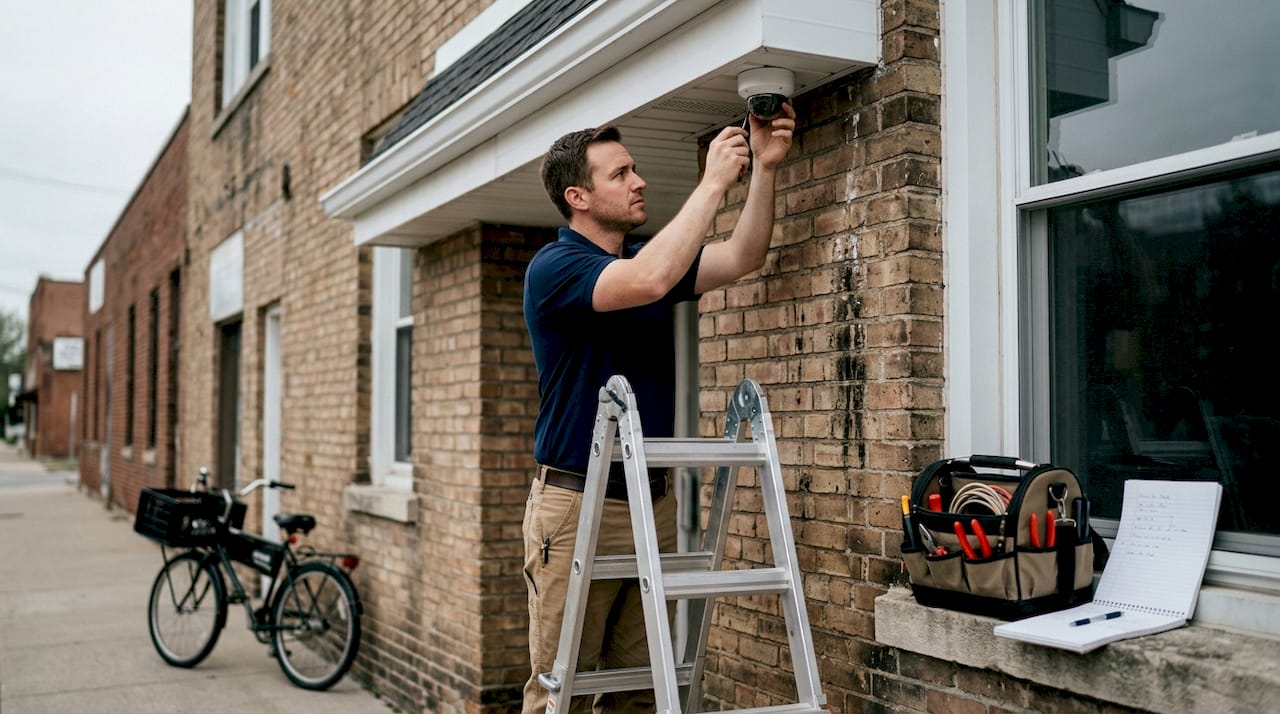
Surveillance cameras provide visual confirmation and act as a powerful deterrent on their own. Visible cameras deter burglars significantly, especially when paired with signage. Modern systems with video analytics can distinguish between a person and an animal, reducing false alarms.
Lighting is one of the most underrated components. Motion-activated floodlights eliminate the cover of darkness that intruders rely on. Well-lit perimeters also improve camera image quality at night.
Access control manages who can enter and when. Keypads, card readers, intercoms, and biometric systems all fall into this category.
| Feature | Traditional solution | Advanced solution |
|---|---|---|
| Boundary barrier | Basic chain-link fence | Anti-climb fence with vibration sensor |
| Surveillance | Fixed analog camera | AI-enabled camera with motion analytics |
| Lighting | Standard floodlight | Motion-triggered LED with camera integration |
| Entry control | Padlock on gate | Keypad or biometric access with audit log |
| Detection | None | LiDAR or infrared beam perimeter sensor |
For practical property security tips, the key is layering. Each component covers the weaknesses of another. A camera sees what a sensor triggers. A light reveals what a camera needs to capture. This interconnected approach is what separates a professional setup from a basic one.
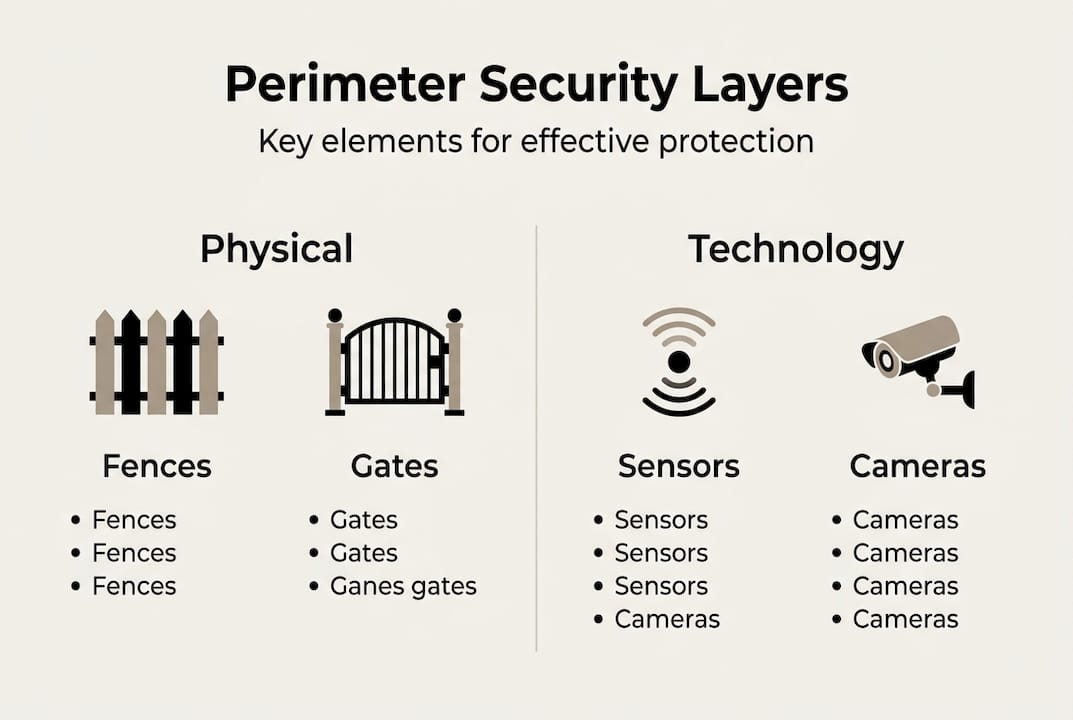
Pro Tip: Never rely on a single layer of security. Combining at least three different types of measures, such as a fence, motion lighting, and a camera system, makes your property exponentially harder to breach than any single solution alone.
How perimeter security differs for homes and businesses
The principles are the same, but the priorities shift depending on whether you are securing a family home or a commercial property.
Homes focus on visible deterrents and basic monitoring, while businesses need more formal access controls, advanced sensors, and often must meet compliance requirements. Here is a side-by-side comparison.
| Component | Residential priority | Commercial priority |
|---|---|---|
| Physical barriers | Fencing, locked gates | Reinforced fencing, bollards, security walls |
| Surveillance | Visible cameras at entry points | Full-coverage CCTV with analytics |
| Lighting | Motion-activated lights | Continuous perimeter lighting |
| Access control | Smart locks, video doorbells | Card readers, biometric systems, audit logs |
| Detection | Basic motion sensors | Vibration sensors, LiDAR, seismic detectors |
| Compliance | Local ordinances | Industry regulations, insurance requirements |
To assess your specific needs, follow these steps:
- Map your boundary. Walk the full perimeter and identify every entry point, blind spot, and vulnerable section.
- Assess your threat level. A rural home faces different risks than an urban retail store. Consider your neighborhood crime data and the value of what you are protecting.
- Identify your detection gaps. Where could someone enter without triggering any alert? These gaps are your priority.
- Match solutions to your environment. Dense landscaping may require different sensor types than an open lot. Terrain and radio interference can affect wireless systems.
- Check local regulations. Camera placement, fence height, and lighting intensity may be governed by local codes or homeowner association rules.
For homeowners in urban areas, urban security solutions often focus on compact, discreet systems that work within tighter property boundaries. For business owners, commercial security strategies typically involve more formal planning and integration with existing building management systems.
Expert strategies: Standards, design principles, and avoiding common mistakes
Once you understand the components and how they apply to your property type, the next step is applying expert-level thinking to your design.
CPTED, which stands for Crime Prevention Through Environmental Design, is a framework that uses the physical environment itself as a security tool. It focuses on natural surveillance (keeping sightlines clear so intruders feel visible), natural access control (using landscaping and pathways to guide movement), and territorial reinforcement (making it clear where public space ends and private property begins). Trimming hedges near entry points, installing low-profile ground lighting, and using gravel paths that crunch underfoot are all CPTED principles in action.
Key standards and compliance issues to be aware of include:
- UFC 4-022-01: A U.S. military standard for perimeter security design that civilian planners often reference for high-risk sites
- UL 681: A standard for installation of burglar and hold-up alarm systems
- NERC CIP-006: Applies to critical infrastructure and governs physical security of cyber assets
- Local zoning codes: Govern fence height, lighting brightness, and camera angles in most municipalities
- Insurance requirements: Many commercial insurers require specific security measures as a condition of coverage
Site surveys are non-negotiable for serious installations. Terrain changes, radio frequency interference from nearby equipment, and even seasonal vegetation growth can all affect how well sensors and cameras perform. A system that works perfectly in summer may develop blind spots in winter when trees lose their leaves and sight angles change.
“The best perimeter security systems are designed to evolve. A phased deployment lets you start with the highest-risk areas and expand as your budget and needs develop, rather than committing to a full system that may not fit your property perfectly from day one.”
Pro Tip: Before installing cameras, review your local privacy laws. Cameras that capture footage of neighboring properties or public sidewalks without proper disclosure can create legal liability, even if the intent is purely protective. Following industry security best practices from the start prevents costly corrections later.
Why layered security is more effective than a single solution
Here is something we have seen repeatedly: property owners invest in one excellent piece of technology and assume the job is done. A top-of-the-line camera system with no lighting is nearly useless at night. A tall fence with no detection system is just an obstacle that a determined intruder will eventually overcome.
The concept of security in depth means that each layer compensates for the limitations of the others. Cameras catch what sensors miss. Lighting helps cameras perform at night. Physical barriers buy time for detection systems to alert a response. No single measure is foolproof, but the combination creates a self-reinforcing system that is dramatically harder to defeat.
Most break-ins are prevented not by technology alone but by the perception of risk. A property with visible cameras, motion lights, and a solid fence sends a clear message: this target is not worth the effort. That is the real power of a layered approach. For practical guidance on strategic camera setup tips, positioning matters as much as the equipment itself.
The uncomfortable truth is that no system is perfect. But a layered one gives you multiple chances to stop a threat, and that makes all the difference.
Next steps: Secure your perimeter with expert help
Knowing what a strong perimeter security system looks like is the first step. Putting it into practice requires the right products and, often, expert guidance tailored to your specific property.

At Safes and Security Direct, we offer a curated range of professional-grade security products designed for both homeowners and business owners. From surveillance cameras with advanced analytics to access control systems built for real-world conditions, our catalog is built around the layered security approach this guide describes. If you are ready to move from planning to action, our effective property security guide is a great place to start building your customized security plan with confidence.
Frequently asked questions
How high should perimeter fences be for effective security?
Perimeter fences should be at least 6 to 8 feet high and include anti-climb design features such as angled tops or smooth surfaces that prevent gripping. Height alone is not enough without a detection system to alert you if someone attempts to scale it.
What is the most important component of perimeter security?
No single component is most important. An effective system combines barriers, detection, surveillance, and lighting because each layer covers the gaps that the others leave exposed.
Is perimeter security different for businesses compared to homes?
Yes. Businesses typically require advanced sensors and formal access controls, along with compliance with industry regulations, while homes generally focus on visible deterrents and basic monitoring.
What legal issues should I consider with perimeter cameras?
You should review local privacy laws before installation to ensure your cameras do not capture footage of neighboring properties or public spaces in ways that violate privacy regulations. Getting this wrong can result in legal liability even when your intentions are protective.
What is CPTED and how does it improve perimeter security?
CPTED, or Crime Prevention Through Environmental Design, uses sightlines and landscaping to deter intruders naturally before they even reach your physical barriers. It turns the environment itself into a security tool.
Recommended
- How to secure property effectively: A practical guide – Safes and Security Direct
- Industry Security Best Practices: Protect Property and Reduce Risk – Safes and Security Direct
- How to secure business premises effectively in 2026 – Safes and Security Direct
- 15 essential property security tips for homes and businesses – Safes and Security Direct