

Industry Security Best Practices: Protect Property and Reduce Risk
Most property owners install cameras and locks, believing technology alone keeps buildings secure. Yet properties with the latest gadgets still experience breaches because visibility gaps and uncoordinated systems leave critical vulnerabilities exposed. Real asset protection requires more than devices—it demands layered, integrated security that follows proven industry standards. This guide reveals what top security frameworks recommend, which components to prioritize, and how managers apply these principles to protect real properties effectively.
Table of Contents
- Understanding the layered approach to property security
- Physical access control: Practices that set secure properties apart
- Surveillance and lighting: The visibility multiplier
- Regular risk assessments: Keeping pace with changing threats
- Cybersecurity: The new frontier for property and asset protection
- Industry benchmarks and compliance: How does your property compare?
- Special scenarios: Securing vacant properties, multi-tenant, and after-hours risks
- Enhance your property security with expert solutions
- Frequently asked questions
Key Takeaways
| Point | Details |
|---|---|
| Layered security is crucial | Integrating multiple security measures reduces risks that single solutions miss. |
| Update assessments regularly | Yearly check-ins keep your security plan effective as threats and tenants change. |
| Combine physical and cyber practices | Protect both your building and its data for complete property security. |
| Benchmark for improvement | Comparing your spending and compliance helps identify gaps and set better priorities. |
| Adapt for special cases | Vacant, after-hours, and multi-tenant properties need extra security adjustments to stay safe. |
Understanding the layered approach to property security
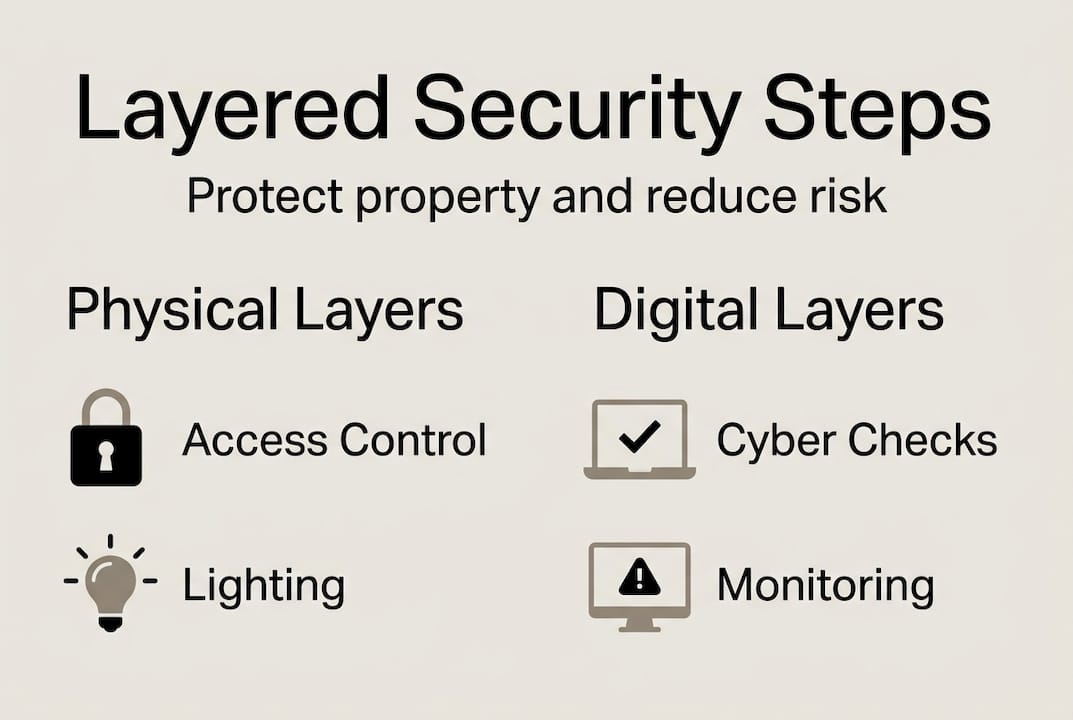
With the pitfalls of relying exclusively on basic devices established, let’s break down what a true industry-standard security system looks like. A layered security approach means combining multiple elements for incident prevention rather than depending on a single solution. Each layer—visibility, access control, surveillance, and response—works independently yet integrates to close gaps that single systems miss.
Think of it like a castle defense. The moat stops some attackers, walls stop others, and guards inside catch anyone who breaches both. When one layer fails, others compensate. This redundancy transforms security from reactive scrambling into proactive protection. The ASIS Physical Asset Protection standard provides systematic frameworks that guide this layered thinking.
Pro Tip: Evaluate how your layers interact every six months. Threats evolve, and what worked last year might leave new gaps today.
| Approach | Breach Prevention Rate | Response Time | Cost Efficiency |
|---|---|---|---|
| Single device (camera only) | 42% | 8-12 minutes | Low initial, high incident cost |
| Layered system (access + surveillance + lighting) | 87% | 2-4 minutes | Higher initial, low incident cost |
| Integrated layers with monitoring | 94% | Under 2 minutes | Moderate ongoing, minimal incident cost |
“Proactive, layered security doesn’t just respond to incidents—it prevents them from happening in the first place. The integration between physical barriers, technology, and human oversight creates a security posture that adapts faster than threats can exploit it.” — Security Industry Association
Implementing layered defense strategies means identifying which combinations work for your property type and risk profile. Start by mapping your current layers, then add missing elements that address your specific vulnerabilities. The goal is creating overlapping protection zones where no single failure compromises the entire system. For comprehensive approaches to securing commercial premises, consider how each layer reinforces the others.
Physical access control: Practices that set secure properties apart
Now that the importance of layers is clear, let’s dive deeper into one of the most crucial—controlling who goes where and when. Access control forms your first defense line, determining whether threats even reach your property interior. Properties with weak entry management become easy targets regardless of their surveillance quality.
Best practice access control includes controlled entry, visitor badging, cloud-based platforms, and zoning. Entry logs track every person entering and exiting, creating accountability that deters unauthorized access. Perimeter fencing establishes clear boundaries, while badge systems differentiate between tenants, staff, contractors, and visitors. Cloud-based control systems let you manage access remotely, update permissions instantly, and generate audit trails without physical key management headaches.
Layering access zones adds another protection dimension. Public areas require minimal credentials, tenant spaces need verified badges, and sensitive zones demand additional authentication. This graduated approach balances security with operational flow, preventing bottlenecks while maintaining control.
Pro Tip: Cloud solutions streamline compliance audits and scale effortlessly as your property portfolio grows, eliminating the nightmare of managing hundreds of physical keys.
Key implementation tips for robust access control:
- Install entry points with automatic locking mechanisms that default to secure
- Require photo ID verification for all visitor badges with expiration times
- Implement two-factor authentication for high-security zones
- Schedule automatic access revocation when leases or contracts end
- Conduct quarterly audits of who has access to which areas
- Use tamper-evident seals on emergency exits to detect unauthorized use
Properties lacking proper access protocols face breach rates 3.2 times higher than those with comprehensive entry management. The difference isn’t just technology—it’s systematic thinking about who belongs where and enforcing those boundaries consistently. Explore essential access control features that transform entry points from vulnerabilities into protective barriers.
Surveillance and lighting: The visibility multiplier
Once you know who’s inside, you need to maintain control over what’s happening—especially in the most at-risk zones. Surveillance systems and strategic lighting work together to deter criminal behavior and enable rapid response when incidents occur. The key is understanding which areas demand coverage and how to integrate visibility with your other security layers.
High-risk areas like parking lots and loading docks require coverage, with lighting serving as visible deterrence. Entrances capture everyone entering, common areas monitor daily activity, and blind spots near dumpsters or service areas need special attention. Criminals avoid well-lit, monitored spaces because the risk of identification outweighs potential rewards.

Integrating cameras with alarm and response systems creates instant escalation paths. When motion sensors trigger in restricted zones after hours, cameras immediately verify whether it’s a false alarm or genuine threat. This integration cuts response times from minutes to seconds, often stopping incidents before damage occurs.
| Property Type | Critical Coverage Zones | Recommended Camera Count | Lighting Requirements |
|---|---|---|---|
| Office building (50,000 sq ft) | Entrances, parking, elevators, stairwells | 12-16 | Motion-activated perimeter, constant entry lighting |
| Retail center | Entrances, loading docks, parking, cash areas | 20-30 | High-intensity parking, storefront accent lighting |
| Multi-tenant residential | Building entries, mailrooms, parking, amenity areas | 15-20 | Pathway lighting, motion-activated garage zones |
| Warehouse/industrial | Loading docks, inventory areas, perimeter, offices | 10-18 | Perimeter flood lighting, motion zones at dock doors |
Common visibility mistakes to avoid:
- Installing cameras without adequate lighting, creating useless footage
- Positioning cameras where glare or backlighting obscures faces
- Neglecting to angle cameras to capture license plates in parking areas
- Using outdated analog systems that can’t provide clear identification images
- Failing to test camera coverage during both day and night conditions
- Forgetting to secure camera feeds with encryption and access controls
“Visibility doesn’t just help you catch perpetrators after the fact—it prevents incidents entirely. When potential threats see comprehensive surveillance paired with strategic lighting, they move on to easier targets. The psychological deterrent value often exceeds the investigative value.” — Commercial Security Consultant
For optimal results, review security camera placement strategies that maximize coverage while minimizing blind spots. Consider how office building video surveillance integrates with access control to create comprehensive monitoring that protects both people and assets.
Regular risk assessments: Keeping pace with changing threats
Surveillance and controls are only effective if you’re adapting to what’s really happening at your property. Risk assessments uncover new vulnerabilities as properties evolve, tenant mixes change, and threat patterns shift. What worked perfectly last year might leave critical gaps today because your property’s risk profile is never static.
Annual reviews, tenant involvement, and mapping of risk zones are critical for adaptive security. Involving tenants increases both compliance and awareness because they experience daily security realities you might miss from a management perspective. Their feedback reveals practical issues like broken locks, dark pathways, or suspicious activity patterns.
Steps for conducting an effective risk assessment:
- Map security zones by categorizing areas as public, restricted, or high-security based on asset value and access requirements
- Review incident history from the past 12 months to identify patterns in timing, location, and incident types
- Gather tenant feedback through surveys or meetings about security concerns and observed vulnerabilities
- Inspect physical barriers including locks, fencing, doors, and windows for wear or compromise
- Test system integration by simulating incidents to verify that alarms, cameras, and response protocols work together
- Update security plan with specific remediation steps, responsible parties, and completion deadlines
- Schedule follow-up to verify improvements were implemented and assess their effectiveness
“Assessment frequency directly correlates with security effectiveness. Organizations that review their security posture annually experience 40% fewer incidents than those conducting assessments only when problems arise. Proactive evaluation catches vulnerabilities before they’re exploited.” — ASIS International
Risk assessments shouldn’t feel like bureaucratic exercises. They’re practical tools for staying ahead of threats rather than constantly reacting to incidents. Document findings, prioritize fixes based on risk severity, and track completion. For guidance on conducting thorough evaluations, explore annual security review tips that help you identify and address vulnerabilities systematically.
Cybersecurity: The new frontier for property and asset protection
Physical threats are only part of the equation—today’s buildings are just as vulnerable to digital risks. Building management systems, access control platforms, and surveillance networks all connect to the internet, creating entry points for cyber attacks. A breach doesn’t just compromise data; it can disable physical security systems, manipulate HVAC controls, or provide unauthorized building access.
Critical cyber practices for property managers:
- Implement multi-factor authentication for all system access, requiring both passwords and secondary verification
- Conduct regular security audits of network infrastructure, identifying outdated software and unpatched vulnerabilities
- Train employees on phishing and social engineering tactics that trick staff into compromising credentials
- Develop incident response plans that specify exactly who does what when a breach occurs
- Segment networks to isolate building systems from general IT infrastructure, limiting breach spread
- Encrypt sensitive data both in transit and at rest, protecting tenant information and operational details
The stakes are substantial. 63% of check fraud occurs through cyber risk, with criminals exploiting digital vulnerabilities to steal funds and compromise financial operations. Property managers handle sensitive tenant data, payment information, and operational systems that become valuable targets.
Physical-cyber convergence creates new challenges. IoT sensors, smart building systems, and connected security devices expand your attack surface. Each connected device represents a potential entry point unless properly secured. Network segmentation becomes critical—isolate building management systems from tenant networks and general internet access. When one system is compromised, segmentation prevents attackers from pivoting to other systems.
Coordinated security upgrades mean updating both physical and digital protections simultaneously. Installing new access control hardware without securing the management software leaves you vulnerable. Review cybersecurity tips for properties and ensure your property technology features include robust digital protections. For comprehensive guidance, consult CRE cybersecurity resources that address industry-specific threats.
Industry benchmarks and compliance: How does your property compare?
Knowing the best practices is powerful, but how do you measure up to industry leaders? Benchmarking reveals whether your security investments align with what top-performing properties prioritize. These metrics help you identify gaps and justify budget requests with concrete data.
| Benchmark Metric | Industry Average | Top Quartile | Your Property |
|---|---|---|---|
| Security budget (% of revenue) | 7.6% | 9.2% | _____ |
| Compliance rate with security standards | 72% | 91% | _____ |
| Primary security concern | Workplace violence | Cyber threats | _____ |
| Annual security system maintenance | 2.1 times/year | 4+ times/year | _____ |
| Incident response time | 6.3 minutes | Under 3 minutes | _____ |
Leading properties don’t just spend more—they spend strategically. Budget allocation focuses on integrated systems rather than isolated devices, preventive measures rather than reactive fixes, and ongoing training rather than one-time installations. The compliance gap between average and top performers reveals that excellence requires systematic attention to standards, not just good intentions.
“Benchmarking transforms security from a cost center into a strategic investment. When you understand where you stand relative to industry leaders, you can make informed decisions about where to allocate resources for maximum impact. The properties with the lowest incident rates aren’t spending the most—they’re spending the smartest.” — Security Industry Association
Use these benchmarks to evaluate your current posture and identify improvement priorities. If your compliance rate falls below 72%, focus on closing gaps in established standards before adding new capabilities. If response times exceed six minutes, investigate integration issues between detection and response systems. Understanding security standards for compliance helps you meet baseline requirements, while studying industry security compliance best practices pushes you toward top-quartile performance.
Special scenarios: Securing vacant properties, multi-tenant, and after-hours risks
Even with robust systems, special cases require extra attention and adaptive measures. Vacant properties, non-business hours, loading docks, and emerging threats like drones create vulnerabilities that standard security approaches might miss. These edge cases often represent your highest-risk scenarios because they fall outside normal operational patterns.
Vacant properties require mobile surveillance, while drones and after-hours risks represent rising threats that traditional systems weren’t designed to address. Empty buildings attract vandalism, squatting, and theft because criminals assume nobody’s watching. Multi-tenant properties face coordination challenges when different tenants maintain different security standards, creating weak points that compromise everyone.
Steps to close high-risk gaps in special scenarios:
- Deploy mobile surveillance units at vacant properties with cellular connectivity for remote monitoring without permanent infrastructure
- Implement after-hours protocols that automatically escalate alerts when activity occurs outside normal business hours
- Coordinate tenant security standards through lease requirements that establish minimum security measures for all occupants
- Secure loading docks with time-restricted access that only permits entry during scheduled delivery windows
- Install drone detection systems in high-security areas where aerial surveillance or delivery poses risks
- Use rapid-deployment barriers like portable fencing and lighting for temporary security during transitions or events
- Establish clear escalation paths that specify who responds to different threat types during various time periods
Loading docks deserve special attention because they’re designed for access, making them inherently vulnerable. Time-restricted controls, surveillance focused on vehicle and personnel identification, and coordination with delivery schedules help balance operational needs with security requirements. After-hours activity in these areas should trigger immediate alerts since legitimate use is rare outside business hours.
Multi-tenant coordination requires establishing baseline security standards that all occupants must meet. When one tenant leaves doors propped open or disables alarms, they create vulnerabilities that affect everyone. Lease agreements should specify security responsibilities, and regular audits should verify compliance. For strategies addressing unique situations, review vacant property security approaches and explore solutions for special security cases that require adaptive thinking.
Enhance your property security with expert solutions
Ready to take your security to the next level and stay ahead of evolving threats? True property protection requires more than installing devices—it demands strategic planning, regular assessment, and partnerships with providers who understand industry best practices. The difference between adequate security and exceptional protection lies in how well your layers integrate and adapt to your specific risk profile.
At Safes and Security Direct, we specialize in comprehensive security solutions that protect both physical and digital assets. Our team helps property managers implement the layered security guidance outlined in this article, from access control and surveillance to cybersecurity integration. Whether you’re securing a single property or managing a diverse portfolio, we provide the expertise and equipment to close vulnerabilities before they’re exploited. Explore our resources, consult with our security specialists, and discover how systematic protection transforms your properties from potential targets into hardened assets.
Frequently asked questions
What is the most important security layer for a property?
Each layer plays a role, but access control is most critical as it prevents unauthorized entry and sets the foundation for other measures.
How often should I update my property’s risk assessment?
Industry guidance recommends performing a risk assessment at least once a year or following significant changes in tenancy or property use.
Why is cybersecurity necessary for building security?
Modern properties use digital systems that can be hacked if not protected, putting both physical and digital assets at risk through cascading breaches.
How do I secure a vacant or multi-tenant property?
Use mobile surveillance and coordinate security standards among all tenants to close special risk gaps that standard systems miss.
Recommended
- How to secure property effectively: A practical guide – Safes and Security Direct
- 15 essential property security tips for homes and businesses – Safes and Security Direct
- Asset Protection Workflow Guide for Maximum Security – Safes and Security Direct
- Role of Security Standards in Asset Protection – Safes and Security Direct