

Cybersecurity vs Physical Security: What Property Owners Must Know
TL;DR:
- Physical and cybersecurity are interconnected’s essential for protecting modern properties.
- Layered security combining hardware, software, and policies reduces overall vulnerability.
- Regular audits and integrated upgrades help address both digital and physical risk gaps.
Over 6.5 million property crimes were recorded in the US in 2022, resulting in roughly $36 billion in losses. For property owners and managers, that number is alarming enough on its own. But here’s what makes it more complicated: today’s criminals don’t always break a window to get in. Sometimes they break a password. The line between digital and physical threats has blurred significantly, and most property owners are defending only one side of that line. This guide breaks down what cybersecurity and physical security actually mean, where they overlap, and how to build a defense strategy that covers both.
Table of Contents
- Understanding physical security: Protecting your assets in the real world
- What is cybersecurity? Digital risks every property owner faces
- Cybersecurity vs physical security: Where do they overlap?
- Which security approach is right for you? Tailoring defense to your property
- Our perspective: Why successful property security always means both
- Next steps: Secure your property with expert guidance
- Frequently asked questions
Key Takeaways
| Point | Details |
|---|---|
| Physical and digital risks | Modern properties face overlapping threats that require attention to both physical safeguards and cybersecurity. |
| Integration is essential | A blended approach is now practical, affordable, and necessary for property owners and managers. |
| Common mistakes | Neglecting one side of security leaves properties vulnerable to preventable crime and loss. |
| Tailored strategies | Selecting and combining protections based on your property’s risks ensures the best defense. |
Understanding physical security: Protecting your assets in the real world
Physical security refers to the measures you put in place to prevent unauthorized people from accessing your property, equipment, or assets in person. It’s the oldest form of protection and still the most visible. Think locks, fences, alarms, surveillance cameras, lighting, and access control systems. The goal is simple: detect threats, delay intruders, and respond before damage occurs.
For property owners, the stakes are high. Rental properties are 50% more likely to be burglarized than owner-occupied homes, and the average loss per commercial burglary runs between $3,000 and $8,000. Parking structures are a particular weak point, with 60% of multi-family break-ins occurring in parking garages. These aren’t abstract statistics. They represent real losses that affect your bottom line, your tenants, and your reputation.
Effective physical security for a property typically includes:
- Perimeter controls: Fencing, gates, and bollards that define and restrict entry points
- Access control: Key fobs, PIN pads, or biometric readers that log who enters and when
- Surveillance cameras: Positioned at entrances, exits, parking areas, and common spaces
- Alarm systems: Motion detectors, alarm sensors and window alarms that trigger alerts on unauthorized entry
- Lighting: Motion-activated lights that eliminate blind spots at night
- On-site personnel: Security guards or concierge staff for high-traffic properties
One of the most overlooked areas in physical security is layering. A single deadbolt on a front door is not a security strategy. Effective defense uses multiple barriers so that bypassing one doesn’t give full access. Explore urban home security solutions and latest asset protection methods to understand how layered systems work in practice.
“The best physical security systems assume failure at every single layer and build redundancy accordingly. If your only line of defense is your front door lock, you don’t have a security strategy.”
Pro Tip: Walk your property after dark at least once a quarter. You’ll spot lighting gaps, broken cameras, and unlocked gates that daytime inspections miss. Most physical breaches exploit exactly these overlooked details.
What is cybersecurity? Digital risks every property owner faces
Cybersecurity is the practice of protecting digital systems, networks, and data from unauthorized access or attack. For most property owners, this used to feel like a corporate concern. That’s no longer true. The moment you install a smart lock, a connected camera, or a building management system, you become a potential target.

Cybercriminals targeting properties aren’t always after your personal data. Sometimes they want access to your physical space. A hacked smart lock can open a door without a key. A compromised camera system can go dark right before a break-in. Phishing emails sent to property managers can expose login credentials for building access platforms. These aren’t hypothetical scenarios. They are documented attack vectors that smart building security experts now treat as standard threats.
Here are the most common digital risks property owners and managers face:
- Smart lock and access system hacking: Weak passwords or outdated firmware make connected locks easy targets
- Phishing attacks on staff: Fake emails trick employees into revealing credentials for property management software
- IoT device vulnerabilities: Cameras, thermostats, and intercoms with default passwords are entry points
- Ransomware on building systems: Attackers lock building automation systems and demand payment
- Unsecured Wi-Fi networks: Guest or tenant networks that share infrastructure with security systems create exposure
Experts recommend treating all physical devices as networked assets and applying zero-trust principles, meaning no device or user is automatically trusted, even inside your network. AI-based anomaly detection tools can flag unusual login patterns or device behavior before a breach escalates.
Pro Tip: Run a device inventory at least twice a year. List every connected device on your property, including cameras, intercoms, and HVAC controllers. If a device hasn’t received a firmware update in over 12 months, treat it as a liability. Review smart home cybersecurity and digital security best practices to build a solid update and audit routine.
Cybersecurity vs physical security: Where do they overlap?
For most of the 20th century, physical and cyber security were completely separate disciplines. Physical security was handled by facilities teams. Cybersecurity was an IT problem. That separation no longer works.
Modern buildings run on interconnected systems. Smart locks report to cloud servers. Cameras stream footage over IP networks. HVAC and lighting systems are controlled through building automation platforms. A vulnerability in any one of these digital layers can create a physical access problem. Conversely, a physical breach, like someone stealing a laptop or a key card, can lead to a network compromise.
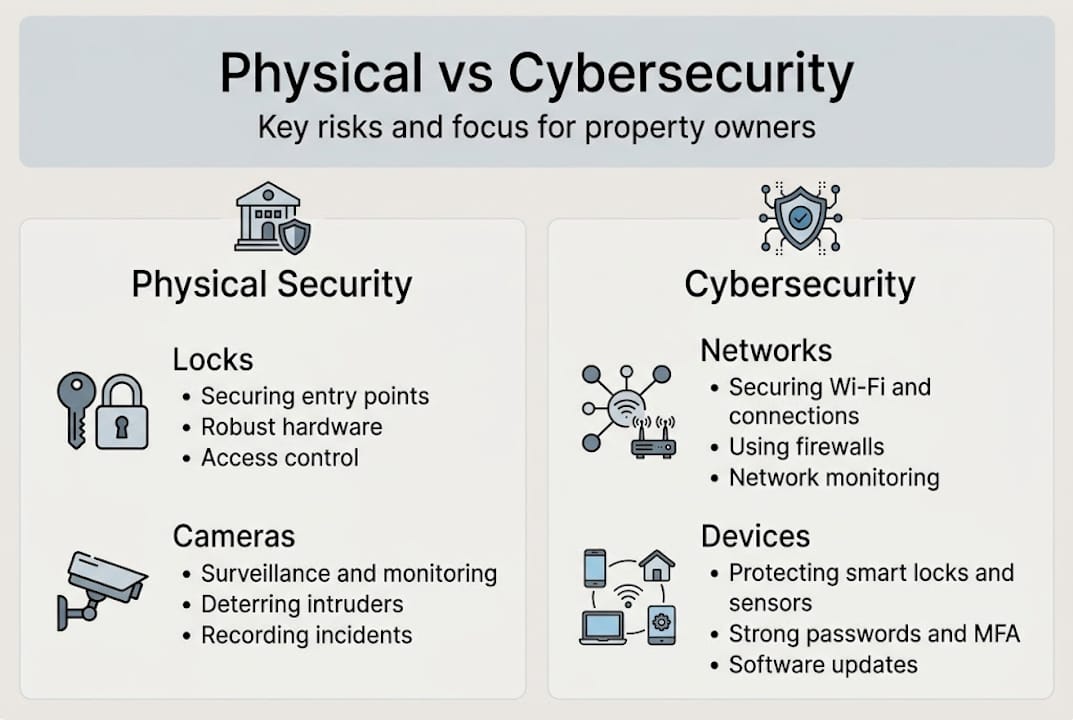
| Feature | Physical security | Cybersecurity |
|---|---|---|
| Primary threat | Unauthorized physical access | Unauthorized digital access |
| Key tools | Locks, cameras, alarms, guards | Firewalls, encryption, authentication |
| Typical entry point | Doors, windows, parking areas | Network connections, devices, email |
| Response time | Immediate (alarm, guard) | Variable (detection lag is common) |
| Biggest blind spot | Insider threats, poor lighting | Legacy devices, weak passwords |
High-traffic and multi-tenant properties face compounded risks. Florida multi-tenant buildings are a well-documented example, where frequent storms damage physical infrastructure while high tenant turnover creates credential management gaps. Both issues feed into each other. You can explore property security best practices and industry risk reduction steps to see how integrated approaches address these compounded risks.
Surveillance is one of the clearest examples of overlap. A surveillance device that isn’t connected to a secure network can be hijacked remotely, giving attackers a live feed of your property’s activity and blind spots.
“Zero-trust is no longer just an IT framework. For modern buildings, it means every door, every camera, and every sensor must be authenticated and monitored as if it could be compromised at any moment.”
The takeaway is clear: if you secure your doors but not your network, you’ve left the back door wide open.
Which security approach is right for you? Tailoring defense to your property
Choosing between physical and cybersecurity is the wrong question. The right question is: which gaps in your current setup expose you most? Start with a realistic assessment of your property type, asset value, occupant profile, and the most likely threat scenarios you face.
52% of multi-family managers report that crime increased in 2024, with car break-ins ranking as the top issue. That tells you physical security in parking areas is an urgent priority for multi-family properties. But if your building uses a cloud-based access control platform, a cyberattack on that platform could unlock every door simultaneously. Both threats are real and both deserve budget.
Here’s a practical framework to help you prioritize:
| Threat type | Suggested defense | Estimated cost range |
|---|---|---|
| Parking lot break-ins | Motion lighting, cameras, patrols | $500 to $5,000 |
| Smart lock hacking | Firmware updates, strong passwords, MFA | $0 to $300/year |
| Phishing attacks on staff | Security awareness training | $200 to $1,500/year |
| Unauthorized building entry | Access control systems, key fob audits | $1,000 to $15,000 |
| IoT device vulnerabilities | Network segmentation, device inventory | $300 to $2,000 |
Steps to take right now:
- Audit your physical perimeter: Check every entry point, camera angle, and lighting zone for gaps
- Inventory all connected devices: Document every networked device and its firmware version
- Train your staff: Run a phishing simulation and review access credential policies
- Segment your networks: Keep security devices on a separate network from tenant or guest Wi-Fi
- Review your insurance: Confirm your policy covers both physical theft and cyber incidents
Review key security features, home security practice tips, and benefits of high security to build a prioritized action plan.
Pro Tip: Don’t let budget drive the sequence of your upgrades. Let risk drive it. A $200 firmware update on a vulnerable camera system may protect you more than a $5,000 fence upgrade if your biggest exposure is digital.
Our perspective: Why successful property security always means both
After reviewing hundreds of property security setups, one pattern stands out clearly. The properties that suffer the most significant losses aren’t those with no security. They’re the ones that invested heavily in one layer and ignored the other entirely.
A commercial property with a state-of-the-art camera system but no network segmentation is one phishing email away from having that system turned against it. A residential building with excellent cybersecurity but broken parking lot lighting is still going to see car break-ins every week. The blind spots always sit at the intersection of the two disciplines.
The good news is that an integrated approach doesn’t require doubling your security budget. It requires smarter sequencing. Start with a risk audit that covers both physical and digital exposure. Then link your upgrades so that each physical improvement has a corresponding digital safeguard. A new access control system should come with a credential management policy. New cameras should come with network security protocols.
The either-or mindset is genuinely outdated. Prioritizing security solution investment across both layers is now practical and achievable for properties of any size. The most resilient property owners we’ve seen treat security as a single discipline with two dimensions, not two separate budgets fighting for priority.
Next steps: Secure your property with expert guidance
Understanding the difference between cybersecurity and physical security is the first step. Acting on it is what actually protects your property. Whether you manage a single rental unit or a large commercial portfolio, the right combination of hardware, software, and policy makes all the difference.
At Safes and Security Direct, we carry professional-grade surveillance cameras, alarm systems, access control hardware, and safes designed for both residential and commercial properties. Our product range is built for owners who want reliable, tested solutions without the guesswork. Browse our catalog to find the right fit for your property’s specific risk profile, and reach out to our team if you need guidance on where to start.
Frequently asked questions
What is the main difference between cybersecurity and physical security for properties?
Cybersecurity protects digital systems and data from attacks, while physical security safeguards people and assets from physical threats like theft or intrusion. For modern properties, both are essential and increasingly interconnected.
Can smart locks and cameras be hacked?
Yes, any connected device, including smart locks and cameras, can be vulnerable to cyberattacks if not properly secured. Experts recommend treating all devices as networked assets and applying zero-trust principles to reduce exposure.
Is physical or cybersecurity more important for property managers in 2026?
Both are critical, and neglecting either increases your vulnerability significantly. Multi-tenant buildings in particular face compounded risks where physical and digital threats reinforce each other.
How can property managers start integrating cyber and physical security?
Begin with a security audit covering both physical and digital exposure, then align upgrades so each has a corresponding safeguard on the other side. With crime rising in 2024 across multi-family properties, waiting is not a low-risk option.
Recommended
- Industry Security Best Practices: Protect Property and Reduce Risk – Safes and Security Direct
- Top security best practices for property managers 2026 – Safes and Security Direct
- Home security best practices: protect property in 2026 – Safes and Security Direct
- Physical Security for SMEs: Protecting Assets and Growth – Safes and Security Direct
- Cybersecurity for Insurers, tools and best practices - Digital Insurance Platform | IBSuite Insurance Software | Modern Insurance System
- Apartment security essentials: What Boca renters should know