

How to assess security vulnerabilities in your property
TL;DR:
- A security vulnerability is any weakness that can be exploited, often caused by process or people failures. Conducting a systematic assessment involves detailed walkthroughs, reviews, and scoring to prioritize fixes effectively. Ongoing, inclusive evaluations and professional assistance are essential for comprehensive protection.
A break-in at a small accounting firm in Ohio revealed something unsettling: the burglar didn’t pick a lock or disable an alarm. He simply walked through an unlocked side door that staff propped open during deliveries. Every camera, every motion sensor, every deadbolt in the building was working perfectly. The procedure was the problem. A security vulnerability is any weakness in your property, systems, or routines that an attacker or accident can exploit. Identifying those weaknesses before something goes wrong is the single most effective thing home and business owners can do to protect what matters most.
Table of Contents
- What is a security vulnerability and why does it matter?
- Preparing for your vulnerability assessment: What you need
- Step-by-step process: How to assess security vulnerabilities
- Prioritizing and interpreting your findings: What’s next?
- Why most vulnerability assessments miss the mark—and how to get it right
- Take the next step: Professional help for home and business security
- Frequently asked questions
Key Takeaways
| Point | Details |
|---|---|
| Assessment is proactive | Regularly checking for vulnerabilities lets you fix security gaps before an incident happens. |
| Start with inventory | A complete, accurate list of assets is the foundation for effective security reviews. |
| Use a step-by-step approach | Follow a clear, repeatable process for both physical and digital security to avoid missing weak spots. |
| Prioritize by impact and likelihood | Rate the risks you find to focus on what really matters for your security. |
| Keep assessment ongoing | Reassess after changes and regularly over time to stay ahead of new threats. |
What is a security vulnerability and why does it matter?
Before diving into the practical steps, it’s important to understand what we mean by a “security vulnerability” and why recognizing them is the foundation of effective protection.
A security vulnerability is any gap, flaw, or weakness that could allow unauthorized access, damage, or loss. Vulnerabilities don’t just live in technology. They exist across four broad categories:
- Physical vulnerabilities: Weak door frames, inadequate lighting in parking areas, easily bypassed window locks, and blind spots in camera coverage.
- Technical vulnerabilities: Unpatched software, default router passwords, unsecured Wi-Fi networks, and outdated alarm firmware.
- Process vulnerabilities: Poorly written procedures, inconsistent key control, no visitor sign-in policy, or a delivery protocol that leaves side doors open.
- People vulnerabilities: Employees who share access codes, residents who let strangers tailgate through gates, or staff who haven’t been trained to spot social engineering attempts.
Understanding security terminology explained helps you communicate more clearly about these risks with contractors, installers, and insurers. Once you know the vocabulary, patterns become much easier to spot.
Why structure matters: A practical vulnerability assessment runs a risk assessment that identifies weaknesses, then prioritizes them by likelihood and impact using qualitative, quantitative, or hybrid approaches. Without that structure, you end up patching obvious problems while missing the ones that actually hurt you.
The Ohio accounting firm example is not unusual. Most successful breaches, physical or digital, trace back to process and people failures, not equipment failures. A structured assessment forces you to look at all four categories systematically rather than assuming your alarm system covers everything.
Preparing for your vulnerability assessment: What you need
Once you know what to look for, the next step is to gather the right tools and information so you don’t overlook anything that could become a serious risk.
The foundation of any solid assessment is knowing exactly what you have. Asset inventory and categorization are foundational to assessing risk credibly, whether you’re evaluating cyber exposure or physical entry points. You can’t protect what you haven’t documented.
Here’s a practical table of what to gather before you start:
| Tool or document | Purpose |
|---|---|
| Flashlight | Inspect dark corners, utility rooms, exterior lighting gaps |
| Property or floor plan | Map entry points, camera coverage, and blind spots |
| Inventory log (spreadsheet or notebook) | Record every asset, system, and access point |
| Camera or smartphone | Photograph weaknesses you find during walkthrough |
| Network scanner app | Identify devices connected to your Wi-Fi |
| List of all security systems | Alarm panels, cameras, smart locks, access control |
| Key and access control log | Track who has keys, codes, and card access |
| Recent incident or near-miss reports | Reveal patterns and recurring weaknesses |
Your asset protection methods will only be as strong as your inventory is complete. If you don’t know you have an old server running in a back closet, you can’t check whether it’s been patched.

Use an asset protection checklist as your baseline document before the walkthrough begins. A checklist keeps you from relying on memory and ensures nothing falls through the cracks during a busy review.
Pro Tip: Don’t do this alone. Bring in a trusted colleague, a family member, or a second employee to walk through the property with you. Fresh eyes catch things you’ve stopped seeing because of familiarity. A neighbor might notice your garage door opener is always left in an unlocked car. A new staff member might flag that your server room key hangs on a hook in plain view.
Step-by-step process: How to assess security vulnerabilities
With your checklist and materials ready, here’s a step-by-step process any home or business can follow to uncover hidden weaknesses and practical solutions.
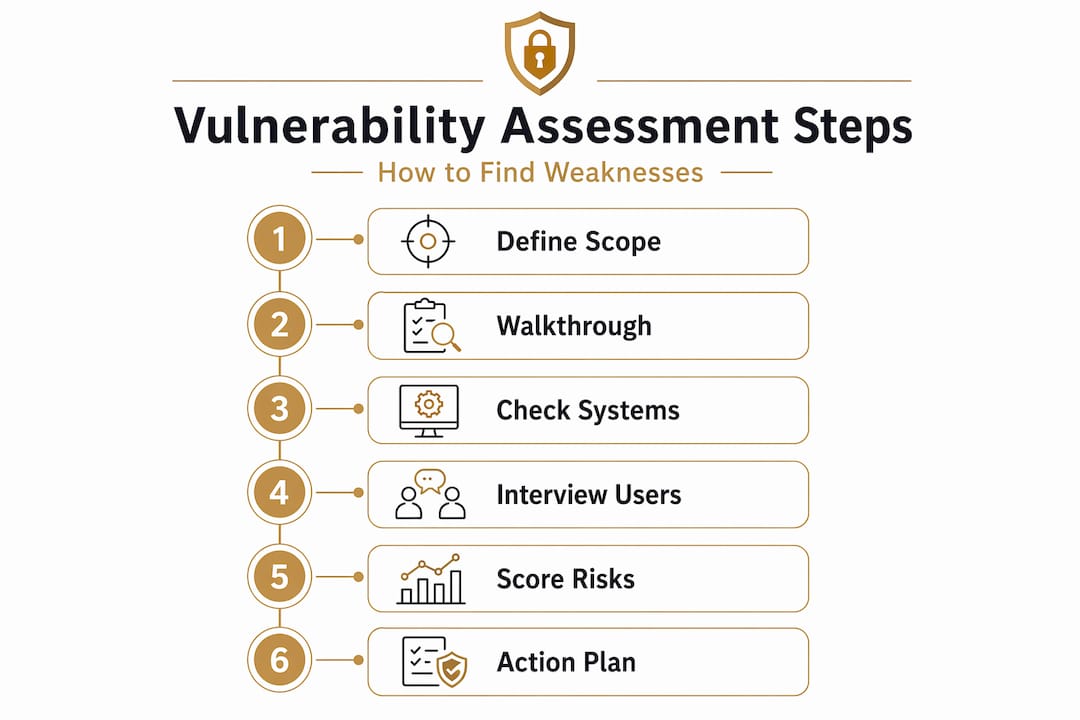
Step 1: Define scope and understand how your premises operate. Decide what you’re reviewing. Is this your entire home, a single office floor, or a warehouse? Note hours of operation, traffic patterns, and which areas are high-value. Understanding context shapes every decision that follows.
Step 2: Perform a physical walkthrough and audit. Walk the entire perimeter first, then work inward. Physical vulnerability assessment typically starts with scoping and understanding how premises operate, then walking the site to inspect weaknesses systematically. Check every door, window, gate, and access hatch. Test locks under actual conditions, not just in theory. Review exterior lighting at night if you can. Try to think like a burglar by looking for concealment spots, low-visibility entry points, and anything that slows your ability to spot an intruder early.
Use the home security checklist as a companion document during this phase. Solid perimeter security tips will help you evaluate fencing, signage, and approach paths with precision.
Step 3: Review all technical systems and controls. Check your alarm system firmware version, camera resolution and coverage angles, smart lock firmware, and Wi-Fi network settings. For businesses, review access control logs for anomalies and confirm that surveillance footage is actually being retained. Many owners discover cameras that stopped recording months ago because a hard drive filled up.
Step 4: Interview staff or residents. Ask people how they actually use the space versus how procedures say they should. Gaps between policy and practice are among the richest sources of vulnerability. Ask: “What do you do when a delivery arrives after hours?” or “What happens if you forget your access badge?” The answers often reveal workarounds that bypass security controls entirely.
Step 5: Score each risk. Vulnerability assessment in practice typically combines multiple methods: automated vulnerability scanning, penetration testing, configuration and control reviews, and human and process review through interviews, surveys, and document review for non-technical vulnerabilities. For each weakness you find, assign a likelihood score (how probable is this being exploited?) and an impact score (how bad would it be?). Multiply or combine them to get a priority ranking.
| Vulnerability found | Likelihood (1-5) | Impact (1-5) | Priority score |
|---|---|---|---|
| Broken exterior light at rear entrance | 4 | 4 | 16 (High) |
| Default password on office router | 3 | 5 | 15 (High) |
| No visitor sign-in log | 3 | 3 | 9 (Medium) |
| Missing camera coverage in stairwell | 2 | 4 | 8 (Medium) |
| Safe not bolted to floor | 2 | 5 | 10 (Medium-High) |
Step 6: Develop and prioritize your action plan. High-priority items get fixed first. Some fixes cost almost nothing, like resetting a router password or installing a motion-sensor light. Others require investment, such as improving home security with upgraded locks, cameras, or a monitored alarm system. Document each action, who is responsible, and a target completion date.
Pro Tip: Re-walk the property after you’ve made changes to confirm the fix actually closed the gap. A lock upgraded on paper may have been installed incorrectly in practice.
Prioritizing and interpreting your findings: What’s next?
Now that you’ve identified gaps and weaknesses, here’s how to make sense of your findings and take appropriate next steps to keep your security plan on track.
Not all vulnerabilities deserve equal urgency. The way you score and categorize them determines where your time and budget go first. Three scoring approaches are commonly used:
| Approach | How it works | Best for |
|---|---|---|
| Qualitative | Descriptive ratings: Low, Medium, High | Quick reviews, smaller properties |
| Quantitative | Numerical scores, financial loss estimates | Businesses with measurable assets |
| Hybrid | Combines numerical scores with descriptive context | Most home and small-business scenarios |
NIST risk assessment guidance emphasizes structured determination of risk using likelihood and impact, including qualitative and semi-quantitative options. For most homeowners and small business owners, a hybrid approach gives you the clarity of numbers with the practical context of descriptions.
Once you have scores, sort vulnerabilities into three action tiers:
- Fix immediately (in-house): Burned-out exterior lights, unlocked access panels, default passwords, missing deadbolts on secondary doors.
- Schedule and budget: Upgrading a camera system, installing monitored alarms, adding motion-activated lighting to a large property, or restructuring key control.
- Escalate to professionals: Complex alarm integrations, compliance requirements (such as PCI or HIPAA for businesses), penetration testing, or any situation where the risk is high and the solution requires licensed expertise.
Use your security audit checklist to document findings, track remediation progress, and create a record you can share with insurers or compliance auditors.
Critical reminder: Vulnerability assessment is ongoing: update inventories and re-run checks after system or process changes. Treat this as a living program, not a one-time task. Anytime you hire new staff, renovate, add new technology, or change procedures, run a focused reassessment of the affected area.
Why most vulnerability assessments miss the mark—and how to get it right
Here’s the uncomfortable truth most security guides won’t tell you: the checklist and the scanner are the easy part. What most home and business owners struggle with is the invisible layer of risk that no tool can automatically detect.
People and processes fail quietly. A camera records everything and still misses the risk when an employee holds the door open for someone they don’t recognize. An alarm system arms flawlessly every night while a critical update goes uninstalled for eighteen months because nobody owns that responsibility. Scanning alone may miss vulnerabilities rooted in process and people, such as weak procedures, insufficient oversight, or lack of awareness, so assessment methods should deliberately include non-technical reviews.
The most revealing part of any vulnerability review is almost never the physical walkthrough. It’s the ten-minute conversation with a staff member or family member that surfaces the workarounds everyone knows about but nobody talks about. Workarounds are where real exposure lives.
Most guides also skip the value of near-misses. A package left on a doorstep for three days, a car that circled your parking lot twice without stopping, or a phishing email that an employee almost clicked—these are warnings. Logging and reviewing near-misses as part of your asset protection workflow builds a data set that shapes smarter, more targeted assessments over time.
Scheduling also matters more than people realize. Don’t wait for an annual review. Reassess after every meaningful change: a new employee, a renovation, a new software platform, or even a change in neighborhood patterns. Security is a posture, not a project.
Finally, involve everyone with a stake in the outcome. In a home, that means your partner, older children, and anyone who has a key. In a business, that means department heads, reception staff, and facilities management. Diverse perspectives surface blind spots that a solo review will always miss.
Take the next step: Professional help for home and business security
If your assessment revealed major gaps—or if you want expert guidance—trusted help is available to ensure lasting protection and peace of mind.
Running a vulnerability assessment is empowering. But when your findings include complex system gaps, compliance obligations, or risks that feel beyond a DIY fix, the right next step is getting professional-grade equipment and expert-backed solutions in place.
At Safes and Security Direct, we work with homeowners and business owners who take security seriously. Whether your assessment flagged inadequate camera coverage, unprotected valuables, or the need for fire-resistant and burglary-resistant safes, our product range is built around protecting what matters most. From high-definition surveillance systems to certified safes rated for fire and forced entry, every product we carry is selected for real-world performance, not just spec sheets. Browse our full catalog to find solutions that match the vulnerabilities your assessment uncovered, and reach out to our team if you need guidance matching products to specific risks.
Frequently asked questions
What’s the difference between a vulnerability assessment and a risk assessment?
A vulnerability assessment identifies specific weaknesses in your property or systems, while a risk assessment takes those weaknesses and evaluates their likelihood and impact to help you decide what to fix first.
How often should I reassess my home or business for vulnerabilities?
At a minimum, run a full assessment annually, but also re-run checks after system changes such as renovations, new technology, staff turnover, or any security incident.
What’s a quick way to check my home’s physical security?
Walk the perimeter and think like a burglar by testing all locks, checking exterior lighting, and looking for concealed entry points that aren’t visible from the street.
Do I need special tools to assess cybersecurity vulnerabilities?
A basic inventory list and a checklist are enough to start. For deeper reviews, automated vulnerability scanning and specialized professional help become necessary, especially for business networks.
Why is asset inventory so important for security?
You can’t protect what you don’t know you have. Asset inventory and categorization are foundational to credible risk assessment because they define the full scope of what needs to be protected.
Recommended
- How to secure property effectively: A practical guide – Safes and Security Direct
- How to secure business premises effectively in 2026 – Safes and Security Direct
- Essential home security checklist: Safeguard your property – Safes and Security Direct
- How to Secure Commercial Premises for Maximum Protection – Safes and Security Direct