

Home security terminology explained: a clear guide
Homeowners often struggle with confusing jargon when shopping for security systems. Terms like PIR sensors, control panels, and UL certifications sound technical and intimidating. This guide breaks down essential home security terminology into simple, practical definitions. You will learn what each component does, how systems differ, and which standards matter. By understanding these key terms, you can confidently choose the right security products to protect your home and family without second-guessing your decisions or overpaying for unnecessary features.
Table of Contents
- Key takeaways
- Understanding core home security components
- Comparing wired and wireless security systems
- Understanding and reducing false alarms
- Recognizing industry standards and certifications
- Explore trusted home security solutions
- Frequently asked questions
Key Takeaways
| Point | Details |
|---|---|
| Clear definitions reduce confusion | Clear definitions help you compare products without misinterpretation. |
| PIR motion understanding | Understanding how PIR sensors detect motion helps guide sensor placement. |
| Wired versus wireless differences | Knowing the differences between wired and wireless systems guides installation decisions. |
| Minimize false alarms | Identifying false alarm causes helps reduce fines and improves system effectiveness. |
Understanding core home security components
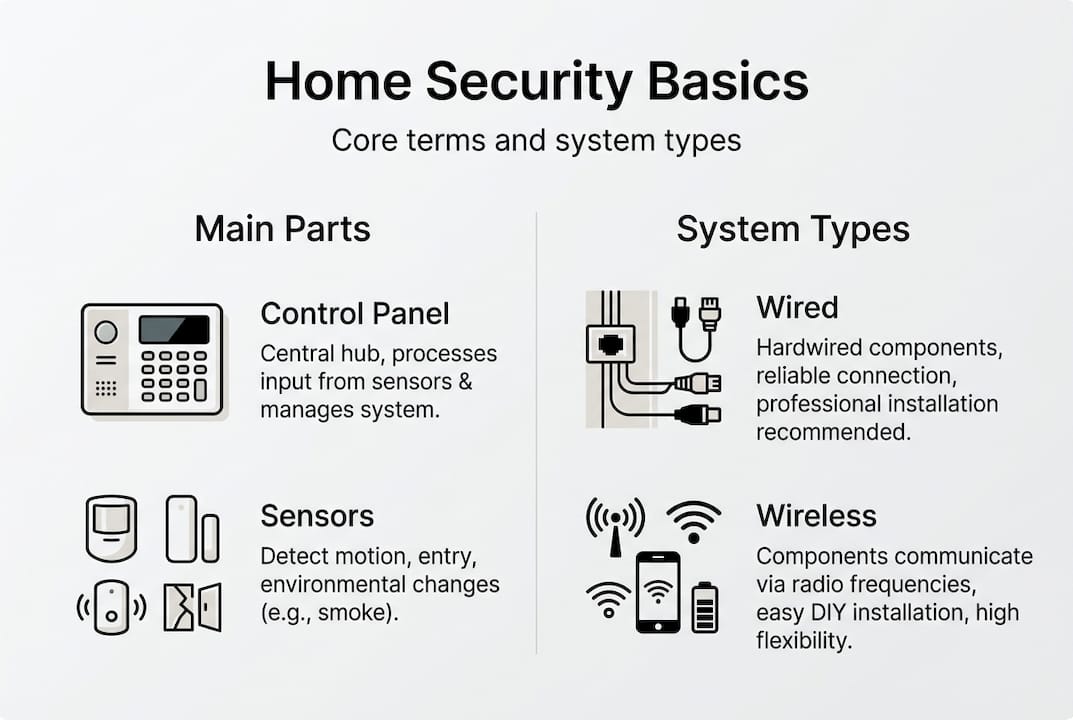
Every home security system relies on three fundamental components working together. The control panel acts as the system’s brain, coordinating all connected devices and triggering alerts when sensors detect threats. Control panels process signals from multiple sensors simultaneously, deciding which events require immediate action versus routine logging. Modern control panels include touchscreens, smartphone connectivity, and battery backup to maintain protection during power outages.
Sensors form the system’s nervous system, detecting specific types of threats throughout your property. Passive infrared sensors measure temperature changes from warm bodies like humans, making them ideal for motion detection in hallways and rooms. Door and window contacts use magnetic switches to alert you when entry points open unexpectedly. Glass break sensors listen for the specific frequency of shattering glass, protecting vulnerable windows without requiring contact. Motion detectors combine multiple technologies to reduce false triggers while maintaining reliable detection.
Alarm systems provide the audible and visual warnings that deter intruders and alert occupants to threats. These systems include sirens, strobe lights, and smartphone notifications that activate when sensors detect unauthorized entry. Understanding core components in 2026 helps you evaluate which features match your specific security needs. The role of security systems extends beyond simple alerts to include deterrence, evidence collection, and emergency response coordination.
Common sensor types include:
- Door and window contacts that trigger when magnetic connections break
- Glass break sensors that detect specific sound frequencies from breaking glass
- Motion detectors using infrared, microwave, or dual technology
- Smoke and carbon monoxide detectors integrated with security systems
- Water leak sensors protecting against flooding and pipe damage
Pro Tip: To reduce false alarms from pets, consider dual sensor setups combining PIR with microwave detection, or invest in AI-assisted sensors that distinguish between human and animal movement patterns. These essential devices represent the next generation of accurate home protection.
Comparing wired and wireless security systems
Choosing between wired and wireless systems significantly impacts installation complexity, ongoing maintenance, and overall reliability. Wired systems use physical cables connecting sensors to the control panel, creating tamper-resistant connections ideal for permanent installations. These systems require professional installation involving drilling, wire routing through walls, and careful planning during construction or renovation. Once installed, wired systems operate independently of batteries and wireless signals, eliminating concerns about dead batteries or signal interference.
Wireless systems transmit signals via radio frequencies, typically using 433 MHz, 868 MHz, or 915 MHz bands depending on regional regulations. Modern wireless systems employ frequency hopping spread spectrum technology and AES encryption to prevent signal jamming and unauthorized interception. Installation takes hours instead of days, making wireless systems perfect for renters, DIY enthusiasts, or properties where running cables proves impractical. Battery-powered sensors require periodic replacement, typically every one to three years depending on usage and sensor type.

| Feature | Wired Systems | Wireless Systems |
|---|---|---|
| Installation complexity | High; requires professional work | Low; DIY-friendly |
| Reliability | Excellent; no signal interference | Good; depends on encryption |
| Maintenance | Minimal; no batteries | Moderate; battery changes needed |
| Tamper resistance | Superior; physical connections | Good with proper encryption |
| Flexibility | Limited; fixed locations | Excellent; easy repositioning |
| Initial cost | Higher due to labor | Lower; self-installation option |
NFPA standards often favor wired systems in commercial contexts due to their proven reliability and reduced vulnerability to electronic attacks. However, residential applications benefit from wireless flexibility, especially in apartments or homes where drilling compromises structural integrity or lease agreements. Understanding wired vs wireless security cameras principles applies equally to full security systems, helping you match technology to your living situation.
Ideal use cases guide your decision:
- Wired systems suit new construction, major renovations, or permanent homes where long-term reliability outweighs installation costs
- Wireless systems excel in apartments, rentals, historic homes, or situations requiring frequent system adjustments
- Hybrid approaches combine wired infrastructure for critical sensors with wireless flexibility for peripheral devices
Pro Tip: Ensure wireless systems use WPA3 Wi-Fi encryption and include battery backup for the control panel. These features maintain security during power outages and protect against network-based attacks. The best alarm system for apartments typically prioritizes wireless technology with robust encryption protocols.
Understanding and reducing false alarms
False alarms occur when security systems trigger alerts without actual threats present. Studies show false alarms constitute 90 to 99 percent of police alarm calls, wasting emergency resources and potentially resulting in fines for homeowners. Common causes include pets triggering motion sensors, environmental factors like moving curtains or temperature fluctuations, user errors during arming and disarming, and equipment malfunctions from improper installation or aging components.
Modern technology dramatically reduces false alarm rates through intelligent detection methods. AI-powered cameras distinguish between humans, pets, and objects like swaying trees or passing cars. Video verification allows monitoring centers to visually confirm threats before dispatching emergency services, reducing false dispatches by up to 96 percent according to verified response programs. Dual sensor systems require two different detection methods to trigger simultaneously, filtering out single-source false positives while maintaining reliable threat detection.
“False alarms constitute 90-99% of police alarm calls nationwide. Video verification and AI detection can reduce false alerts by up to 96%, saving homeowners from fines and preserving emergency response resources for genuine threats.”
Environmental factors require careful consideration during installation. Placing motion sensors away from heating vents, direct sunlight, and moving objects prevents temperature-based false triggers. Adjusting sensor sensitivity levels balances detection capability with environmental tolerance. Regular maintenance including cleaning sensor lenses, testing battery levels, and updating firmware keeps systems operating at peak accuracy. Understanding why choose security systems with advanced false alarm reduction features protects both your home and community resources.
Best practices to minimize false alarms:
- Install pet-immune motion sensors rated for your animal’s weight
- Position sensors away from windows, vents, and heat sources
- Train all household members on proper arming and disarming procedures
- Schedule regular maintenance checks for sensor alignment and battery health
- Enable video verification features when available
- Use entry delay settings allowing time to disarm before triggering alerts
Many municipalities implement verified response policies requiring visual confirmation before dispatching police to alarm calls. These policies emerged directly from overwhelming false alarm rates straining emergency services. Homeowners benefit from understanding these policies and investing in systems with built-in verification capabilities.
Recognizing industry standards and certifications
UL certification indicates that independent testing laboratories have verified a security product meets specific safety, performance, and reliability standards. UL standards like UL 294, UL 365, and UL 2050 apply to access control equipment, commercial burglar alarm systems, and industrial security systems respectively. These standards ensure products withstand tampering attempts, maintain encrypted transmissions, and operate reliably under various environmental conditions. Purchasing UL-certified products provides confidence that your security equipment meets rigorous quality benchmarks.
Understanding relevant UL standards helps you evaluate product quality when shopping. UL 294 covers access control systems including electronic locks and card readers. UL 365 and UL 2610 address police station connected and local burglar alarm systems. UL 2050 focuses on national industrial security systems for large facilities. While residential systems may not require the same certification levels as commercial installations, UL-listed components demonstrate manufacturer commitment to quality and safety.
| UL Standard | Focus Area | Benefit to Homeowners |
|---|---|---|
| UL 294 | Access control equipment | Ensures electronic locks resist tampering |
| UL 365 | Police-connected alarms | Verifies reliable emergency communication |
| UL 2610 | Local burglar alarms | Confirms proper detection and alerting |
| UL 2050 | Industrial security | Applies to high-security residential systems |
| UL 681 | Installation standards | Guarantees proper professional installation |
Verifying UL certification when shopping protects you from substandard products. Follow these steps:
- Check product packaging and documentation for UL marks and certification numbers
- Visit the official UL Product iQ database online to verify listed products
- Confirm the certification covers your specific application and installation type
- Verify the manufacturer maintains current certification status
- Ask installers about their UL training and certification for proper installation
Encryption standards within UL certifications ensure wireless transmissions resist interception and tampering. AES-128 or AES-256 encryption protects communication between sensors, control panels, and monitoring stations. Understanding home security standards helps you ask informed questions when comparing products and evaluating installer qualifications.
Tamper resistance features tested under UL standards include physical enclosures that trigger alerts when opened, encrypted wireless protocols preventing signal replay attacks, and backup power systems maintaining protection during outages. These features transform security systems from simple alarms into comprehensive protection platforms resistant to sophisticated bypass attempts.
Explore trusted home security solutions
Now that you understand essential home security terminology, you can confidently evaluate products and systems for your property. Knowledge of sensors, control panels, system types, and industry standards empowers you to ask the right questions and recognize quality equipment. Safes and Security Direct specializes in professional-grade security solutions designed for homeowners who prioritize reliable protection.

Our curated selection includes UL-certified cameras, alarm systems, and safes engineered to meet rigorous safety standards. Browse our guide to top home security products to discover essential devices that match your specific needs. Whether you need wireless flexibility or wired reliability, our product specialists help you build comprehensive protection tailored to your property. Explore home security standards explained to deepen your understanding of quality benchmarks before making your investment.
Frequently asked questions
What is a passive infrared sensor?
PIR sensors detect motion by measuring changes in infrared light emitted by warm objects like humans and animals. These sensors divide their field of view into zones, triggering alerts when temperature differences move between zones. PIR sensors work best indoors and require line-of-sight to detected objects, making proper placement critical for reliable operation.
Which is better for home security: wired or wireless systems?
Wired systems offer tamper-resistant connections ideal for permanent installations where reliability outweighs installation complexity. Wireless systems provide DIY-friendly flexibility perfect for renters and temporary installations, though they require strong encryption and battery maintenance. Your choice depends on property ownership, installation budget, and long-term security priorities.
How can I reduce false alarms in my security system?
Implement video verification and AI detection to reduce false alarms by up to 96 percent. Install pet-immune sensors rated for your animal’s weight, position detectors away from heat sources and moving objects, and train household members on proper system operation. Regular maintenance including sensor cleaning and battery checks maintains optimal accuracy.
What do UL certifications mean for home security products?
UL standards ensure tested safety and reliable performance across various environmental conditions. Certification indicates products withstand tampering attempts, maintain encrypted transmissions, and meet rigorous quality benchmarks. Look for UL marks on packaging and verify certifications through the official UL Product iQ database before purchasing security equipment.
Recommended
- What is home security? A 2026 homeowner’s guide – Safes and Security Direct
- Role of Security Systems: Protecting Homes and Businesses – Safes and Security Direct
- Top Home Security Products: Essential Devices – Safes and Security Direct
- Defining Home Security Standards for Real Protection – Safes and Security Direct
- Understanding Landlord Insurance Jargon Explained