

Essential home security checklist: Safeguard your property
TL;DR:
- Installing a single front door camera is a common security mistake; effective security requires layered deterrence, detection, and response. A comprehensive checklist ensures all safety measures, from lighting to escape plans, function properly and address potential vulnerabilities. Regular maintenance and device checks, along with secure storage of valuables, are critical for long-term protection and preparedness against threats.
Installing a camera above your front door and calling it a day is one of the most common mistakes homeowners and small business owners make. Real security means layering deterrence, detection, and response into a system that gets checked regularly, not just set up once and forgotten. A well-structured security checklist is what keeps every layer functioning as intended, catching problems before they become vulnerabilities. This guide walks you through every critical element, from surveillance and alarms to safes and fire escape planning, so nothing gets overlooked.
Table of Contents
- Core elements of an effective home security checklist
- Surveillance, alarm, and access controls: Devices and checks
- Safes and valuables: Secure storage checklist
- Life safety and fire escape: The overlooked essentials
- Checklist upkeep: Maintenance and review routines
- Quick comparison: Home versus small business security needs
- Why security checklists work when habits fail
- Get started with a tailored home security checklist
- Frequently asked questions
Key Takeaways
| Point | Details |
|---|---|
| Checklist coverage | A complete security checklist includes deterrence, detection, and response steps. |
| Tech and routine | Regular device testing and maintenance keeps your security system reliable. |
| Safe storage tips | Always use secure, anchored safes for valuables and keep combinations updated. |
| Fire and escape planning | Include smoke alarm checks and practiced escape plans in your safety routine. |
| Continuous improvement | Review and update your checklist as your property or security needs evolve. |
Core elements of an effective home security checklist
Now, let’s break down exactly what your security checklist should include.
Think of your checklist in three categories: deter, detect, and respond. Each one handles a different phase of a security incident, and skipping any one of them creates a gap that can be exploited.
Deterrence is your first line. It includes well-lit exteriors, visible surveillance cameras, strong deadbolts, and even window signage warning about your alarm system. Deterrence works because it raises the perceived effort for a would-be intruder. Most criminals are opportunists who move on when they see a harder target.
Detection covers everything that alerts you when something goes wrong: motion-activated alarms, glass break sensors, smoke detectors, carbon monoxide detectors, and active video surveillance. These devices only work if they’re operational, which is exactly why your checklist needs to confirm their status regularly.
Response is often the most neglected category. This means having a clear plan for what happens after an alarm triggers. Who gets called first? Where do family members meet outside? Do your employees know the emergency shutdown procedure?
Following home security best practices helps you align all three categories into a cohesive system rather than a collection of disconnected devices. A structured checklist for household safety can be used to verify life-safety readiness, including smoke alarms, knowing how to get outside, and having two ways out.
Here are the core items your checklist should cover in each category:
- Exterior lighting tested and functional on all entry points
- Cameras positioned to cover blind spots, not just main doors
- Deadbolts and window locks checked for damage or looseness
- Alarm system tested and armed appropriately
- Smoke and CO detectors verified operational
- Emergency contact list posted and updated
- Escape plan reviewed with all household or team members
Pro Tip: Use a free digital checklist app on your phone, such as Google Tasks or Trello, to track completed checks with timestamps. This creates an accountability record and makes it easy to spot which items get skipped repeatedly.
Your checklist should also follow a clear security setup workflow so that new devices and changes to your layout get added promptly, rather than becoming blind spots.
Surveillance, alarm, and access controls: Devices and checks
With your checklist’s structure in mind, see how to address tech devices and regular checks.
Technology fails silently. A camera that stops recording, a battery-dead motion sensor, or an alarm system that glitched after a power surge all look fine from the outside. That’s why device-specific checks are a non-negotiable part of your checklist.
For surveillance cameras, check that each unit is actively recording, that the lens is clean and free of dust or spider webs, and that the viewing angle hasn’t shifted due to wind or tampering. Also confirm that your footage is saving correctly to your DVR, NVR, or cloud storage.
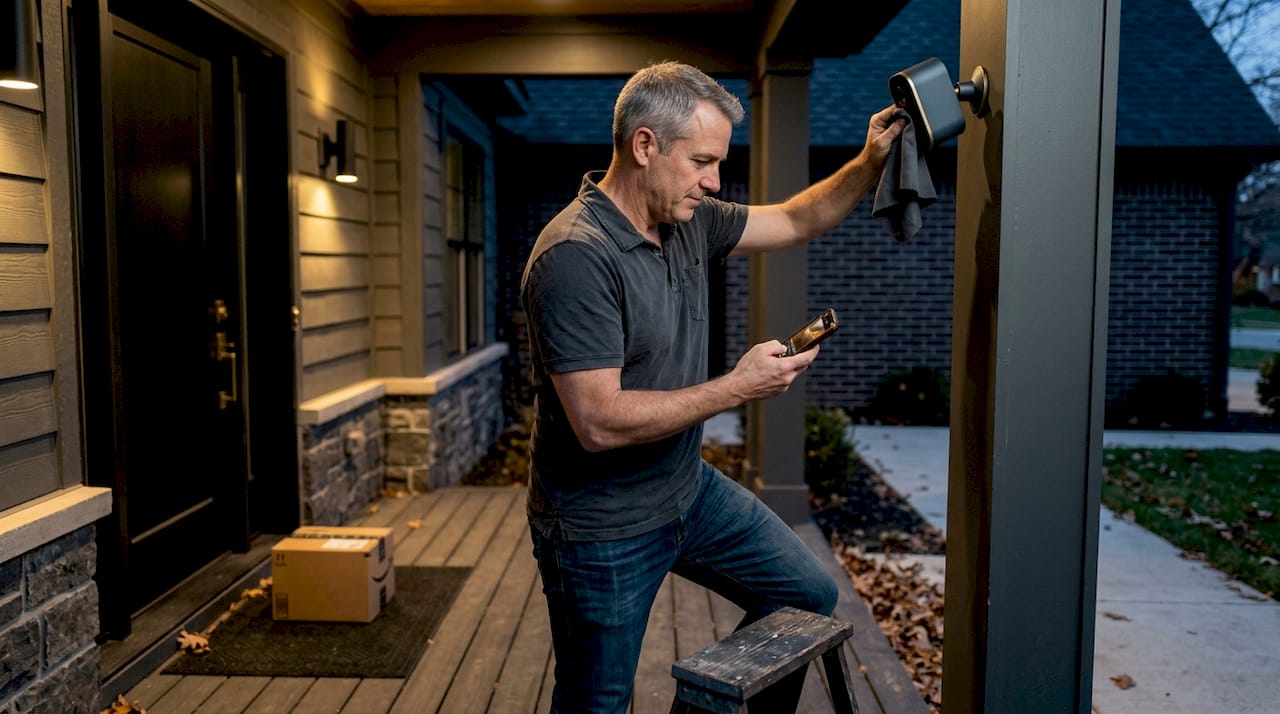
For alarm systems, test each sensor monthly by triggering it intentionally. Replace batteries annually at minimum, or as soon as low-battery alerts appear. Many homeowners miss this step until the alarm fails during an actual event.
For access control systems, whether you use keypads, key fobs, or smart locks, review the access logs regularly. Look for unusual entry times or unfamiliar credentials. Update PINs and user credentials every few months, and immediately remove access for former employees or housekeepers.
A physical security checklist for small businesses should combine cameras, access controls, alarms, physical barriers, procedures, and recurring security assessments. This is especially true for retail locations, offices, and service businesses where staff turnover and client traffic create higher exposure.
Here’s a quick reference for maintaining security systems by device type:
| Device | Checklist task | Recommended frequency |
|---|---|---|
| Security cameras | Test recording, clean lens, check angles | Monthly |
| Alarm sensors | Trigger test, battery check | Monthly / Annually |
| Smoke detectors | Function test, battery swap | Monthly / Annually |
| Access control (keypad/fob) | Review access log, update credentials | Quarterly |
| Door and window locks | Inspect for damage, test latching | Monthly |
| Backup power / UPS | Test battery health and failover | Biannually |
Reviewing essential security system features will also help you identify gaps in your current setup before they appear on a real-world incident report.
Pro Tip: Schedule a five-minute “device check” on the first day of each month. Set a recurring phone reminder and physically walk through each device on your checklist. What gets scheduled gets done.
Safes and valuables: Secure storage checklist
Security is not just about entry points; protecting valuables is equally crucial.
Even if your perimeter security is excellent, valuables need their own layer of protection. Safes are one of the most effective and underused tools in home and business security, especially when chosen and positioned correctly.
Start by identifying what you need to protect. Common categories include:
- Documents: Passports, birth certificates, property deeds, insurance policies
- Cash and precious metals: Currency, gold, silver, or collectible coins
- Jewelry: High-value items that are not in everyday use
- Digital backups: External hard drives, USB drives, and backup codes for financial accounts
- Firearms: Handguns and ammunition that require secure, childproof storage
Your checklist for secure storage should confirm the following: the safe is anchored to the floor or wall to prevent removal, it has a verified fire and water resistance rating appropriate for its contents, the combination or code has been tested recently, and a backup access method (override key or secondary code) is stored offsite.
One critical but often ignored rule: don’t advertise where your safe is. Avoid telling guests, contractors, or casual acquaintances about its location. An unused guest room, inside a closet, or behind a built-in shelf is far better than a master bedroom in plain view.
Explore essential security devices to round out your valuables protection strategy beyond just the safe itself.
Important stat: Most burglars spend less than 10 minutes inside a home. That means a properly secured and hidden safe is almost always enough to protect your valuables, even if entry is forced. The goal isn’t to make theft impossible but to make it take longer than any intruder is willing to wait.
Rotate your combinations or access codes every six months, and store the backup access information in a secure location separate from the safe itself, such as a safe deposit box at your bank or with a trusted family attorney.
Life safety and fire escape: The overlooked essentials
Don’t neglect life-safety elements as part of complete security.
Most people think of security purely in terms of burglary prevention. But a fire, gas leak, or medical emergency is statistically more likely to impact your home or business than a break-in. These threats deserve equal space on your checklist.
Here’s a numbered checklist for life safety, adapted from fire escape planning guidance:
- Install smoke alarms on every level of the home, outside each sleeping area, and inside each bedroom.
- Install carbon monoxide detectors on every level and near sleeping areas.
- Identify two exit routes from every room in the building.
- Choose a designated outdoor meeting point that everyone knows.
- Practice your fire escape plan at least twice per year.
- Keep escape routes clear of furniture, boxes, or other obstructions.
- Teach every household member how to alert others and exit safely.
- Post emergency numbers prominently near exits and in common areas.
“Draw a map of your home, find two ways out of every room, and practice your fire escape plan.” — U.S. Fire Administration
Including fire escape planning as part of your home security checklist, with specific requirements like knowing two exits from every room, is what transforms a good checklist into a truly complete one. Review property security essentials for additional guidance on merging physical and life-safety measures.
Checklist upkeep: Maintenance and review routines
To keep your security effective, maintenance should be routine, not reactive.
Setting up a security system is the easy part. Keeping it effective over months and years is where most homeowners and business owners fall short. Devices age, layouts change, and attention fades. A scheduled maintenance routine is what bridges the gap between installation and long-term reliability.
Security checklists should cover maintenance cadence explicitly, including batteries, camera recording health, and smoke alarm testing, so the system remains effective over time rather than only during initial setup.
Here’s a practical maintenance schedule broken out by frequency:
- Monthly: Test alarm sensors, verify camera recording, check battery indicators on all wireless devices, walk the perimeter for new vulnerabilities.
- Quarterly: Update access codes or PINs, review camera footage storage capacity, confirm backup contacts are current.
- Biannually: Replace smoke alarm and CO detector batteries, conduct a full fire escape drill, inspect locks and hinges for wear.
- Annually: Full security system maintenance review, reassess camera placement after any renovations, test safe access and backup codes.
After any renovation or significant change to your floor plan, update your checklist immediately. New hallways, added rooms, or repositioned furniture all affect escape routes and camera coverage.
Pro Tip: Assign specific checklist tasks to different family members or employees. When one person owns each task, accountability goes up sharply and nothing slips through simply because “someone else was going to handle it.”
Document your completed checks with brief notes. Even a single line like “tested bedroom smoke alarm, replaced battery” creates a record that catches gaps and proves due diligence if you ever need to file an insurance claim.
Quick comparison: Home versus small business security needs
If you’re not sure which checklist priorities matter most for you, compare needs side by side.
| Checklist element | Homeowner priority | Small business priority |
|---|---|---|
| Entry door locks | High, daily use | High, multiple access points |
| Surveillance cameras | 2 to 4 cameras typical | 6 or more, covering stock and entrances |
| Alarm system | Basic motion and perimeter | Zoned system with staff codes |
| Access logs | Optional | Required, reviewed regularly |
| Safe or secure storage | Documents and jewelry | Cash, records, and backup drives |
| Fire escape plan | Family drill twice yearly | Staff training and posted exit maps |
| Security assessment | Annual review | Semiannual with documented findings |
A physical security checklist for small businesses should combine cameras, access controls, alarms, physical barriers, procedures, and recurring security assessments, which goes well beyond what most residential setups require.
Adapting your checklist to your situation means asking the right questions:
- Do you have employees or contractors who need access credentials managed separately?
- Is your valuables storage shared, or does each stakeholder have a separate secure area?
- Do your business hours create predictable vulnerability windows that need specific camera coverage?
- Are your escape routes sized and marked appropriately for the number of people in the building?
For homeowners in high-density areas, security solutions for urban homeowners offers a targeted look at checklist priorities that differ from rural or suburban settings, such as shared entry points and proximity to neighbors.
Why security checklists work when habits fail
Here’s something we’ve noticed after years of helping homeowners and business owners build out their security setups: most people are remarkably confident in their routines, right up until the moment something goes wrong.
The human memory is not designed for consistent, multi-step verification. It’s designed for shortcuts. You get home, you think you locked the back door because you always lock the back door. But “always” isn’t the same as “tonight.” This is the exact gap that a written checklist eliminates.
We’ve seen this play out repeatedly in our conversations with customers. Someone upgrades their camera system, walks through the house once to confirm placement, and then never revisits the setup until a camera stops recording three months later because the hard drive filled up. A 30-second monthly check would have caught it immediately.
The small stuff is almost always what gets missed: a loose sensor, a camera aimed slightly off from when the delivery driver bumped it, a safe combination that only one person knows and that person is traveling. Write it down. Assign it. Check it off.
What separates a security system that works from one that just looks like it works is the discipline of reviewing your 2026 home security basics on a schedule, not just when something feels wrong.
In our experience, structured audits catch significantly more issues than informal walk-throughs. The reason is simple: a checklist forces you to engage with each item individually, while a habit lets you mentally check the whole room at once without actually verifying anything. One works. The other feels like it works.
Get started with a tailored home security checklist
Knowing what your checklist should include is the first step. Turning it into action is where Safes and Security Direct can help.
We carry a wide range of cameras, alarms, safes, and access control solutions built for both residential and commercial needs. Whether you’re refining an existing setup or building your security plan from scratch, our product specialists and detailed product guides are designed to match you with the right tools for your specific situation. Browse our home security products and security advice resources to find devices that fit your checklist, your layout, and your budget. When your checklist and your equipment work together, your protection is no longer a guess.
Frequently asked questions
What should be checked every month on a home security checklist?
Test security system devices, replace batteries if needed, verify camera operation, and review escape routes each month. Security checklists should cover batteries, camera recording health, and smoke alarm testing as part of a regular maintenance cadence.
How often should smoke alarms be checked?
Test smoke alarms monthly and replace batteries at least once a year. A household safety checklist should verify smoke alarms, exit knowledge, and two-way egress as life-safety essentials.
What’s the best way to secure valuables at home?
Use a safe anchored to the floor or wall, and keep its location discreet and out of plain sight. Choose a model rated for both fire and burglary resistance based on what you’re storing.
Why add fire escape planning to a home security checklist?
Fire escape planning saves lives and ensures every family member knows exactly how to exit in an emergency. A home security checklist should include knowing two exits from every room and practicing the plan at least twice a year.
How does a security checklist differ for small businesses?
Small business checklists include additional steps for access control, regular employee training, and semiannual security assessments. A business physical security checklist should combine cameras, access controls, alarms, physical barriers, procedures, and recurring security reviews.
Recommended
- How to secure property effectively: A practical guide – Safes and Security Direct
- Home security best practices: protect property in 2026 – Safes and Security Direct
- How to protect valuables at home: strategies for 2026 – Safes and Security Direct
- Security system features list: Essential options for homes & businesse – Safes and Security Direct