

What is security compliance? A clear guide for business leaders
TL;DR:
- Security compliance is an ongoing process that varies by industry, regulation, and client demands.
- Frameworks like NIST CSF and ISO 27001 help structure security efforts, with ongoing monitoring being essential.
- Achieving compliance is necessary but not sufficient; continuous risk-based security measures are critical beyond certifications.
Most business leaders assume that passing a security audit means their company is protected. It isn’t. The average US data breach costs $10.22M in 2026, up 9% year over year, and many of those breached organizations had compliance certifications on file. Security compliance is not a trophy you earn once. It is a living process, and understanding the difference between checking boxes and building real protection is what separates resilient businesses from expensive headlines.
Table of Contents
- What is security compliance?
- Key frameworks and standards
- Core elements and everyday practices
- The value and limitations of security compliance
- How to put security compliance into action
- A practical perspective: Security compliance is your floor, not your ceiling
- Taking the next step toward effective security
- Frequently asked questions
Key Takeaways
| Point | Details |
|---|---|
| Compliance isn’t security | Passing an audit proves process but does not ensure safety against threats. |
| Continuous improvement wins | Modern compliance means ongoing monitoring and adapting to new risks. |
| Choose the right framework | Select industry-relevant frameworks like NIST CSF or ISO 27001 for best results. |
| Automation cuts breach costs | Leveraging automation can save your business millions in the event of a breach. |
| Layer controls for best defense | Combine basic compliance with tailored risk strategies for stronger protection. |
What is security compliance?
Security compliance is not a project with a finish line. It is an ongoing commitment. As ongoing security compliance is defined by industry experts, it is the process of meeting security requirements from laws, regulations, industry standards, and contracts through policies, procedures, technical controls, and documentation to protect data and systems.
For business owners and compliance officers, this definition has real weight. It means your obligations span multiple sources at once: federal and state law, your industry’s governing bodies, and even the contracts you sign with enterprise clients. Miss any one of them, and you face fines, lost contracts, or worse.
“Compliance is not a destination. It is a continuous discipline that keeps your security posture aligned with evolving threats and regulatory expectations.”
The core elements of a compliance program include:
- Policies and procedures: Written rules that define how your team handles sensitive data, access, and incidents
- Technical controls: Firewalls, encryption, access management, and monitoring tools that enforce those rules
- Documentation: Logs, audit trails, and reports that prove controls are working
- Continuous monitoring: Ongoing checks to detect gaps before regulators or attackers do
One critical distinction every leader needs to understand: compliance and security are not the same thing. Compliance checks whether you meet a defined set of requirements. Security measures whether those requirements actually protect you. You can pass every audit and still be breached through a gap the framework never addressed. Understanding security standards for businesses helps clarify where the two concepts overlap and where they diverge.
Key frameworks and standards
Once you understand what security compliance means, the next question is: which rules apply to you? The answer depends on your industry, your customers, and where you operate. Several key compliance frameworks dominate the landscape for medium-sized businesses.
| Framework | Type | Best for | Certifiable? |
|---|---|---|---|
| NIST CSF | Voluntary, outcome-based | Most industries | No |
| ISO 27001 | International standard | Global operations | Yes |
| SOC 2 | Service org controls | SaaS, cloud vendors | Yes (audit report) |
| PCI DSS | Prescriptive | Payment card data | Yes |
| HIPAA | Regulatory | Healthcare | No (self-assessed) |
| FedRAMP | Federal standard | Government contractors | Yes |
| CMMC | DoD requirement | Defense supply chain | Yes |
Each framework has a distinct purpose. NIST CSF organizes security around five functions: Identify, Protect, Detect, Respond, and Recover. ISO 27001 builds a formal Information Security Management System (ISMS) that auditors can certify. SOC 2 focuses on service organizations and evaluates controls across security, availability, and confidentiality.
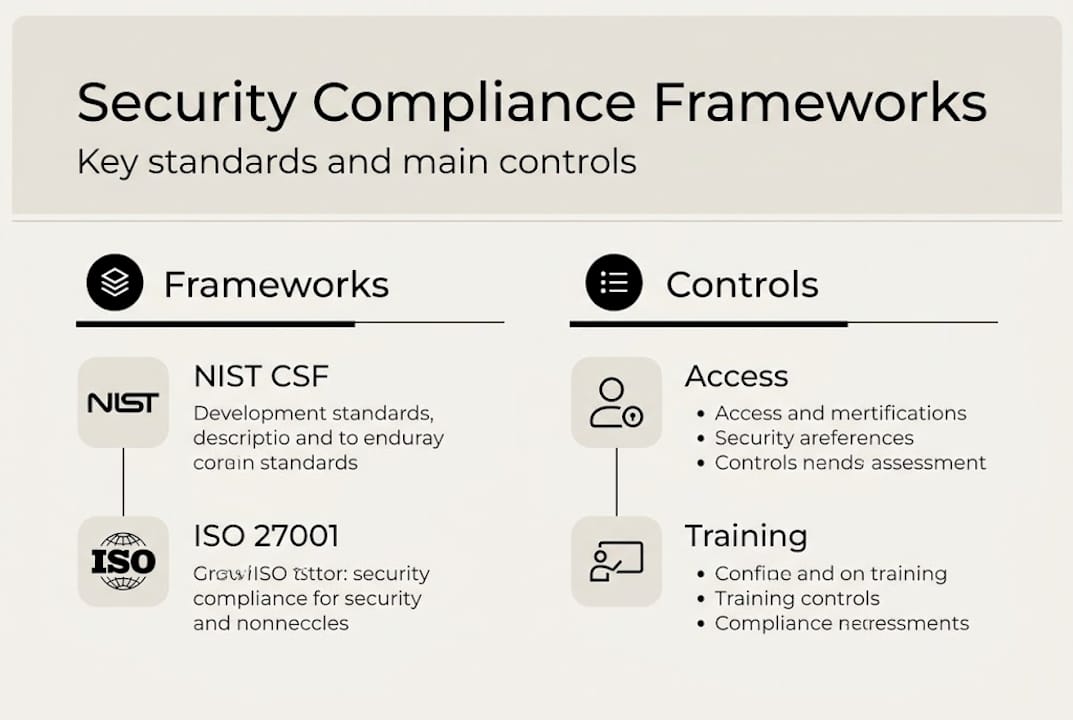
For most medium-sized companies, NIST CSF or ISO 27001 is the right starting point. NIST CSF is flexible and free, making it ideal for building a foundation. ISO 27001 adds external credibility, which matters when enterprise clients demand proof of your security posture.
Here is how to narrow your choice:
- Industry: Healthcare requires HIPAA. Defense contractors need CMMC. Financial firms often face PCI DSS.
- Customer demands: Enterprise clients frequently require SOC 2 reports before signing contracts.
- Geography: International operations benefit from ISO 27001’s global recognition.
Pro Tip: Many organizations run hybrid approaches, mapping NIST CSF as their internal backbone while pursuing ISO 27001 certification for external credibility. This avoids duplicating effort across two separate programs. Learning more about defining security standards can help you build that map efficiently.
Core elements and everyday practices
Frameworks tell you what to achieve. Execution determines whether you actually get there. Continuous compliance practices break down into three core areas: controls, evidence collection, and monitoring.
Controls come in two types. Administrative controls are your policies, training programs, and access approval workflows. Technical controls are the systems that enforce those policies: multi-factor authentication, endpoint detection, data loss prevention tools. Both matter equally. A strong firewall means nothing if employees share passwords.
Evidence collection is what auditors actually review. This includes access logs, change management records, vulnerability scan results, and incident response reports. Many mid-sized companies underestimate how much documentation is required until they face their first audit.

Continuous monitoring replaces the old model of annual assessments. Threats change daily. A control that worked in January may be bypassed by March. Modern compliance programs use automated tools to flag gaps in real time.
Here is a practical sequence for building your compliance program:
- Conduct a formal risk assessment explained to identify your most critical assets and vulnerabilities
- Map those risks to your chosen framework’s requirements
- Implement both technical and administrative controls to address gaps
- Build a documentation system that captures evidence automatically where possible
- Schedule recurring internal reviews, not just annual audits
- Assign clear ownership for each control area
| Compliance task | Frequency | Owner |
|---|---|---|
| Access review | Quarterly | IT/HR |
| Vulnerability scanning | Monthly | IT Security |
| Policy review | Annual | Compliance Officer |
| Incident log review | Weekly | Security team |
| Vendor risk assessment | Annual or on-change | Procurement |
Pro Tip: Automation platforms can handle evidence collection and control monitoring simultaneously, cutting the manual workload for small security teams by a significant margin. For mid-sized companies without a full security department, this is often the most cost-effective investment you can make.
The value and limitations of security compliance
Compliance delivers real value. It forces organizations to document their controls, train their staff, and respond to incidents in a structured way. But it has hard limits that every business leader should understand before treating a certification as a safety guarantee.
The core limitation is this: compliance verifies processes, not outcomes. A framework checks whether a control exists and whether it was applied at the time of assessment. It does not measure whether that control actually stopped an attacker.
Several security compliance limitations create real exposure for otherwise compliant organizations:
- Point-in-time audits: A certification reflects your posture on audit day. Controls can decay the week after the auditor leaves.
- Out-of-scope gaps: Frameworks define their own boundaries. Anything outside that scope, including certain third-party integrations, may not be evaluated.
- Third-party risk: Your vendor’s breach becomes your problem. Most frameworks address this inadequately.
- Framework collisions: Companies subject to both HIPAA and PCI DSS sometimes face conflicting requirements that create compliance blind spots.
- Emerging technology gaps: AI-generated code and modern supply chain attacks often fall outside the scope of legacy framework controls.
“A compliant organization is not necessarily a secure one. Compliance is the baseline. Real security requires continuous, risk-based decisions that go beyond what any single framework demands.”
This is why experienced compliance officers treat their framework as a floor, not a ceiling. They use it to satisfy regulators and clients while layering additional controls based on their specific threat environment. Reading about industry best practices gives you a clearer picture of what that layered approach looks like in practice.
How to put security compliance into action
Knowing the limits of compliance makes the execution roadmap more valuable, not less. Here is a practical sequence built for medium-sized companies:
- Assess your risks: Identify what data and systems matter most, who can access them, and what threats are realistic for your industry.
- Select your framework: Use your industry, client requirements, and regulatory obligations to choose one primary framework and any required add-ons.
- Conduct a gap analysis early: Map your current controls against framework requirements before investing in new tools. This prevents expensive rework.
- Implement controls systematically: Start with high-risk areas. Don’t try to address everything at once.
- Document as you go: Build evidence collection into your workflows from day one, not as an afterthought before an audit.
- Monitor continuously: Set up automated alerts for control failures, access anomalies, and policy violations.
- Repeat on a defined cycle: Treat compliance as a program, not a project.
Medium-sized companies face specific compliance challenges for SMEs that larger enterprises rarely encounter. Scope creep happens when teams add systems or vendors without updating their compliance boundary. Documentation overload buries small teams. Supply chain requirements, especially under CMMC, flow down to vendors who may not have the resources to comply.
The most effective solutions are automation platforms that handle evidence collection and monitoring, virtual Chief Information Security Officers (vCISOs) who provide expert guidance without a full-time salary, and early gap analysis that catches problems before they become audit failures.
Pro Tip: Don’t wait for a client to demand a SOC 2 report or a regulator to flag a gap. The role of security standards in protecting your business is most powerful when you build compliance proactively, before pressure forces your hand.
A practical perspective: Security compliance is your floor, not your ceiling
Here is the uncomfortable truth that most compliance consultants won’t say directly: the organizations that get breached after achieving certification usually didn’t fail their framework. They succeeded at it. They met every requirement, passed every audit, and still got hit through a gap the framework never covered.
For medium-sized companies, the right approach is to prioritize security solutions that go beyond what any checklist demands. Automating continuous compliance cuts breach costs significantly while reducing the manual burden on your team. But automation alone isn’t enough. You need a risk-based mindset that asks: what are our specific threats, and do our controls actually address them?
Certifications earn client trust and satisfy regulators. That matters. But experienced security leaders know that the real work begins after the certificate arrives. Layer organization-specific controls on top of your framework. Review what your auditors didn’t test. Build a program that treats compliance as the starting point for real security, not the finish line.
Taking the next step toward effective security
Understanding security compliance gives you a foundation. Acting on it is where protection becomes real. Whether you are building your first compliance program or strengthening an existing one, having the right physical and digital security infrastructure in place matters as much as your policies and documentation.
At Safes and Security Direct, we work with businesses that take asset protection seriously. From surveillance systems to fire-resistant and burglary-resistant safes, our product range supports the physical security layer that compliance frameworks often overlook. Explore our catalog to find solutions that align with your risk profile and help you build a security posture that goes beyond passing the next audit.
Frequently asked questions
Why isn’t passing a security audit enough for true cyber risk protection?
Passing an audit proves you met requirements at a specific point in time, but point-in-time audits miss control decay and gaps that emerge after certification. Threats evolve faster than audit cycles.
Which compliance framework should my mid-size business choose first?
Most medium-sized companies start with NIST CSF or ISO 27001, with the choice guided by industry regulations and client expectations. NIST CSF or ISO provides the strongest general foundation for most sectors.
How often do organizations need to update their compliance measures?
Modern compliance requires continuous monitoring rather than annual reviews, because threats, regulations, and technology change too rapidly for point-in-time assessments to keep pace.
What’s the biggest compliance pain point for SMEs?
Documentation overload and limited internal resources are the top obstacles, and most organizations resolve them through automation platforms and vCISO support rather than hiring full-time staff.
How much money can automation save on data breach costs?
AI and automation tools reduce average breach costs by $1.9M to $2.22M per incident, making them one of the highest-return investments in any compliance program.
Recommended
- Business Security Compliance: Safeguarding Assets and Reputation – Safes and Security Direct
- Security Standards for Businesses: Reducing Risk and Ensuring Complian – Safes and Security Direct
- Business security checklist 2026: protect your SME assets – Safes and Security Direct
- Security audit checklist guide for asset protection – Safes and Security Direct
- Understanding What is IT Security Compliance - IT Start
- What is digital compliance: enterprise guide for 2026 - 40Q