

Business Security Compliance: Safeguarding Assets and Reputation
Meeting security regulations can feel overwhelming when you juggle limited resources and daily operations. The need for robust compliance becomes urgent as a single misstep exposes your business to financial loss and reputational harm. By focusing on business security compliance essentials, you gain practical guidance for protecting assets, securing customer data, and meeting global regulatory expectations—giving you a framework that works for your company, not just for auditors.
Table of Contents
- Defining Business Security Compliance Essentials
- Major Security Compliance Frameworks and Standards
- Key Compliance Requirements for Businesses
- Legal Obligations and Risk Management Strategies
- Common Compliance Mistakes and Effective Solutions
Key Takeaways
| Point | Details |
|---|---|
| Importance of Compliance | Business security compliance is essential for protecting assets, data, and reputation while meeting regulatory requirements. |
| Unique Challenges for SMBs | Small and medium businesses must address compliance with limited resources, making effective risk management crucial. |
| Risk Assessment | Conduct thorough risk assessments to identify threats and develop tailored security strategies. |
| Continuous Improvement | Compliance programs must adapt to evolving regulations and threats to remain effective in protecting the organization. |
Defining Business Security Compliance Essentials
Business security compliance means meeting regulatory requirements and implementing controls to protect your company’s assets, data, and reputation. It’s not optional—it’s the foundation that prevents breaches, protects customer trust, and keeps your organization operating legally.
Compliance isn’t about checking boxes. It involves understanding what regulations apply to your business, assessing your security risks, and building systems that address those specific threats. Think of it as creating a security roadmap tailored to your industry and size.
Why This Matters for Small and Medium Businesses
Your company faces unique challenges. Unlike large enterprises with dedicated security teams, you need to manage compliance with limited resources while maintaining operations. A single breach could damage your reputation for years.
Compliance protects three critical areas:
- Financial assets and physical valuables stored on-site
- Customer data and business information requiring legal protection
- Operational continuity and stakeholder confidence in your organization
Regulatory bodies expect you to meet the same standards regardless of size. That’s why small to medium-sized businesses need a practical, scalable approach to security compliance.
Key Compliance Components
Effective compliance combines multiple elements working together. Security frameworks like the Information Security Forum’s Standard of Good Practice provide guidance on integrating these components with your risk management and business processes.
Your compliance strategy should address:
- Risk Assessment – Identify threats to your assets, data, and operations
- Threat Response – Develop procedures for detecting and responding to security incidents
- Supply Chain Management – Ensure vendors and partners meet your security standards
- Regulatory Compliance – Meet industry-specific legal requirements
- Physical Security – Protect tangible assets with appropriate safeguards
Physical security solutions directly support compliance by securing valuables and sensitive materials from theft and unauthorized access.
Compliance isn’t one-time. Regulations evolve, threats change, and your business grows. You need systems that adapt.
Your compliance framework must balance regulatory requirements with practical implementation—creating protection that actually works for your business, not just on paper.
Pro tip: Start by documenting what data and assets your business holds, then map those to applicable regulations. This foundation makes every other compliance decision clearer and faster.
Major Security Compliance Frameworks and Standards
Security frameworks are the blueprints that guide your compliance efforts. They translate regulatory requirements into actionable steps your team can actually follow. Without a framework, compliance becomes guesswork instead of strategy.

Two major frameworks dominate the compliance landscape globally. Both are designed for organizations of all sizes, making them equally relevant whether you run a small office or a growing operation.
NIST Cybersecurity Framework
The NIST Cybersecurity Framework provides globally recognized standards for managing cybersecurity risks. It works by defining high-level outcomes your organization should achieve, then letting you decide how to get there based on your industry and resources.
NIST’s approach focuses on five key functions:
- Govern – Establish organizational policies and oversight
- Identify – Know what assets and risks you have
- Protect – Implement safeguards for critical systems
- Detect – Find security incidents when they occur
- Respond – React quickly and effectively to breaches
What makes NIST practical for small to medium businesses is flexibility. You don’t implement everything at once. You prioritize based on your actual risk profile and build from there.
ISO/IEC 27000 Series Standards
The ISO/IEC 27000 family represents the international standard for information security management. ISO/IEC 27001:2022 specifically sets requirements for building and maintaining an information security management system (ISMS).
ISO compliance demonstrates to customers, partners, and regulators that your security program meets worldwide expectations. Organizations adopt these standards to protect critical information and maintain resilience against threats through systematic management.
ISO/IEC 27001 requires you to document everything—policies, procedures, risk assessments, and improvements. It’s thorough and rigorous, creating an auditable trail of your security efforts.
Choosing the Right Framework
Security standards help protect your assets by providing structure and consistency. NIST suits organizations building their security from the ground up. ISO works best if you need internationally recognized certification or operate across multiple countries.
Many organizations use both. NIST provides the thinking process; ISO provides the formalization. Your choice depends on your industry requirements, customer expectations, and compliance deadlines.
Here’s how the NIST Cybersecurity Framework and ISO/IEC 27001 compare for business compliance:
| Aspect | NIST Cybersecurity Framework | ISO/IEC 27001 |
|---|---|---|
| Global Recognition | Widely adopted in the US | Global ISO standard |
| Certification | No formal certification | Offers official certification |
| Documentation Rigor | Flexible, outcome-focused | Detailed, thorough documentation required |
| Ideal Use Case | Building new security programs | Demonstrating mature, formalized controls |
| Adaptability | Highly flexible to business needs | Best for structured, repeatable processes |
A framework without physical security controls is incomplete. Your digital protections must be backed by real-world safeguards for assets and data stored on-site.
Pro tip: Map your current security practices to NIST or ISO before choosing one. This shows you exactly which gaps exist, making implementation faster and more cost-effective.
Key Compliance Requirements for Businesses
Compliance requirements vary by industry, size, and jurisdiction. But every business needs foundational elements that prevent fraud, protect data, and demonstrate organizational integrity to regulators and stakeholders.
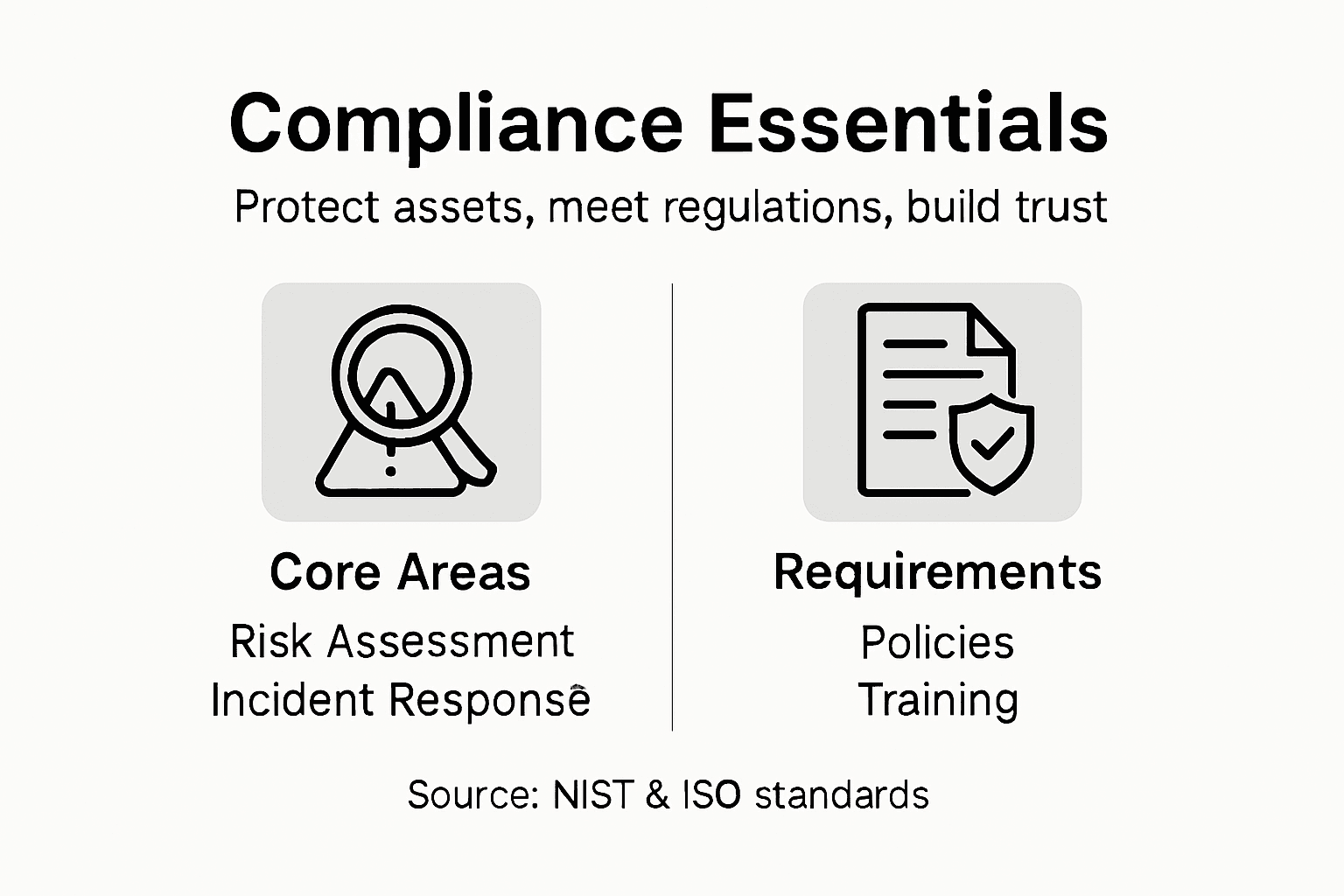
Your compliance program isn’t just about following rules. It’s about creating systems that catch problems before they become scandals, legal battles, or operational failures.
Seven Core Elements of a Compliance Program
The US Department of Health and Human Services Office of Inspector General outlines seven basic elements that form the foundation of effective compliance programs across industries:
- Written Policies and Procedures – Document what compliance looks like in your organization
- Leadership and Oversight – Assign responsibility to specific people with authority
- Training and Education – Ensure employees understand compliance expectations
- Effective Communication – Create safe channels for reporting concerns and violations
- Enforcement of Standards – Consistently apply consequences for policy violations
- Risk Assessment and Monitoring – Identify where problems are most likely to occur
- Corrective Action Plans – Fix gaps and prevent repeat violations
These elements work together. Without training, policies mean nothing. Without monitoring, enforcement becomes random. Each piece supports the others.
What Regulations Actually Require
Businesses must adhere to federal, state, and international regulations like SOX, FCPA, HIPAA, and Dodd-Frank. Key compliance requirements include establishing internal controls, accurate record-keeping, preventing fraud and bribery, safeguarding sensitive information, and providing sufficient training.
Your specific obligations depend on your industry. A healthcare provider faces different rules than a financial services firm. A retailer handling customer data has different requirements than a manufacturing company.
Building Your Compliance Program
Start by identifying which regulations apply to your business. Map those requirements to the seven core elements. Then assign ownership—someone needs to be accountable for each element.
Compliance without enforcement is just theater. Rules only matter if people know consequences apply consistently and fairly.
Small teams can implement this effectively. You don’t need a massive compliance department. You need clear thinking about risk, transparent communication about expectations, and commitment from leadership to back it up with action.
Pro tip: Review your compliance program quarterly against the seven elements. This identifies which gaps to address first and keeps your team focused on what actually reduces risk.
Legal Obligations and Risk Management Strategies
Every business has legal obligations that vary by industry, location, and size. Meeting those obligations requires more than checking boxes—it demands a strategic approach that balances regulatory demands with business objectives while protecting assets and reputation.
Risk management in compliance means identifying where problems are most likely, then building systems to prevent or catch them. This protects your company from liability, operational disruptions, and reputational damage.
Understanding Your Legal Obligations
Your first step is knowing which laws and regulations apply to your specific business. These span federal, state, and sometimes international requirements depending on where you operate and what you sell.
Common obligations include:
- Maintaining accurate financial records and internal controls
- Protecting customer and employee data from unauthorized access
- Preventing fraud, bribery, and illegal payments
- Reporting suspected violations to appropriate authorities
- Maintaining required licenses and certifications
- Following industry-specific regulations for your sector
Not all obligations carry equal weight. Some violations result in minor fines; others can shut down your business or result in criminal charges. Understanding this hierarchy helps you allocate compliance resources effectively.
Use this table to quickly identify the types of legal compliance obligations businesses face:
| Compliance Area | Common Legal Requirements | Potential Consequence |
|---|---|---|
| Financial Controls | Accurate reporting, anti-fraud processes | Fines, loss of licenses |
| Data Protection | Secure storage, privacy regulations | Data breaches, legal penalties |
| Employee Conduct | Anti-bribery, training mandates | Criminal charges, reputational harm |
| Regulatory Reporting | Timely disclosures, audits | Business closure, lawsuits |
Strategic Compliance and Risk Management
Strategic compliance design involves tailoring your internal policies to meet mandatory obligations while optimizing resources based on enforcement intensity and your internal risk profile. This requires cooperation between legal, compliance, and executive teams.
Effective risk management follows a structured approach:
- Assess – Identify which areas of your business face the highest compliance risk
- Treat – Design controls and procedures to address those risks
- Monitor – Track whether controls are actually working
- Evaluate – Review results and adjust your approach
This isn’t static. As your business changes, as regulations evolve, and as you learn from incidents, your risk management strategy must adapt. What worked last year might need updating this year.
Protecting Assets Through Compliance
Compliance directly protects your physical and informational assets. Proper controls prevent theft, unauthorized access, fraud, and data breaches. They also create audit trails that prove you took reasonable precautions if something does go wrong.
Compliance risk management requires developing improvement plans, establishing governance frameworks, and building ongoing capacity. This structured discipline helps organizations maintain legal obligations while supporting growth.
Legal compliance and business success aren’t opposing forces. A company with strong compliance systems has fewer disruptions, lower insurance costs, and better relationships with regulators and customers.
Pro tip: Assign a specific person accountability for each major compliance obligation. Shared responsibility means no responsibility. Clear ownership ensures nothing falls through the cracks.
Common Compliance Mistakes and Effective Solutions
Many businesses build compliance programs that fail silently. They check boxes, document procedures, and think they’re protected. Then a breach happens, and they realize their program was never designed to actually prevent anything.
The gap between a compliance program that exists on paper and one that works in reality determines whether your business survives a crisis or becomes a cautionary tale.
The Most Common Mistakes
Organizations stumble on compliance in predictable ways. Understanding these mistakes helps you avoid them before they damage your business.
Box-checking without purpose – Many programs focus on compliance metrics instead of actual outcomes. You can have 100 training sessions completed and still have employees who don’t understand what compliance means or why it matters.
Weak leadership commitment – Compliance requires visible support from the top. If leadership treats it as an HR function instead of a business imperative, employees notice and compliance becomes optional.
Insufficient training and communication – Employees can’t follow rules they don’t understand. Compliance training must be clear, relevant to their roles, and repeated regularly.
Slow response to detected issues – Finding a problem means nothing if you don’t fix it quickly. Delays signal that violations don’t have real consequences.
Poor measurement of effectiveness – Common compliance program shortcomings often stem from inadequate oversight and failure to measure whether controls actually work.
Building Programs That Actually Work
Effective compliance requires shifting from box-checking to objective-driven design. Setting clear goals and using better metrics tailored to your actual compliance objectives makes all the difference.
Key solutions include:
- Establish written policies aligned with your specific business risks
- Create strong leadership roles with clear accountability
- Develop comprehensive, role-specific education programs
- Open communication channels where people can report concerns safely
- Audit regularly and thoroughly
- Respond quickly and visibly when issues emerge
These elements work together. Written policies without training fail. Strong leadership without measurement fails. Communication channels that go nowhere kill trust.
A compliance program’s real test isn’t whether it exists. It’s whether it actually catches problems and changes behavior before damage occurs.
Small and medium-sized businesses have an advantage here. You move faster than large enterprises. You can implement changes, see results, and adjust. Your compliance culture can become genuinely embedded in how people work.
Pro tip: Pick one compliance metric that truly matters to your business—like percentage of employees completing training, audit findings resolved within 30 days, or reported concerns handled promptly—and track it monthly. This keeps focus on what actually reduces risk.
Strengthen Your Business Security Compliance with Trusted Solutions
Meeting business security compliance requires more than policies and frameworks. Protecting your assets and reputation starts with reliable physical security measures tailored to your risk profile. Whether you need fire-resistant safes, burglary-resistant storage, or advanced surveillance cameras, securing your tangible and informational assets is critical to closing compliance gaps and mitigating risks effectively.

Explore robust security products that align with your compliance strategy at Safes and Security Direct. Our professional-grade solutions support the key compliance components highlighted in this article such as physical security and risk management. Don’t leave your safeguards to chance. Visit our website today to secure your business with technology and equipment built for security-conscious organizations. Take action now to protect what matters most and maintain your regulatory peace of mind.
Frequently Asked Questions
What is business security compliance?
Business security compliance involves meeting regulatory requirements and implementing controls to protect a company’s assets, data, and reputation. It is essential for preventing breaches and maintaining legal operations.
Why is compliance particularly important for small and medium-sized businesses?
Small and medium-sized businesses often face unique challenges with limited resources. A single breach can have devastating effects on their reputation and operations, making compliance essential for protecting assets and maintaining customer trust.
What are the key components of an effective compliance strategy?
An effective compliance strategy includes risk assessment, threat response procedures, supply chain management, regulatory compliance, and physical security measures. These components work together to create a comprehensive protection framework.
How do I choose the right compliance framework for my business?
Choosing the right compliance framework involves assessing your industry’s requirements and your business’s specific needs. The NIST Cybersecurity Framework suits businesses building security from the ground up, while ISO/IEC 27001 is ideal for those seeking formal certification and international recognition.
Recommended
- Why Secure Commercial Assets: Protecting Profit and Growth – Safes and Security Direct
- Business Security Needs: Protecting Assets in 2026 – Safes and Security Direct
- Asset Protection Strategies 2026: Safeguard Your Business Assets – Safes and Security Direct
- Role of Security Standards in Asset Protection – Safes and Security Direct