

How to prevent break-ins: a practical guide for homeowners
TL;DR:
- Most break-ins occur rapidly through easily accessible ground-floor entry points, often exploiting weak locks or unlocked doors.
- Implementing layered security, including physical barriers, detection devices, deterrents, and routine habits, significantly deters burglars and closes vulnerabilities.
- Regularly assessing and maintaining your security system ensures continuous protection, emphasizing that comprehensive, vigilant strategies outperform gadgets alone.
Most break-ins don’t look like movie heists. They happen fast, in broad daylight, through the front door. A burglar spots a weak lock, an unlocked window, or a property that looks empty and acts within seconds. For homeowners and small business owners, that window of opportunity is the real threat. This guide walks you through every practical step to close those gaps, from identifying your most exposed entry points to building layered defenses that make your property a genuinely hard target.
Table of Contents
- Assessing vulnerabilities: know your weak spots
- Essential tools and layers: building blocks of break-in prevention
- Step-by-step: how to secure entry points
- Visibility and routines: deterring opportunists before they try
- A realistic view: why layering and routines beat gadgets alone
- Take the next step in securing your property
- Frequently asked questions
Key Takeaways
| Point | Details |
|---|---|
| Start with entry points | Securing doors and ground-level windows blocks the most common burglary routes. |
| Layer your protection | Combine physical barriers, alarms, cameras, and routines for the strongest defense. |
| Stay visible | Lighting and clear security signs deter opportunistic break-ins before they start. |
| Check and update regularly | Test your security setup and update it as your property or habits change. |
Assessing vulnerabilities: know your weak spots
Having set the stage for why break-ins happen, let’s start by identifying your property’s unique vulnerabilities. You can’t fix what you haven’t found, and most people don’t realize how many easy openings they’re offering without knowing it.
Ground-floor entry points are consistently the most targeted spots in both homes and businesses. That includes front doors, back doors, first-floor windows, and any side or basement access that’s hidden from the street. Hidden glass panels beside doors, old single-pane basement windows, and unlocked utility doors are all goldmines for someone looking for the path of least resistance.
Behavioral habits create just as much risk as physical weaknesses. Spare keys hidden under doormats or flowerpots are essentially invitations. Leaving a side door unlocked “just for a few minutes” while you run an errand is exactly the gap a burglar needs. Letting mail and packages pile up on the porch signals that nobody’s home. These patterns are predictable, and experienced criminals count on them.
Small businesses face some unique pressure points on top of all this. Multiple staff entrances, high employee turnover that makes key management difficult, and merchandise or cash kept visible near windows all raise the stakes. A retail display that looks impressive from the sidewalk can also look tempting to the wrong person after hours.
Common vulnerabilities at a glance
| Vulnerability type | Example | Risk level |
|---|---|---|
| Unsecured front door | Worn deadbolt, hollow-core door | Very high |
| Ground-floor windows | Single-pane glass, broken latches | High |
| Hidden side/back entry | Utility doors, basement windows | High |
| Behavioral habits | Spare keys outside, unlocked doors | High |
| Poor lighting | Dark entryways, no motion sensors | Medium |
| Business-specific | Visible cash/stock, multiple entrances | Very high |
Key habits and spots to check right now:
- All ground-floor door locks, including side and garage service doors
- Window latches on every accessible window, not just the obvious ones
- Outdoor lighting coverage, especially around hidden corners
- Mail and package collection routines during absences
- Spare key locations (better stored with a trusted neighbor)
- For businesses: who holds keys and how access changes when staff leave
Pro Tip: Walk your property exterior and interior once a month as if you were a stranger looking for a way in. You’ll spot things you overlook every day, like a tree branch that provides easy second-floor access or a side gate that doesn’t fully latch.
Learning proven home security steps helps you match these vulnerabilities to the right solutions before spending a dollar on hardware.
Essential tools and layers: building blocks of break-in prevention
Once vulnerabilities are clear, choosing the right mix of defenses is your next line of action. The single biggest mistake people make is buying one good device and treating it as a complete solution. Security doesn’t work that way.
Physical barriers are your first line. A quality deadbolt on a solid wood or steel door resists forced entry far better than a basic knob lock on a hollow-core door. Reinforced door frames prevent the frame itself from splitting when kicked, which is how most forced entries actually happen. Upgraded window locks and security film on glass make windows significantly harder to break quietly and quickly. Garage service doors deserve the same attention as front doors since they’re often overlooked.
Electronic security adds detection and response. Door and window sensors alert you the moment an opening is breached. A full alarm system with professional monitoring means even if you’re asleep or away, someone is responding. Camera systems with night vision and remote access let you check in from anywhere and record evidence if something does happen.
Visible deterrents work on a psychological level. Alarm company signage, camera housings in visible positions, and motion-activated exterior lighting all send a clear message before anyone even tries a handle. Burglars generally don’t want to work hard or attract attention. Anything that signals “this place is monitored and protected” shifts their attention to an easier target.
“For small businesses, layering matters: combine access controls and alarms, physical barriers, strategic lighting, and video monitoring at vulnerable access points.”
Understanding why layered security matters is foundational before you start shopping for individual products.
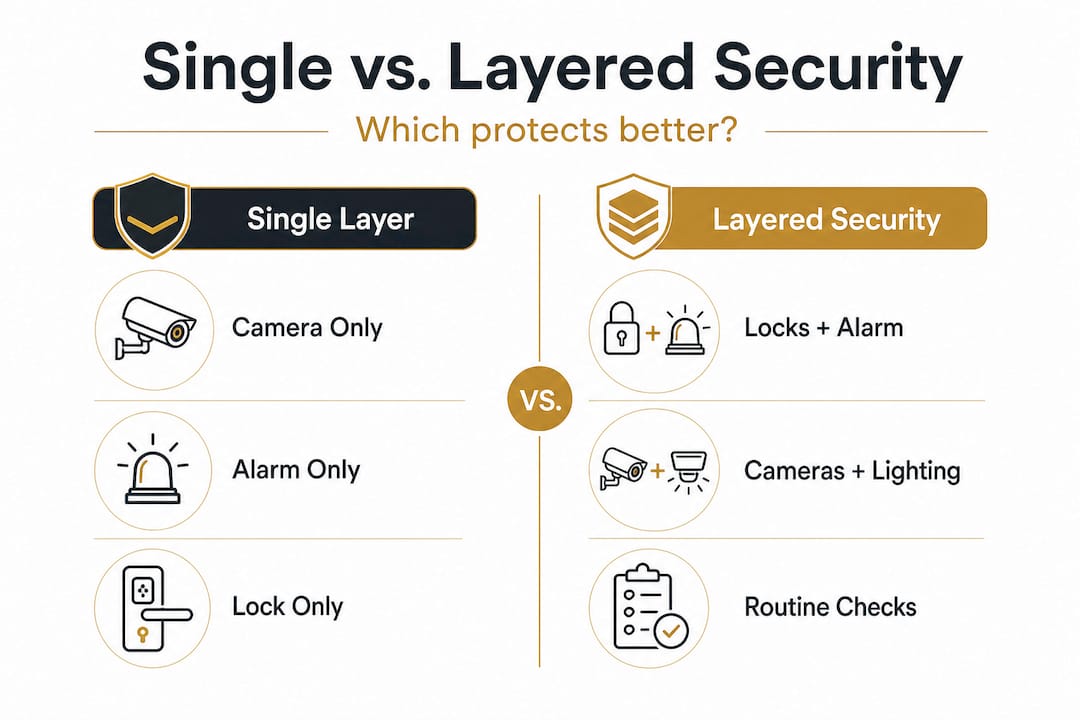
Comparing single-layer vs. layered security
| Approach | What it covers | What it misses | Effectiveness |
|---|---|---|---|
| Camera only | Visual evidence, some deterrence | No physical barrier, no alarm | Low to moderate |
| Deadbolt only | Forced entry resistance | No detection, no alert | Moderate |
| Alarm only | Detection and alert | No barrier, no deterrence before entry | Moderate |
| Layered system | Barriers, detection, deterrence, monitoring | Very little when done correctly | High |
A cameras paired with sensors approach consistently outperforms standalone technology because it creates multiple problems for an intruder to solve at once. See how CCTV protects your property as one layer within a wider system.
Here’s a practical order for building your layered protection:
- Start with physical reinforcement: doors, frames, locks, windows
- Add sensors on every accessible entry point
- Install an alarm system with professional monitoring
- Place cameras at main approach points and vulnerable areas
- Add motion-activated exterior lighting
- Post visible signage at eye level near entry points
Step-by-step: how to secure entry points
With your defenses chosen, take action with this step-by-step approach to securing real access points. This is where intentions turn into actual protection.
Front and back doors are always priority one. Install a grade-1 or grade-2 deadbolt on every exterior door. Check that the strike plate uses 3-inch screws that reach the stud behind the frame, not just the thin door casing. If your door has a glass panel within reach of the lock, replace the glass with security film or a reinforced alternative so breaking the glass doesn’t give direct access to the lock.
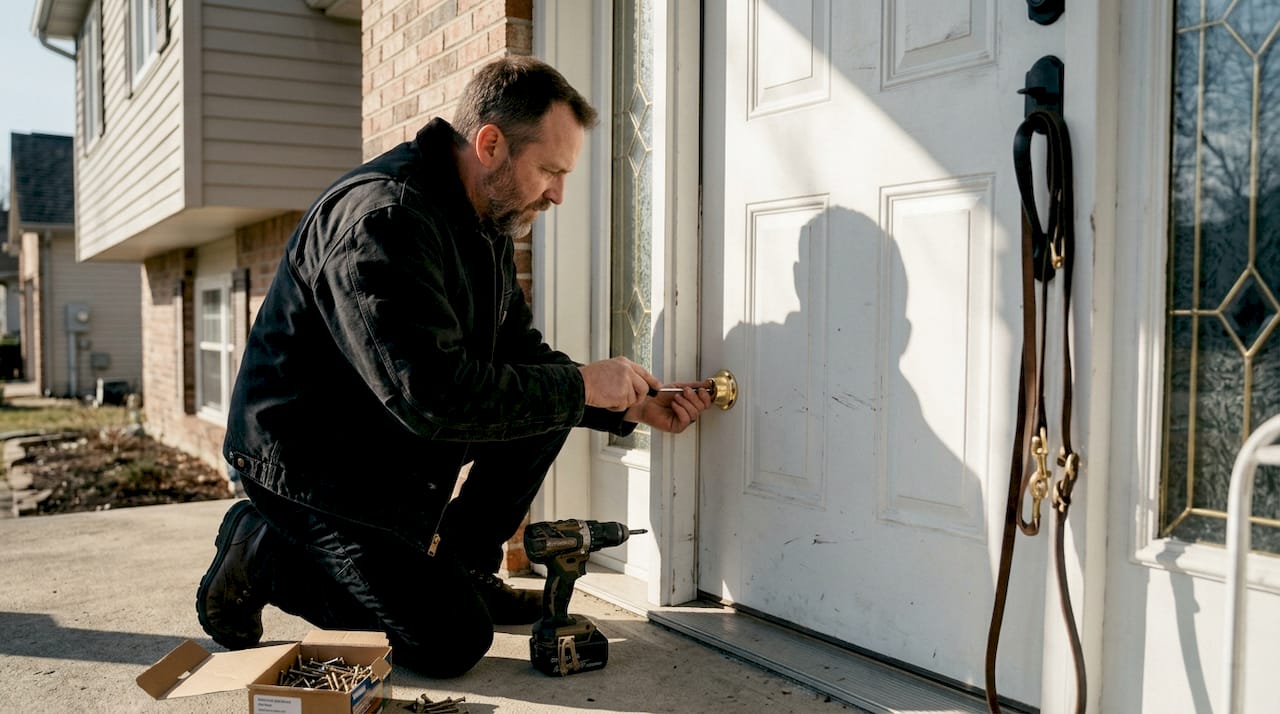
Ground-floor and basement windows need functioning locks as a baseline. Add window security film, which holds broken glass in place and dramatically slows forced entry. For windows you never open, pin locks or window security bars add another obstacle. Basement windows are often completely forgotten and left with cracked latches or broken locks. Check them all.
Garage and side doors deserve the same investment as front doors. The service door connecting your garage to your home is one of the most exploited entry points precisely because people treat it as an interior door. It isn’t. Treat it exactly like a front door.
Good exterior lighting removes hiding spots and increases the risk that a potential intruder will be seen. Install motion-activated lights at every entry point and along the paths that lead to them. Shrubs and trees that provide natural cover for someone working on a door or window should be trimmed back, especially near ground-floor entries.
Door and window sensors are the electronic layer that tells you the moment something opens that shouldn’t. Place sensors on every exterior door and every accessible window. Pair them with a monitored alarm so that even if you’re not watching your phone, someone responds.
Additional steps that make a measurable difference:
- Use a door reinforcement bar or security bar on sliding doors
- Secure sliding glass doors with a track lock or security bar in the track
- Replace exterior hinges with security hinges or add hinge bolts so doors can’t be popped from outside
- Mark high-value items with your name or a code so they’re harder to sell if stolen
Pro Tip: After any renovation, staff change, or major property update, do a full review of your entry points. Contractors leave doors propped, new staff may duplicate keys without thinking, and renovations sometimes affect window and door fits.
The full security setup workflow gives you a structured checklist to follow, while security best practices covers the ongoing maintenance side.
Visibility and routines: deterring opportunists before they try
Beyond hardware, your everyday routines and how you present your property play a big role in deterring break-ins. Most burglars are opportunists. They scan for signals that make a property look like a low-risk, high-reward target. Your routines either confirm or contradict that impression.
Keep outdoor areas well lit every night, not just on nights you remember. Timer-based and sensor-based automation removes the human error from this entirely. A well-lit property at 2 a.m. on a Tuesday sends a clear message without you lifting a finger.
When you’re away for more than a day, make the property look occupied. Timers on interior lights and even the TV, combined with paused mail and package deliveries, create the impression that someone is home. For small businesses, consistent lighting schedules and security lighting that activates after hours send the right signals without requiring constant attention.
Visible security signaling works because it shifts a burglar’s calculation before they even test a door. Alarm company stickers at eye level, camera housings in visible positions, and yard signs all add to the impression that this property is monitored. They don’t replace actual devices, but they reinforce the message your hardware is sending.
Key behavioral habits to build into your routine:
- Lock all doors and windows every night and every time you leave, no exceptions
- Pause deliveries or arrange collection when traveling
- Use light and TV timers on different schedules so patterns don’t look mechanical
- Keep high-value items out of sight from windows and doors
- For businesses: vary your close-up and open routines so schedules aren’t predictable
Automation and consistent routines reduce easy-opportunity windows, especially for small businesses where staffing is limited during off-hours.
Statistic to note: Over one-third of burglars enter through the front door. That single fact underlines why visible deterrents and strong daily habits at your most obvious entry point matter more than elaborate systems at secondary locations.
Building smart home security habits into your daily routine is where long-term security actually lives.
A realistic view: why layering and routines beat gadgets alone
Here’s what many people get wrong about break-in prevention after reading every tip and buying every product: they expect technology to replace vigilance.
The reality is that most break-ins exploit predictable habits and visible weaknesses, not sophisticated bypass techniques. A burglar isn’t hacking your smart lock. They’re checking whether you left the garage door cracked or whether that side door has a worn-out frame. They want to be in and out in under five minutes. Any complication that adds time or visibility pushes them to the next target.
Expensive single devices give people a false sense of coverage. A premium camera system with cloud storage is genuinely useful, but it doesn’t stop entry. If someone walks through your unlocked back door, your camera documents the crime rather than preventing it. The cameras paired with other layers principle isn’t just a sales pitch for more equipment. It reflects how break-ins actually work and where they actually get stopped.
What works consistently is the combination of physical resistance, electronic detection, visible deterrents, and repeatable habits. Each layer makes the job harder. Each routine closes a predictable gap. A deadbolt that a burglar can’t kick through, a sensor that triggers an alarm when they try a window, a camera that’s clearly visible, and lighting that removes cover: that combination is genuinely intimidating. One device in isolation is not.
We’ve seen homeowners and small business owners spend significant money on high-end cameras while leaving their garage service door with a basic knob lock. The camera records what happens. The lock would have stopped it. Think about your weakest point first, then layer outward.
Regular checks matter more than most people expect. Security systems degrade quietly. Sensors lose battery power. Camera angles shift. Lighting bulbs burn out. A monthly walk-through of your defenses, combined with a test of all sensors and alerts, keeps your system actually functional rather than just present. Explore our layered security perspective for a deeper look at building protection that holds up over time.
Take the next step in securing your property
Ready to move from knowledge to action? Safes and Security Direct is here to help you close every gap identified in this guide. Whether you need to reinforce your front door, set up a full camera and alarm system, or lock down high-value assets in a quality safe, we carry professional-grade solutions designed for real homes and real businesses.
Browse our complete range of security cameras, alarm systems, and safes, all paired with detailed specifications to help you choose the right fit. Our team understands that every property is different, and our product selection reflects that. From entry-level deterrents to fully layered setups, you’ll find equipment that works together rather than in isolation. Start building your custom layered defense today and stop leaving gaps that opportunists are actively looking for.
Frequently asked questions
What is the most common entry point for break-ins?
The majority of break-ins occur through front doors and ground-level entrances, making them the highest priority for reinforcement and monitoring.
Are cameras enough to stop burglaries?
Cameras deter some intruders but are far more effective when paired with locks and sensors rather than used as the only defense layer.
How does lighting prevent break-ins?
Good exterior lighting removes hiding spots and significantly increases the chance that a potential intruder will be seen, which discourages most attempts before they start.
What routines help reduce the risk of burglary?
Setting timers for lights and interior electronics, locking all entry points every time you leave, and pausing deliveries during absences make your property look occupied and well-managed, which pushes opportunists to easier targets.
Is there a single best device to prevent break-ins?
No single device is enough. A layered approach combining alarms, physical barriers, lighting, and cameras provides the strongest real-world protection for both homes and businesses.
Recommended
- How to secure property effectively: A practical guide – Safes and Security Direct
- 15 essential property security tips for homes and businesses – Safes and Security Direct
- Home security best practices: protect property in 2026 – Safes and Security Direct
- How to Improve Home Security: Proven Steps for 2026 – Safes and Security Direct