

How CCTV protects your home and business effectively
TL;DR:
- CCTV footage is available in 45% of cases and useful in 29% of investigations.
- Cameras deter property crime and reduce incidents through visible surveillance and behavioral patterns.
- Effective CCTV requires strategic placement, high resolution, proper storage, and regular monitoring.
CCTV footage is available in 45% of cases and useful in 29%, which means cameras are doing far more investigative work than most people assume. The idea that surveillance cameras are just passive recording devices collecting dust between incidents couldn’t be further from the truth. When placed strategically and monitored properly, CCTV systems actively contribute to solving crimes, reducing incidents before they escalate, and giving property owners real leverage in legal disputes. This guide walks through the actual evidence, the environments where cameras work best, and how emerging technology is making modern systems even more effective.
Table of Contents
- The evidentiary value of CCTV in crime resolution
- CCTV’s impact on property crime and deterrence
- Where CCTV works best: environment matters
- The rise of AI-enhanced CCTV: smarter security
- What most security guides miss about CCTV: real-world lessons
- Take the next step: secure your property with expert solutions
- Frequently asked questions
Key Takeaways
| Point | Details |
|---|---|
| Critical crime evidence | CCTV increases case resolution by providing valuable footage for investigations. |
| Proven crime deterrence | Property crime is reduced after CCTV installation, especially in hot spots. |
| Environment affects results | Controlled spaces like retail stores benefit most from CCTV systems. |
| AI enhances monitoring | AI-powered CCTV adds real-time analytics but works best with human oversight. |
| Layered security works best | CCTV is most effective when combined with other security strategies. |
The evidentiary value of CCTV in crime resolution
When a break-in happens at your property, the first thing investigators ask for is footage. That’s not a coincidence. Video evidence cuts through conflicting witness accounts, establishes timelines, and places suspects at the scene with a level of precision that no other form of evidence can match. Courts increasingly rely on it, insurance companies request it, and law enforcement agencies build entire case strategies around it.
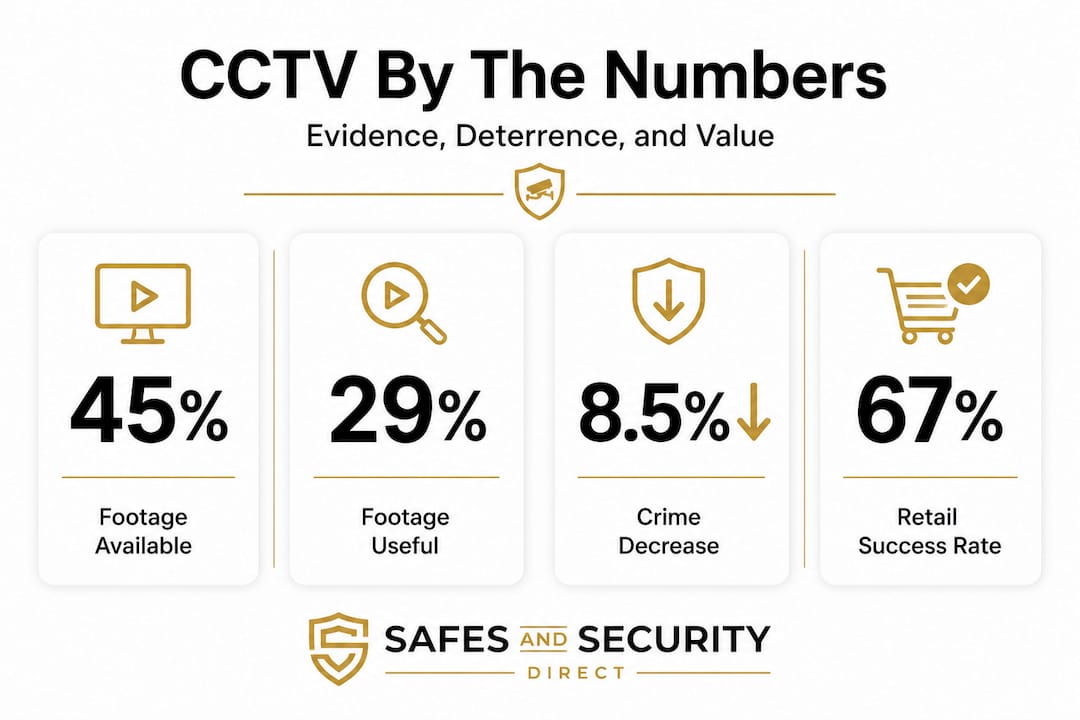
Research confirms what security professionals have long argued. CCTV footage increases solve rates across most crime categories, with footage available in 45% of investigations and proving genuinely useful in 29% of cases. Those numbers might sound modest, but in real-world policing terms, footage that directly contributes to identifying a suspect in nearly one in three cases is a significant advantage.
Here’s where CCTV evidence tends to make the biggest difference:
- Burglary and residential break-ins: Footage provides timestamps, suspect descriptions, and vehicle identifications that narrow down perpetrators quickly.
- Retail theft and shoplifting: Cameras capture repeated offenders who are often active across multiple locations, connecting crimes that might otherwise seem unrelated.
- Vandalism and property damage: Video evidence removes all ambiguity, making it nearly impossible for suspects to claim innocence.
- Assault and violent incidents: Footage documents exactly what happened, in what order, removing the “he said, she said” problem entirely.
- Parking lot incidents: Hit-and-run cases are frequently resolved because cameras captured license plates or vehicle descriptions at the time of the incident.
“Cameras are not just passive witnesses. They become active participants in the justice process when footage is properly stored, clearly recorded, and accessible to investigators.”
For homeowners, this translates directly to faster insurance claims and a stronger position if a dispute ever goes to court. For business owners, it means protecting against fraudulent slip-and-fall claims, employee theft investigations, and liability exposure. You can read more about deterring burglary with cameras and how deterring theft and protecting property works across different property types.
The practical takeaway here is straightforward. If your cameras are recording at poor resolution, storing footage for only 24 hours, or positioned in locations that only capture partial views, you’re not actually getting the evidentiary benefit that makes CCTV valuable. Image quality, storage duration, and camera placement are not optional upgrades. They’re the foundation of any system worth having.
CCTV’s impact on property crime and deterrence
The presence of cameras doesn’t just help solve crimes after the fact. It actively changes whether crimes happen at all. Offenders make decisions based on perceived risk, and visible surveillance cameras significantly raise that perceived risk at any given location.
Research on CCTV in small city hot spots found that property crime dropped by 8.5% in areas with camera coverage, while comparable areas without cameras actually saw a 13.4% increase over the same period. That’s nearly a 22-percentage-point difference between protected and unprotected locations.
| Area type | Change in property crime |
|---|---|
| CCTV-covered hot spots | -8.5% decrease |
| Control areas (no CCTV) | +13.4% increase |
| Net difference | ~22 percentage points |
This data tells a compelling story. Property crime doesn’t just stay flat without cameras. It tends to grow. Installing cameras doesn’t just hold the line, it actively pushes numbers in the right direction. For homeowners in higher-crime neighborhoods and business owners in commercial zones with foot traffic, this is the kind of measurable protection that justifies the investment immediately.
What makes this deterrence effect real is visibility. Cameras positioned where potential offenders can see them communicate a clear message: this property is monitored, and you will be recorded. That message alone is enough to redirect criminal behavior to easier targets. The benefits of CCTV for theft deterrence work through both direct surveillance and this psychological deterrence layer.
It’s also worth understanding that cameras do more than just watch. When footage is actively reviewed, patterns emerge. Repeated loitering, suspicious vehicles, and unusual activity around entry points can all be caught before an incident occurs. This shifts CCTV from a reactive tool into a proactive one, and the room surveillance benefits extend well beyond catching someone in the act.
Pro Tip: Pair your CCTV setup with motion-activated lighting and clear signage indicating the property is monitored. The combination dramatically increases deterrence because it removes the darkness that opportunistic offenders depend on and makes the surveillance explicit rather than implied.
Where CCTV works best: environment matters
Not all locations benefit equally from surveillance cameras. The type of space, how much control you have over access, the quality of lighting, and whether someone is actively watching the footage all determine how effective your system will actually be.
Research comparing CCTV effectiveness across environments found significant variation. Controlled spaces like retail stores see up to 67% effectiveness, parking facilities reach 51%, while open public spaces like parks and streets see considerably lower impact.
| Environment | Effectiveness rate | Key contributing factor |
|---|---|---|
| Retail stores | Up to 67% | Controlled access, active staff monitoring |
| Parking lots | 51% | Limited entry/exit points, good sightlines |
| Public streets | Lower | Open access, inconsistent lighting |
| Public parks | Lower | Wide open areas, poor coverage angles |
The reason controlled environments outperform open public spaces comes down to two factors: access control and active monitoring. In a retail store, every customer enters through a limited number of points, staff are present and alert, and the space is designed around visibility. In a public park, cameras face wide open areas with multiple entry and exit points, inconsistent lighting, and usually no one actively watching the feed.
For homeowners, this means thinking carefully about which parts of your property are most vulnerable and how controllable those areas are. Driveways and entryways have natural choke points. Side yards and rear areas are more open and need cameras with wider angles or overlapping coverage. For businesses, optimizing security with CCTV placement requires a systematic look at every access point, blind spot, and high-value area.
Key factors that determine how effective your cameras will be:
- Lighting quality: Cameras in poorly lit areas capture grainy, unusable footage. IR (infrared) cameras or motion-activated lights solve this problem directly.
- Camera resolution: Higher resolution means you can actually identify faces and license plates. Low-resolution footage often isn’t useful to investigators.
- Active monitoring: Cameras that no one watches only provide post-incident value. Live monitoring or alert-triggered review dramatically increases prevention.
- Coverage overlap: Blind spots are exploitable. Strategic setups ensure there’s no gap a determined intruder can exploit.
A strategic camera setup plans for all these variables rather than just mounting cameras at obvious points and hoping for the best.
The rise of AI-enhanced CCTV: smarter security
Traditional CCTV systems record everything and rely on humans to review footage after an incident. AI-enhanced systems change that model entirely, turning cameras into intelligent sensors that can identify, categorize, and respond to what they’re seeing in real time.
AI-powered surveillance systems bring capabilities that were exclusive to large enterprise security operations just a few years ago. Today, these features are increasingly accessible for residential and small business use. Here’s what modern AI-enhanced CCTV can actually do:
- Real-time motion analytics: Instead of recording all motion, the system distinguishes between a person, a vehicle, an animal, and wind-blown foliage. This reduces false alerts dramatically.
- Facial recognition: The system can flag unknown individuals and alert you when someone who has been flagged appears on camera again, useful for repeat offenders or banned individuals.
- License plate recognition (LPR): Vehicles entering and exiting your property are logged automatically, with alerts triggered for specific plates.
- Behavioral analysis: AI can detect loitering, perimeter breaches, or unusual crowd behavior and send immediate alerts before a situation escalates.
- Object detection: Abandoned bags, removed equipment, or unauthorized vehicles can trigger alerts without any human actively watching the feed.
AI-enhanced systems are effective 75 to 85% of the time in outdoor environments, which represents a significant improvement over passive recording. However, they’re not without limitations. Low-light conditions reduce accuracy, partially obscured individuals can confuse recognition systems, and ambiguous situations, where behavior looks suspicious but isn’t necessarily criminal, still require human judgment. This is why AI-enhanced CCTV still requires human oversight to interpret context that automated systems misread.
When choosing the best camera type for your property, it’s worth understanding what level of intelligence you actually need. Not every property requires facial recognition. A well-placed camera with motion detection and reliable storage already addresses the majority of residential security needs. For businesses with higher foot traffic, more sensitive inventory, or specific access control requirements, AI-enhanced systems justify their additional cost.
Pro Tip: If full AI integration isn’t in your budget yet, look into subscription-free CCTV systems that offer smart alerts and local storage. You get a meaningful upgrade over basic cameras without ongoing monthly fees eating into your security budget.
What most security guides miss about CCTV: real-world lessons
Here’s something that rarely gets said clearly: putting cameras up isn’t the same as having security. It’s a common mistake, and it leaves a lot of property owners with a false sense of protection that doesn’t survive contact with a real incident.
We’ve seen setups where cameras are installed at the right entry points, but the footage is stored for only 48 hours, so by the time someone reports a theft that happened over the weekend, the evidence is already gone. We’ve seen businesses with four cameras covering two overlapping angles and two blind spots large enough to drive a truck through. We’ve seen homeowners who haven’t checked whether their cameras are still functioning in months, only to find dead units after a break-in.
The uncomfortable truth about CCTV is that the hardware is the easy part. The discipline is harder. That means regularly checking that cameras are operational, that storage is functioning, that lighting hasn’t changed in a way that now shadows a critical angle, and that someone is actually reviewing footage when alerts fire. A camera that nobody checks is not a security asset. It’s an expensive placebo.
Another lesson worth absorbing: CCTV works best as part of a layered approach. Cameras catch what happens. Locks, alarms, and physical barriers slow down or prevent it. Lighting and signage deter it. Monitoring and response protocols deal with it in real time. Any property that relies entirely on cameras without these other layers has a critical gap. Reading through DIY security tips is a good starting point for understanding how these layers fit together.
The most secure properties we encounter aren’t the ones with the most cameras. They’re the ones where every camera serves a clear purpose, footage is reviewed regularly, and the overall system has been thought through rather than assembled piece by piece. That’s the standard worth aiming for, whether you’re protecting a home or a commercial property.
Take the next step: secure your property with expert solutions
Understanding how CCTV works in theory is one thing. Getting the right system in place for your specific property is where the real difference gets made. Placement decisions, resolution requirements, storage capacity, and whether AI features are worth it for your situation all depend on variables that are unique to your property and your risk profile.
At Safes and Security Direct, we’ve helped homeowners and business owners navigate exactly these decisions. Our range of professional-grade cameras, complete surveillance systems, and physical security products is built around real-world performance, not just spec-sheet numbers. Whether you’re starting from scratch or upgrading an existing setup, securing your property starts with having the right equipment backed by the right guidance. Browse our full selection and find the solution that fits your property, your budget, and your security goals.
Frequently asked questions
How much does CCTV reduce crime in residential areas?
Research shows CCTV can reduce property crime by 8.5% in specific hot spots, compared to a 13.4% increase in areas without cameras over the same period.
Can AI-powered CCTV systems completely replace human monitoring?
AI systems handle routine detection and alerts effectively, but human oversight remains essential for interpreting ambiguous situations, managing low-light conditions, and making judgment calls that automated systems aren’t equipped to handle.
What types of environments benefit most from CCTV installations?
Controlled environments deliver the highest returns, with retail stores reaching up to 67% effectiveness and parking lots hitting around 51%, largely because limited access points make monitoring more manageable and precise.
Is CCTV footage always useful in investigating crimes?
Not always, but more often than people assume. Footage is available in 45% of cases and proves genuinely useful in resolving around 29%, making it one of the most consistently valuable investigative tools available to law enforcement.
Recommended
- Optimize Business Security with CCTV Installation – Safes and Security Direct
- How security cameras deter theft and protect your property – Safes and Security Direct
- Secure Your Home with Satellite Security Camera Systems – Safes and Security Direct
- How to Secure Commercial Premises for Maximum Protection – Safes and Security Direct