

The homeowner's guide to safe certifications explained
TL;DR:
- Safe certifications from UL and ETL provide verified standards for fire and burglary resistance.
- Proper safe installation and placement are crucial to ensure certification performance safeguards valuables.
- Matching safe ratings to your specific assets and risks is essential for effective security.
Walk into any hardware store or browse online, and you’ll find dozens of safes claiming to protect your valuables. But here’s what most product descriptions won’t tell you: without a legitimate certification, a safe is little more than a metal box. Studies show that certified safes protect contents as rated in real fires, while uncertified models can fail completely within minutes. Choosing the wrong safe doesn’t just mean a financial loss. It can mean losing irreplaceable documents, heirlooms, or business records. This guide walks you through what safe certifications actually mean, how to read the labels, and how to match the right rating to what you’re protecting.
Table of Contents
- Why safe certifications matter: Separating myth from reality
- Behind the label: UL vs. ETL and how testing works
- Decoding ratings: Burglary and fire resistance explained
- How to choose the right certified safe for your home or business
- What most experts miss about safe certifications
- Need help securing your valuables? We’ve got you covered.
- Frequently asked questions
Key Takeaways
| Point | Details |
|---|---|
| Certification is crucial | Only certified safes offer proven protection against theft and fire. |
| UL and ETL matter | These two certifications guarantee independent, standardized testing for safes. |
| Ratings guide buying | Match safe ratings to your security and fire protection needs to avoid overpaying. |
| Install and document | Proper installation and keeping records of certification enhance your valuables’ protection. |
Why safe certifications matter: Separating myth from reality
A safe certification is an official confirmation from an independent testing laboratory that a product has been evaluated and meets a defined security standard. It’s not a manufacturer’s claim. It’s a verified result. That distinction matters enormously when you’re counting on your safe to survive a break-in or a house fire.
Here’s a surprising reality: a large portion of safes sold online carry no meaningful certification at all. They may look sturdy and use phrases like “heavy-duty steel” or “fireproof,” but without independent verification, those terms are marketing language. You have no way of knowing how long the safe would hold up under heat, drilling, or prying.
“A certified 1-hour safe rated at 1,700°F is engineered to keep paper documents intact during a real house fire, which typically burns between 1,100°F and 1,200°F.” Understanding fireproof safes’ real protection gives you the context to evaluate that claim accurately.
Here are the major reasons why certification should be your baseline, non-negotiable requirement:
- Independent verification: A third-party lab tests the safe, not the manufacturer. That removes bias from the equation.
- Standardized conditions: Testing follows strict protocols, so you can compare two certified safes on equal terms.
- Proven performance thresholds: Ratings tell you exactly how long and at what temperature or attack method the safe is rated to resist.
- Insurance recognition: Many home and business insurance policies require certified safes for claims involving theft or fire to be honored.
- Legal compliance: Certain industries, like firearms retail or pharmacy, legally require certified storage solutions.
The bottom line is that certification closes the gap between a manufacturer’s promise and real-world performance.
Pro Tip: Before purchasing any safe, ask the seller for the full certification documentation, including the lab name, the specific standard tested, and the rating achieved. If they can’t provide it, walk away.
Behind the label: UL vs. ETL and how testing works
In the United States, two names dominate safe certifications: UL (Underwriters Laboratories) and ETL (Intertek). Both are Nationally Recognized Testing Laboratories, or NRTLs, which means they are officially recognized by OSHA to test and certify products to American safety standards. This recognition is what separates them from countless labs that issue certificates with no regulatory backing.
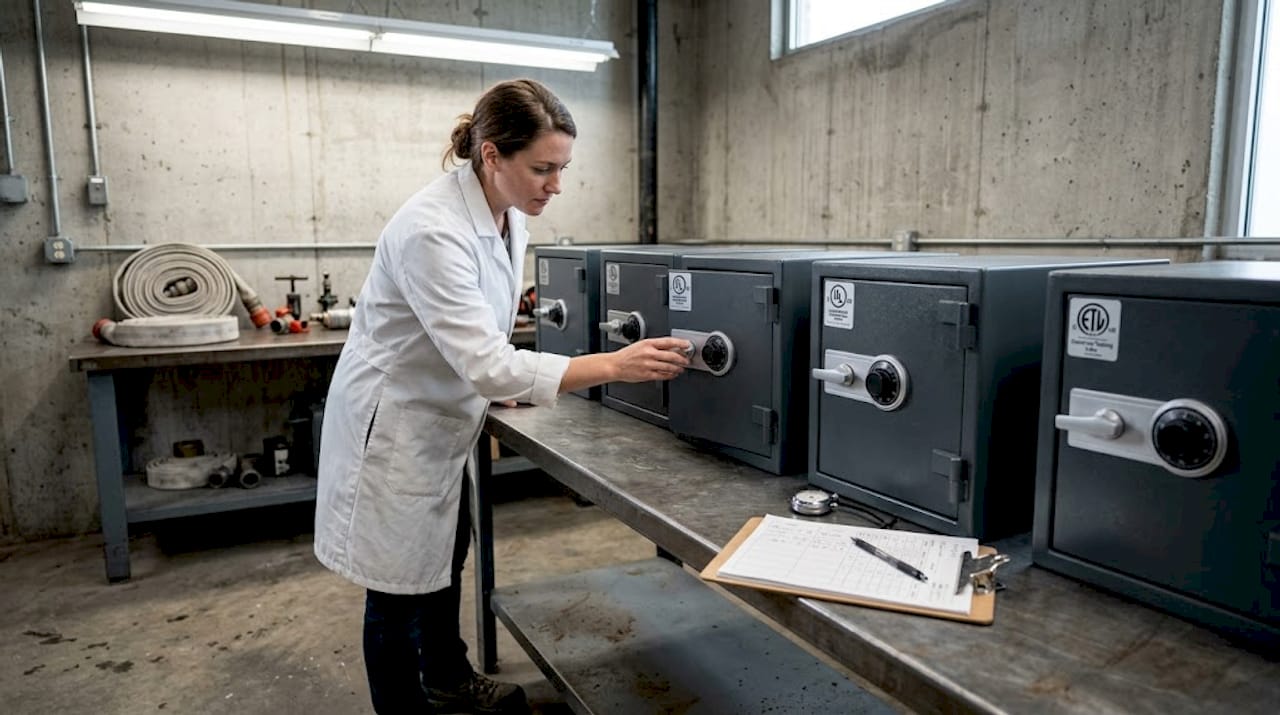
UL and ETL are primary certifications for safes, ensuring rigorous independent testing that manufacturers cannot influence or shortcut. UL has historically been the standard-setter, developing the actual testing protocols that define what a “TL-30” or “1-hour fire rating” means. ETL, operated by Intertek, tests products to those same UL-developed standards. Both marks carry equal legal weight with insurers and regulators.
Here’s a side-by-side comparison:
| Feature | UL (Underwriters Laboratories) | ETL (Intertek) |
|---|---|---|
| Role | Standards development + testing | Testing to existing standards |
| Recognition | OSHA-recognized NRTL | OSHA-recognized NRTL |
| Acceptance | Widely recognized globally | Widely recognized in North America |
| Coverage | Burglary, fire, data protection | Burglary, fire, general safety |
| Cost to manufacturers | Higher | Often lower |
When you’re evaluating a safe in person or online, knowing what to look for on the certification plate makes all the difference. Check for these specifics:
- The certifying lab name: UL or ETL, not an unknown or unrecognized body
- The specific standard number: For example, UL 687 for burglary or UL 72 for fire resistance
- The exact rating achieved: TL-15, TL-30, 1 Hour at 1,700°F, etc.
- The classification mark: A physical stamp or embossed plate on the safe itself, not just a sticker
- Date or version of the standard: Older standards may not reflect current threats
Using a safe selection guide that filters by verified certifications helps you narrow down options before you ever read a product page.
Decoding ratings: Burglary and fire resistance explained
Once you know who certifies a safe, you need to understand what the ratings on the label actually mean. Safe ratings fall into two main categories: burglary resistance and fire resistance. Each uses its own scale and terminology.
Burglary resistance ratings measure how long a safe can resist a skilled attack using specific tools. Here are the most common:
- B-rate: Basic construction, no formal burglary test. Minimal protection.
- C-rate: Slightly heavier steel, still no rigorous burglary test. Entry-level.
- TL-15: Resists a tool attack for 15 minutes using drills, grinders, and other hand tools.
- TL-30: Resists a tool attack for 30 minutes under the same conditions.
- TL-30x6: Resists attack on all six sides for 30 minutes. Strongest common commercial rating.
Fire resistance ratings measure how long the interior of a safe stays below a critical temperature when exposed to extreme external heat. Paper ignites at around 451°F, so most fire-rated safes aim to keep interior temperatures below that threshold. A common label reads “1 Hour / 1,700°F,” meaning the safe was tested for one hour with an external temperature of 1,700°F.
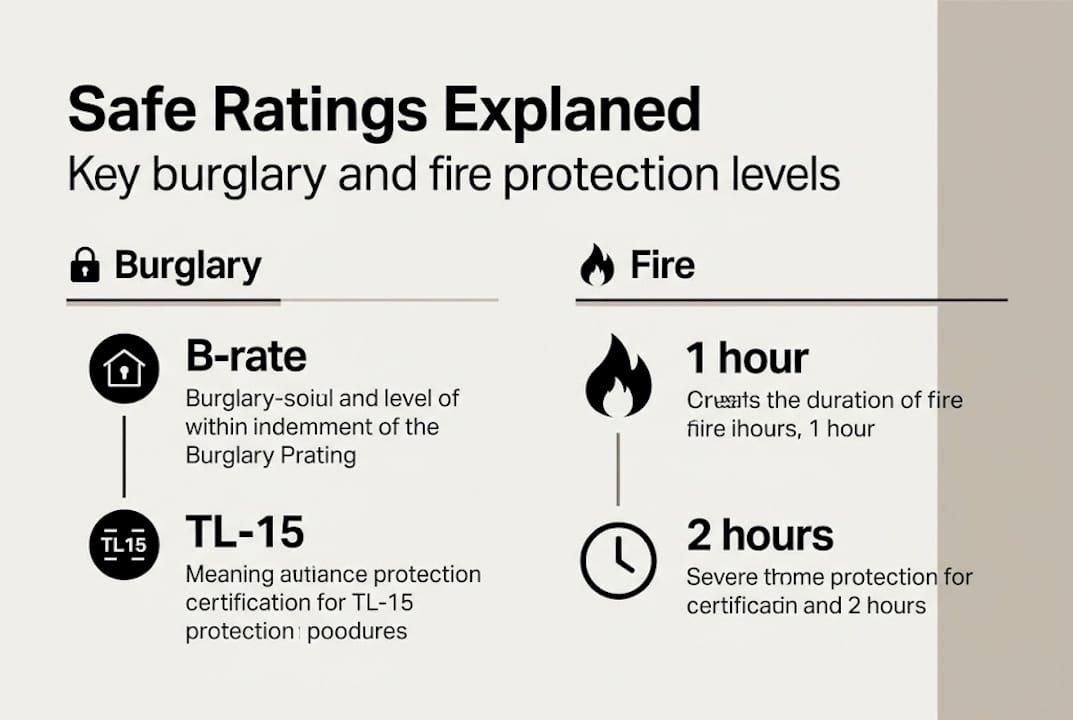
Here’s a quick reference table:
| Rating | Type | What it means | Best for |
|---|---|---|---|
| B-rate | Burglary | No formal test, basic steel | Low-value storage |
| TL-15 | Burglary | 15-min tool attack resistance | Home cash/jewelry |
| TL-30 | Burglary | 30-min tool attack resistance | Business assets |
| 30 min / 1,200°F | Fire | 30-min fire exposure | Basic documents |
| 1 hr / 1,700°F | Fire | 1-hour fire exposure | Important documents |
| 2 hr / 1,850°F | Fire | 2-hour fire exposure | Legal/business records |
Certified safes protect contents if used within their rated conditions, which means you need to match the rating to what you’re actually storing. Keeping fireproof home safe ratings in mind as you shop prevents both overspending and under-protecting.
Pro Tip: If you’re storing digital media like USB drives or hard drives, paper fire ratings are not enough. Digital media fails at much lower temperatures, around 125°F, so look for safes with a separate “media” or “data” rating.
How to choose the right certified safe for your home or business
Selecting the right certified safe is less about finding the most expensive model and more about matching the product to your actual risk profile. Here’s a clear process to follow:
- List exactly what you’re protecting: Cash, jewelry, firearms, paper documents, digital media, or legal contracts each have different vulnerabilities and require different ratings.
- Identify your primary risk: Is theft more likely in your neighborhood, or are you in a fire-prone area? Many buyers need protection from both.
- Choose your location: A floor safe provides different benefits than a wall safe or a freestanding unit. The location also affects anchoring options.
- Match ratings to risk: Use the rating table above to align what you’re storing with the right burglary and fire resistance levels.
- Verify the certification: Look for UL or ETL marks on the physical safe, not just in the product listing. Cross-check by searching the lab’s official registry online.
- Check dimensions and capacity: A safe that’s too small encourages poor habits like leaving valuables unsecured.
UL and ETL tested safes have reliable performance for both fire and burglary risks, which is why they’re the industry benchmark. For businesses with more complex needs, exploring safe types for business gives you a clearer view of commercial-grade options. If theft is your primary concern, burglary-resistant safes designed for urban environments are worth your attention. And if fire is the bigger worry, the buying guide for fire resistant safes covers the full spectrum of what’s available in the U.S. market.
Pro Tip: Photograph your safe’s certification plate and store the image digitally. If you ever file an insurance claim, having that documentation ready can speed up the process significantly.
What most experts miss about safe certifications
Here’s an uncomfortable truth that most buying guides skip entirely: a certified safe that’s installed poorly is nearly as vulnerable as one with no certification at all. We’ve seen homeowners buy a well-rated TL-30 safe, place it on a closet shelf without anchoring it, and lose everything when a burglar simply carried it out. The rating tested a bolted, stationary unit. An unanchored safe in a soft location defeats the purpose.
Similarly, understanding fire-resistant safes means recognizing that placement matters. A fire-rated safe stored in a basement can end up submerged in water from firefighting efforts, which is why water resistance ratings deserve attention alongside fire ratings.
Watch out for these common pitfalls:
- Assuming all certifications are equal: An unknown lab’s “certification” carries no enforceable standard.
- Relying only on the label: The label reflects what was tested. Your actual usage conditions must match.
- Skipping maintenance: Locks, seals, and hinges degrade over time. A safe that passed testing in 2015 may not perform the same in 2026 without upkeep.
- Ignoring upgrades: If your valuable assets grow significantly, your original safe rating may no longer be appropriate.
Certification gives you the foundation. What you do with the safe after you buy it determines whether that foundation holds.
Need help securing your valuables? We’ve got you covered.
Choosing the right safe doesn’t have to feel overwhelming. At Safes and Security Direct, we specialize in helping homeowners and business owners find certified, proven solutions that actually match their security needs.
Our catalog includes a wide range of UL and ETL certified safes covering everything from basic home document storage to commercial-grade burglary-resistant units. If you’re not sure where to start, our fireproof safe selection resource breaks down the options by use case, rating, and budget. We also offer guidance for business owners who need solutions that meet industry-specific compliance requirements. Reach out to our team directly for personalized recommendations.
Frequently asked questions
What are the most recognized safe certifications in the U.S.?
UL and ETL are primary certifications for safes in the U.S., both recognized by OSHA as Nationally Recognized Testing Laboratories that conduct rigorous, standardized burglary and fire resistance testing.
Do certified safes really protect valuables in a real fire?
Yes, certified safes protect contents as rated during actual house fires, keeping paper documents intact when the safe’s fire rating exceeds the fire’s internal temperature. Always match the rating to what you’re storing.
Are all safe certifications equally reliable?
No. Only certifications from UL and ETL trusted NRTLs guarantee standardized, enforceable testing protocols. Certifications from unrecognized labs carry no verifiable standard and should not be trusted.
Can I trust a safe if it says ‘fireproof’ but has no certification?
No. Without verification by a recognized lab like UL or ETL, “fireproof” is an unsubstantiated marketing claim with no proven performance data behind it.
Recommended
- Defining Home Security Standards for Real Protection – Safes and Security Direct
- Home security terminology explained: a clear guide – Safes and Security Direct
- What is secure storage: homeowner and business guide 2026 – Safes and Security Direct
- What is home security? A 2026 homeowner’s guide – Safes and Security Direct
- Fire safety certification guide for Texas managers 2026