

Advantages of electronic locks for home and business
TL;DR:
- Electronic locks offer enhanced security through real-time access logs, instant credential revocation, and remote control capabilities. They reduce costs related to rekeying, improve operational efficiency, and integrate seamlessly with smart home systems, transforming traditional access management. Despite some hesitation due to past experiences or interoperability concerns, adopting certified electronic locks provides significant safety and convenience benefits for homeowners and small businesses.
Most people assume a heavy-duty deadbolt is the gold standard of door security. It looks solid, it feels permanent, and it has worked for decades. But that confidence is misplaced. The real advantages of electronic locks go well beyond what a traditional key-and-cylinder setup can offer: real-time access logs, instant credential changes, remote control, and the complete elimination of key-related vulnerabilities. Whether you own a rental property, a retail shop, or a family home, understanding what electronic locks actually deliver can change how you think about protecting what matters most.
Table of Contents
- Why electronic locks are reshaping home and small business security
- Key advantages of electronic locks over traditional mechanical locks
- Cost savings and operational efficiencies with electronic locks
- Practical features and considerations for choosing electronic locks
- Applying electronic locks in your home or small business: practical tips
- Why many still hesitate to adopt electronic locks — and what that means for you
- Secure your property with reliable electronic locks today
- Frequently asked questions
Key Takeaways
| Point | Details |
|---|---|
| Growing market adoption | Electronic locks dominate the residential market with 71% share due to their convenience and integration benefits. |
| Security and control | They enhance security by eliminating physical keys, providing audit trails, and enabling instant access changes. |
| Cost savings | Electronic locks reduce costly rekeying and administrative labor, improving operational efficiency. |
| Durability and certification | ANSI/BHMA Grade 3 locks withstand extensive use and physical attacks, ensuring reliable protection. |
| Practical management tips | Using temporary codes and managing batteries proactively maximizes security and convenience benefits. |
Why electronic locks are reshaping home and small business security
The shift away from mechanical locks is not a trend driven by novelty. It is being driven by real problems that traditional locks cannot solve. Lost keys, unauthorized copies, and the inability to track who entered your property are daily risks that homeowners and small business owners quietly accept. Electronic locks solve all three.
The market numbers back this up. The smart locks market is growing at a 10.5% CAGR, expanding from $3.1 billion in 2026 to an estimated $8.4 billion by 2036. That is not a niche product category quietly growing in the background. That is a fundamental shift in how people think about access control. And residential use dominates, accounting for 71% of current smart lock market share, because homeowners want exactly what electronic locks offer: keyless access and activity logs.
Small businesses are catching up fast. A retail store, an office suite, or a rental unit all share the same access control problem: people come and go, credentials need to change, and you rarely have time to call a locksmith. Electronic locks solve that operationally, not just technologically.
Here is what is driving adoption across both segments:
- No physical key management means no lost keys, no copies made without your knowledge, and no lock changes after staff turnover
- Activity logging gives you a timestamped record of every entry and exit
- Remote access control lets you unlock for a delivery or lock up after hours from your phone
- Smart home integration connects your lock to cameras, alarms, and lighting for a coordinated smart home security setup that works as a system, not a collection of individual gadgets
- Scalability allows small businesses to add multiple entry points without proportionally increasing management complexity
Now that we understand their rising popularity, let’s explore exactly what advantages electronic locks offer over traditional ones.
Key advantages of electronic locks over traditional mechanical locks
The pros of digital locks are not just about convenience. The security benefits are concrete and measurable. Electronic locks reduce risk by eliminating the vulnerabilities that come with physical keys, including unauthorized copies and the time gap between someone losing a key and a lock being changed.
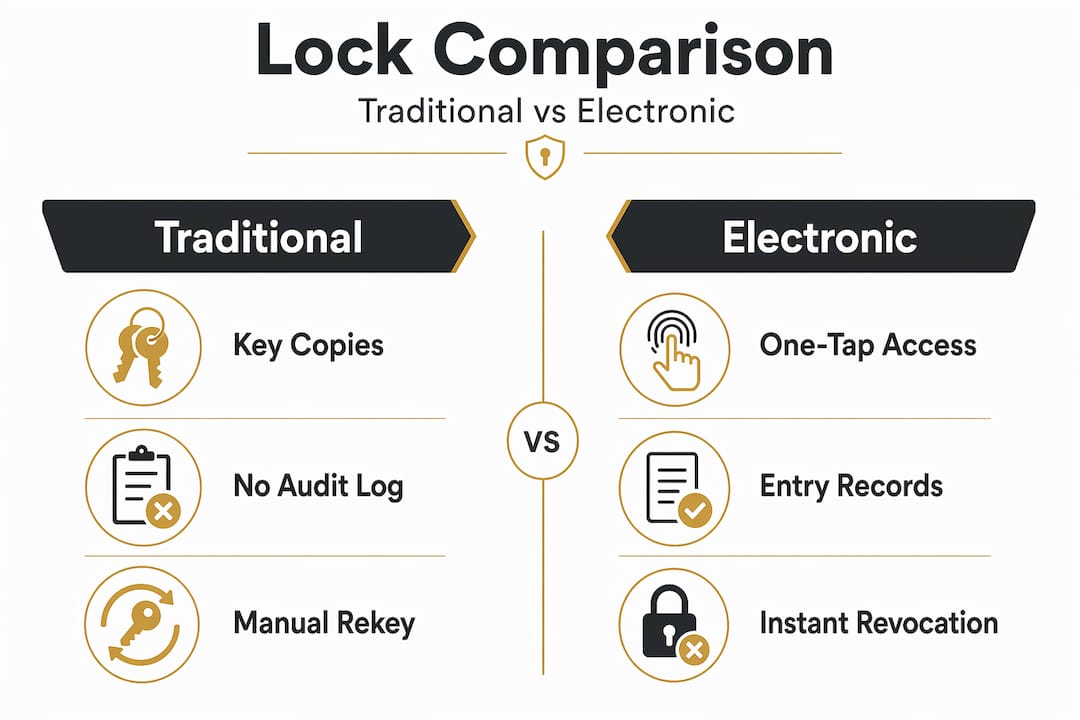
Access logs and accountability are among the most undervalued electronic lock security features. Every entry is timestamped. If a question arises about who accessed your office storeroom at 11 PM on a Tuesday, you have an answer. Traditional locks give you nothing. A full audit trail with remote locking, unlocking, and auto-lock functionality is simply not possible with a mechanical system.
Instant permission revocation is another critical security advantage. With a traditional lock, if an employee leaves your business, you either trust them not to use their key or you pay to rekey the lock. With an electronic lock, you remove their credential in seconds from any device. This is especially important for businesses with high staff turnover or rental properties between tenants.
Physical durability is a common concern, and it should be addressed directly. Are electronic locks safe from a physical standpoint? Yes. ANSI/BHMA Grade 3 locks withstand 100,000 open and close cycles and resist forced entry at 150 lbf, which is appropriate for residential use. Grade 1 commercial-rated locks exceed this significantly. The hardware itself is not a weak point.
Here is a direct comparison of what you get with each system:
| Feature | Traditional lock | Electronic lock |
|---|---|---|
| Key duplication risk | High | None |
| Access log | None | Full timestamp history |
| Remote locking | Not possible | Standard feature |
| Credential revocation | Requires locksmith | Instant, digital |
| Auto-lock | Not available | Programmable |
| Multi-user access | Limited by keys | Unlimited, manageable |
| Integration with alarms | None | Yes, via smart systems |
The security benefits of smart locks become even more apparent when you pair them with cameras or battery-powered alarm systems, creating a property-wide response layer rather than a single point of defense.
Pro Tip: If you are evaluating electronic locks for a small business, prioritize models that let you assign individual PIN codes or credentials to each employee rather than one shared code. Individual credentials make audit trails actionable, not just decorative.
Having outlined what makes electronic locks superior, let’s examine specific financial and operational impacts for property owners.
Cost savings and operational efficiencies with electronic locks
The financial case for electronic locks is often stronger than people expect, especially for anyone managing multiple units or employees.
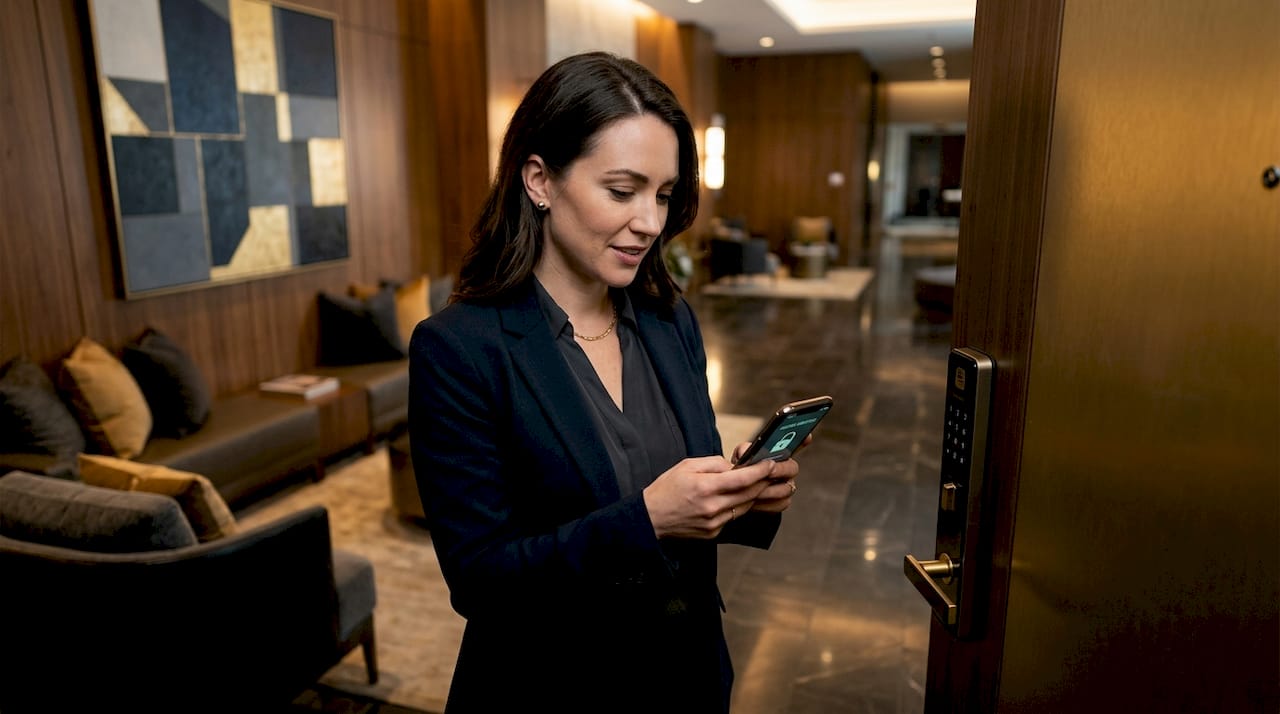
Consider a 200-unit apartment complex with 25% annual tenant turnover. Under a traditional lock model, each turnover requires a locksmith visit to rekey the lock. That adds up to $7,500 in annual rekeying costs that disappear entirely when you switch to electronic access control. The digital credential change takes minutes and costs nothing per unit.
The labor savings go further than rekeying. Administrative access management labor drops by 60 to 80% when teams manage credentials through a cloud platform rather than coordinating physical key handoffs, tracking who has which copy, and scheduling locksmith appointments. For a small business owner who handles security personally, that time reclaimed has real value.
Here is a breakdown of where the savings accumulate:
- Rekeying elimination saves $30 to $75 per lock per turnover event
- Administrative labor reduction saves staff hours previously spent on key management logistics
- Faster tenant or employee onboarding reduces the window where access is unsecured or delayed
- Insurance considerations since some insurers offer premium reductions for properties with certified access control systems
- Integration with surveillance reduces incident investigation time, which has its own indirect cost savings
“Smart access control doesn’t just replace locks. It replaces a process. And that process was costing you money, time, and gaps in your security coverage you probably weren’t tracking.” — Security operations perspective
Pro Tip: Use your access control setup guide to map every access point before purchasing locks. Properties often discover entry points they have been managing inefficiently — side doors, utility rooms, or loading areas that are either unsecured or over-secured with inconvenient lock-and-key setups.
Check the electronic lock cost breakdown before you buy to understand the true total cost of ownership versus what you are already spending on key management each year.
Beyond cost, it is important to consider the practical features and nuances of electronic locks to make an informed choice.
Practical features and considerations for choosing electronic locks
Knowing the best features of electronic locks is one thing. Choosing the right product for your situation requires understanding a few specific technical details that most buyers overlook.
Certification matters more than price. Look for ANSI/BHMA Grade 3 certification as a minimum for residential use. This certification confirms the lock withstands 100,000 operational cycles and resists forced entry, which is the standard that gives you genuine security, not just keyless convenience. Grade 1 is the commercial standard and appropriate for high-traffic business entrances.
Battery performance in cold climates is a real issue. A lock that lasts 3 years on batteries in California may need replacement every 6 months in a cold climate. Premium alkaline batteries outperform standard ones significantly in this context. If you are installing electronic locks on exterior doors in a cold region, build battery replacement into your maintenance schedule and use the lock’s low-battery alert rather than waiting until it fails.
Temporary access codes are one of the most useful and underused features. You can issue a code that expires after a contractor’s visit, a guest’s stay, or a scheduled maintenance window. The code works when needed and stops working automatically. No chasing people for keys. No worrying about whether they copied the code somewhere.
Key features to prioritize when selecting a lock:
- Auto-expiring temporary codes for guests, contractors, and service visits
- Multi-factor authentication options such as PIN plus fingerprint for higher-security areas
- Smart home ecosystem compatibility so your lock works with your existing hub or voice assistant
- Cloud management access for remote control and log review
- Physical override option such as a backup key cylinder, for emergencies
- Low-battery notification via app or audible alert before lockout occurs
Pro Tip: Before purchasing, verify which smart home protocols the lock supports. Locks using the Matter protocol work across most major ecosystems including Amazon Alexa, Google Home, and Apple HomeKit, which protects your investment if you switch platforms later.
These security solutions for homeowners pair well with electronic locks when you want layered protection. Also review home security best practices to make sure your lock choice fits into a broader security plan rather than standing alone.
With these practical insights, let’s look at how you can apply electronic lock technology to your property for best results.
Applying electronic locks in your home or small business: practical tips
Installing an electronic lock is straightforward. Getting the most out of it requires a bit of planning upfront.
- Map your entry points first. Identify every door that needs access control, including side entrances and interior high-value areas, not just the front door. Many security gaps exist at secondary entry points.
- Assign individual credentials. Give each person their own PIN or digital credential. Shared codes are convenient but untrackable. Individual codes give you a usable audit trail.
- Use temporary codes for short-term access. Temporary codes that auto-expire avoid up to 22% of rekeying costs in rental properties by eliminating the need to recover keys or rekey after short-term stays or contractor visits.
- Connect to your broader ecosystem. Integrate your lock with cameras and alarms so that a forced entry attempt triggers a camera recording and alert simultaneously, not just a lock resistance test.
- Schedule maintenance proactively. Replace batteries on a fixed schedule, not when the alert fires. Review firmware update availability every 3 to 6 months to keep the lock’s software current and patched.
- Review your access logs regularly. Monthly log reviews reveal patterns, including failed entry attempts, unusual access times, and credentials that are no longer in use.
For rental property owners specifically, the combination of temporary codes and instant revocation addresses the two biggest security vulnerabilities in tenant turnover: the gap between a tenant leaving and the lock being changed, and the risk that a former tenant retained a key copy.
Pairing electronic locks with the right physical deterrents also matters. Read the guide on preventing break-ins and review key security features for every entry point on your property.
Pro Tip: When onboarding new employees or tenants, create their access credential before they arrive, then activate it on their start date. This eliminates the awkward physical handoff and gives you a clean credential record from day one.
Now that you know how to implement electronic locks effectively, here is a unique perspective on their role and adoption challenges.
Why many still hesitate to adopt electronic locks — and what that means for you
Here is the honest truth: most hesitation around electronic locks comes from bad experiences with early-generation products, not from any fundamental flaw in the technology.
The real adoption barriers are interoperability issues, battery life anxiety, and a vague concern that anything digital can be hacked. These are legitimate concerns with specific, solvable answers. Interoperability is improving rapidly with Matter protocol standardization. Battery life is manageable with the right battery type and a maintenance routine. And while no security system is hack-proof, the practical risk profile of a well-configured electronic lock is lower than a traditional lock that can be bumped, picked, or bypassed with a copied key.
What we find consistently is that people who delay the switch do so because they are comparing a theoretical worst case for electronic locks against an idealized version of their existing mechanical lock. They forget that their current lock has had the same key in circulation for three years, that at least two people have a copy they cannot account for, and that there is no record of who entered last Thursday.
The hesitation also reflects a trust gap with technology. That gap closes quickly once people see their first audit log, use their first temporary code, or lock their door from an airport terminal. The skepticism is understandable, but it should not delay a decision that pays for itself within the first year for most rental property owners and within months for many small businesses.
If you are weighing the investment in high security versus the status quo, the honest comparison is not electronic locks versus a perfect traditional system. It is electronic locks versus the actual vulnerabilities you are living with right now.
Early adopters who choose certified products, pair them with compatible ecosystems, and treat maintenance as a routine rather than an afterthought are going to be significantly better positioned as this technology continues to mature and costs continue to fall.
Secure your property with reliable electronic locks today
If this article has made one thing clear, it is that the advantages of keyless systems go well beyond convenience. They represent a measurable upgrade in security, accountability, and operational efficiency for homeowners and small business owners alike.
At Safes and Security Direct, we carry a curated range of electronic locks suited for residential and commercial applications, selected for certified durability, smart home compatibility, and real-world reliability. Our team can help you match the right lock to your specific entry points, access needs, and budget. Whether you are upgrading a single front door or securing an entire business location, we offer the products and guidance to get it right the first time. Browse our range, compare specifications, and take control of your property’s security today.
Frequently asked questions
Are electronic locks more secure than traditional locks?
Yes. Electronic locks eliminate lost or copied key risks and provide real-time access management, making them more secure in practical day-to-day use than standard mechanical locks.
How long do batteries in electronic locks typically last?
Batteries typically last 3 to 5 years under normal conditions, but cold weather reduces life significantly and requires premium alkaline replacement every 6 months in colder climates.
Can I manage electronic locks remotely?
Yes. Most models let you lock, unlock, and update access permissions from anywhere via a smartphone app, as remote control is a standard feature in current electronic lock systems.
Do electronic locks reduce rekeying costs for rental properties?
Absolutely. A 200-unit building saves $7,500 annually in rekeying costs alone by switching to electronic locks, since credentials are updated digitally at no per-unit cost.
Are electronic locks compatible with smart home systems?
Most modern electronic locks integrate with smart home ecosystems via Bluetooth, Wi-Fi, or the Matter protocol, enabling centralized control alongside cameras, alarms, and automation routines.
Recommended
- 7 Key Benefits of Smart Safes for Secure Asset Protection – Safes and Security Direct
- Advanced security systems: 300% less burglary risk – Safes and Security Direct
- Smart locks: how they enhance security and control – Safes and Security Direct
- Top Benefits of Battery Powered Alarm Systems – Safes and Security Direct