

2026 SMB security trends: protect your business now
TL;DR:
- Cyber threats in 2026 are increasingly driven by AI-automated attacks and cyber-enabled fraud, surpassing ransomware concerns. Building resilience through proactive policies, layered security, and AI governance is essential to counter evolving risks, regulatory volatility, and deepfake-based social engineering. Integrating physical security with digital protections provides comprehensive defense, addressing both technical vulnerabilities and human-targeted fraud.
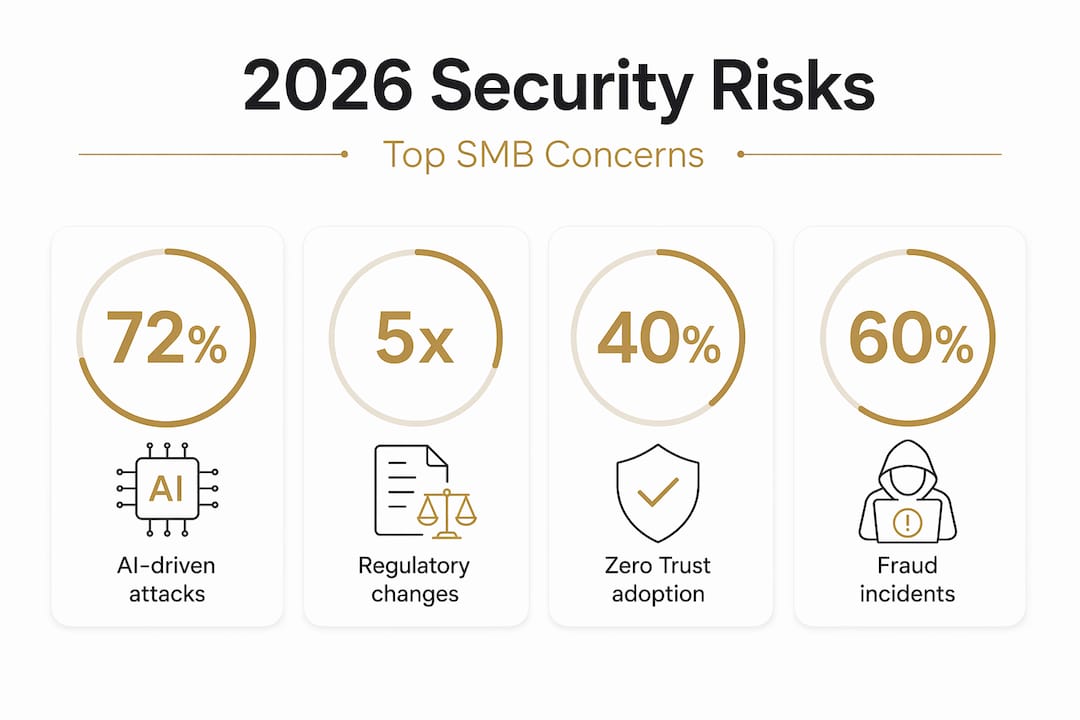
Most decision-makers still picture ransomware as the defining cyber threat of the era. That picture is already outdated. The Global Cybersecurity Outlook 2026 from the World Economic Forum reports that 73% of respondents said someone in their network was personally affected by cyber-enabled fraud over the course of 2025, a figure that dwarfs the direct ransomware impact most boards plan for. For SMBs heading into 2026, the threat landscape is being reshaped by AI-powered attacks, regulatory whiplash, and deepfake-driven social engineering. This article lays out the five emerging security trends you need to understand right now, along with practical steps to act on them.
Table of Contents
- AI-driven threats and agentic oversight: What’s changing in 2026
- Regulatory volatility and cyber resilience: Why compliance isn’t enough
- Zero Trust for AI: The new security foundation
- Cyber-enabled fraud, deepfakes, and the new human risk
- Modern ransomware tactics: What SMBs must do differently in 2026
- Why focusing only on ransomware is no longer enough
- Protect your business with practical, up-to-date solutions
- Frequently asked questions
Key Takeaways
| Point | Details |
|---|---|
| AI alters attack and defense | Both attackers and defenders now use AI—review oversight and response playbooks accordingly. |
| Resilience outpaces compliance | Building organization-wide resilience is more effective than focusing only on evolving regulations. |
| Zero Trust covers AI | Extend identity and access controls to automated and AI-driven systems, not just human users. |
| Human risks are rising | Deepfake and fraud tactics target employees directly, making social engineering defenses a priority. |
| Ransomware is evolving | Modern ransomware attacks use automation and double extortion, requiring updated multi-layered defenses. |
AI-driven threats and agentic oversight: What’s changing in 2026
With new threats dominating headlines, understanding how AI and automation are reshaping the battlefield is the first step. The changes are not incremental. They are structural.
Agentic AI refers to AI systems capable of making and executing decisions on their own, without a human approving each step. Think of an AI model that can browse the internet, write scripts, query databases, and take action, all inside a single automated workflow. According to Gartner’s top cybersecurity trends for 2026, agentic AI oversight, regulatory volatility, and post-quantum cryptography planning are now concrete action items for security teams, not future-state discussions. That shift in framing matters. If your security roadmap still treats these as emerging research topics, you are already behind.
On the threat side, the picture is equally stark. Trend Micro’s 2026 predictions describe AI and automation blurring the line between manual and machine-driven attacks, with ransomware evolving toward fully AI-driven, automated operations. This means threat actors no longer need large teams of skilled operators. A small group with access to the right AI tooling can run campaigns at enterprise scale.
Here is a side-by-side look at how AI functions on both sides of the security equation:
| Capability | AI as defender | AI as attacker |
|---|---|---|
| Speed | Detects anomalies in milliseconds | Automates scanning and exploitation in minutes |
| Scale | Monitors thousands of endpoints simultaneously | Runs phishing campaigns across millions of targets |
| Adaptability | Updates detection models with new threat data | Adjusts attack payloads to evade signature-based tools |
| Human dependency | Reduces analyst fatigue through automation | Removes the need for skilled human operators |
| Key risk | False positives and over-reliance on single tools | Attacks that outpace traditional defenses |
Key areas to prioritize in 2026 based on this shift:
- Establish agentic AI governance policies before deploying any autonomous AI tools internally
- Audit which AI systems in your environment can take actions, not just produce outputs
- Begin evaluating post-quantum cryptography readiness for any data that must remain private for more than five years
- Train security operations teams to detect AI-generated phishing and synthetic content
Pro Tip: Traditional security awareness training focused on spotting poorly written phishing emails will not protect your team against AI-generated content. Update your program to include realistic, AI-crafted simulations and train staff on behavioral indicators rather than grammar mistakes.
“Organizations that treat agentic AI governance as a 2027 problem are making a strategic error. The tools are already deployed and in active use by threat actors today.”
If you want a broader map of where top security trends for 2026 are headed, physical and digital security investments are converging faster than most SMBs expect.
Regulatory volatility and cyber resilience: Why compliance isn’t enough
AI and new attack models shift technical priorities, but policy and legal changes are dramatically altering the strategic landscape as well. Regulatory environments in 2026 are not stable. New frameworks are being enforced across regions, existing rules are being updated rapidly, and penalties for data breaches are increasing in both frequency and size.
Gartner identifies regulatory volatility as a primary driver of cyber resilience investment in 2026. The key insight here is the word resilience rather than compliance. Compliance is a snapshot. It tells you whether you met a standard at a specific point in time. Resilience is a posture. It describes your ability to absorb disruption, adapt quickly, and continue operating.
The 73% fraud exposure figure referenced earlier makes this point concretely. A significant number of those affected organizations were almost certainly compliant with their applicable regulations. Compliance did not prevent the impact. Resilience might have reduced it.
Here is a practical three-step framework for building resilience rather than just checking boxes:
- Assess your current exposure. Map every asset, process, and third-party connection that could become an attack vector. This goes beyond a typical vulnerability scan. Include supply chain partners, cloud storage configurations, and any AI tools with access to sensitive data.
- Build and test your incident response plan. A plan that has never been tested is a document, not a capability. Run tabletop exercises at least twice per year, with scenarios that reflect current threats including ransomware, fraud, and regulatory notifications.
- Design for rapid recovery. Invest in immutable backups, redundant systems, and clear communication trees. When a breach happens, the speed of your recovery determines the business impact far more than the elegance of your prevention stack.
Using a solid business security checklist as a starting point can help SMBs move from ad-hoc security decisions to a structured, repeatable process. Structure matters as much as technology when you are operating with a lean team.
Zero Trust for AI: The new security foundation
In parallel to regulatory shifts, technical teams are also updating core frameworks. Zero Trust, the model that assumes no user or system is inherently trustworthy, is evolving to include a category most organizations have not yet thought about: AI agents and automated systems.
Microsoft’s announcement on Zero Trust for AI describes extending Zero Trust principles across the entire AI lifecycle, including AI-specific assessment structures and governance layers. In practice, this means your Zero Trust architecture cannot stop at human users and service accounts. Every AI system, automated workflow, and non-human actor must be scoped, auditable, and explicitly authorized.
Here is how Zero Trust access controls look across three types of actors:
| Actor type | Identity verification | Access scope | Logging requirement |
|---|---|---|---|
| Human user | MFA, SSO, conditional access | Role-based, least privilege | Session logs, anomaly alerts |
| Service account | Certificate-based auth, rotation | API-scoped, no lateral access | API call logs, rate monitoring |
| AI agent | Defined permission boundary, policy-enforced | Task-scoped, time-limited | Full action audit trail |
The AI agent row is the one most SMBs have not implemented. An AI system that can query your CRM, send emails, and access financial records without a comprehensive audit trail is a significant liability. Not because the AI itself is malicious, but because if it is compromised or misconfigured, the blast radius is enormous.
Practical actions to implement Zero Trust for AI:
- Catalog every non-human actor in your environment, including bots, scripts, and AI tools with network or data access
- Apply least-privilege principles to AI systems the same way you do to junior employees
- Require explicit, logged authorization for any AI action that touches sensitive data or external systems
- Review and revoke unused AI permissions quarterly, just as you would user access
Pro Tip: Map out all non-human actors in your environment by mid-2026. Most SMBs are surprised to discover how many automated systems have access that was never formally reviewed or scoped. Start with your cloud platforms and SaaS tools. Review property security tips to see how layered authorization thinking applies across both physical and digital domains.
Cyber-enabled fraud, deepfakes, and the new human risk
Beyond technology and process, the human element is now being targeted in increasingly sophisticated ways. And the tools available to attackers have made those attacks far more convincing than anything security teams trained against even two years ago.
Vishing (voice phishing) and smishing (SMS phishing) are growing rapidly, both powered by AI-generated audio and text. According to the CyberProof 2026 Global Threat Intelligence Report, deepfake audio in vishing attacks is a rising threat specifically targeting collaboration platforms like Microsoft Teams. This is not a theoretical concern. SMBs in professional services, finance, and healthcare are already seeing cases where employees received calls from convincing audio clones of executives requesting urgent fund transfers.
The WEF’s Global Cybersecurity Outlook 2026 positions AI-accelerated fraud as a major executive priority, with high organizational exposure across sectors.
“73% of respondents said someone in their network was personally affected by cyber-enabled fraud over 2025. For SMBs, that statistic reflects a real operational risk, not just a headline.”
SMBs are disproportionately targeted in fraud and impersonation attacks for a straightforward reason. Larger enterprises have dedicated fraud detection teams, multi-layer approval workflows, and AI-based transaction monitoring. Smaller organizations often rely on manual processes and trust-based communication, which is exactly what attackers exploit.
Top controls to prioritize for fraud and deepfake defense:
- Implement out-of-band verification for any urgent financial or access requests, regardless of how convincing the communication appears
- Use a visual or code-based confirmation step for sensitive internal requests, even when the caller sounds familiar
- Enable caller ID spoofing detection and train staff not to act on urgency alone
- Review your security checklist to ensure physical access controls are part of your fraud defense strategy
- Run deepfake awareness sessions quarterly so employees understand what synthetic media sounds and looks like
Modern ransomware tactics: What SMBs must do differently in 2026
The intersection of changing human risks and evolving automation sets the stage for the most enduring threat: ransomware. But the ransomware of 2026 operates very differently from even recent campaigns. Understanding the current attack chain is essential before designing your defenses.

Modern ransomware commonly steals data before encrypting it, a tactic called double extortion. This means even if you restore from backup, attackers can still threaten to publish your sensitive data unless you pay. That changes the math on traditional “just maintain backups” advice significantly.
The typical sequence of a modern AI-driven ransomware attack:
- Initial access. Phishing email, credential stuffing, or exploitation of a public-facing vulnerability gets the attacker inside your network.
- Reconnaissance. Automated tools map your environment, identifying high-value targets, backup systems, and administrative accounts.
- Lateral movement. The attacker moves quietly through your network, gaining access to more systems while avoiding detection.
- Data exfiltration. Sensitive files are copied and sent to attacker-controlled infrastructure before any encryption begins.
- Encryption and extortion. Files are encrypted. A ransom note demands payment and includes the threat of publishing stolen data.
Three essential actions SMBs must take to reduce ransomware risk in 2026:
- Segment your network. Isolate critical systems, backup infrastructure, and financial data from general employee access. Lateral movement is much harder when flat networks are eliminated.
- Enforce multi-factor authentication on every privileged account. The majority of ransomware entry points exploit compromised credentials. MFA is not optional for admin accounts in 2026.
- Maintain offline, immutable backups. Ransomware operators specifically target and destroy connected backup systems. Offline copies stored separately are the last line of defense.
Understanding why you should prioritize security solutions now rather than after an incident is a mindset shift that makes financial sense at every budget level.
Why focusing only on ransomware is no longer enough
After reviewing these attack methods in detail, there is a strategic problem that deserves direct attention. Most SMB security budgets and most boardroom conversations are still organized primarily around ransomware. That focus made sense in 2022 and 2023. In 2026, it is creating a dangerous blind spot.
The WEF’s analysis of cybersecurity priorities puts cyber-enabled fraud and phishing at the top of CEO concerns, which signals that the threat category causing the most organizational impact is not ransomware, it is fraud and impersonation. Yet most SMBs we interact with have robust endpoint detection and response tools, solid backup infrastructure, and almost no budget for identity verification controls or social engineering defenses.
The financial impact of fraud is often invisible in ways that ransomware is not. A ransomware attack shuts down operations and makes the news. A successful business email compromise or deepfake-driven wire fraud may not be discovered for weeks, and may never generate a public disclosure. That invisibility does not mean the damage is smaller.
Pro Tip: Begin evaluating whether your security budget reflects where actual losses are occurring, not just where the media attention is. Shifting even a modest portion of your tooling investment toward social engineering controls, identity verification, and property security tips that address physical impersonation risks can close gaps that pure technical solutions miss.
The “headliners” are not always the biggest business risk. Ransomware is real and damaging. But in 2026, building an SMB security strategy around ransomware alone is like reinforcing only one wall of a building with four exposed sides. The attackers know exactly which walls you left open.
Protect your business with practical, up-to-date solutions
Having understood the trends and actions that matter, here’s how you can put this knowledge into practice.
The five trends covered here require a combination of updated technology, clearer policies, and layered physical and digital security. That is where Safes and Security Direct can help.

At Safes and Security Direct, we provide security solutions designed for exactly the kind of environment SMBs are navigating in 2026. From advanced surveillance cameras with AI-enabled detection capabilities to fire-resistant and burglary-resistant safes for protecting critical documents and physical assets, our product range supports the layered security posture that today’s threat landscape demands. Pair your cybersecurity investments with robust physical security to ensure every layer of your operation is covered. Browse our full range of solutions and use our expert-curated guides to build a security strategy that actually fits your business.
Frequently asked questions
What is agentic AI in cybersecurity?
Agentic AI refers to autonomous AI systems that can make and execute decisions without human approval at each step, requiring new oversight and authorization controls. Gartner identifies agentic AI governance as a top security challenge for 2026.
How are deepfakes used in cyber attacks against businesses?
Deepfakes increasingly power voice phishing scams where attackers impersonate executives or colleagues to authorize fraudulent transfers or access. Vishing with deepfake audio is a rising and specifically documented threat targeting workplace collaboration tools.
What is Zero Trust for AI and why does it matter?
Zero Trust for AI applies strict identity, access, and verification principles to all AI and automated systems rather than just human users. Microsoft’s Zero Trust for AI framework extends these controls across the full AI lifecycle to reduce governance gaps.
How are ransomware attacks changing in 2026?
Ransomware in 2026 is largely AI-automated and typically includes double extortion, where attackers steal data before encrypting it to maximize leverage. Modern ransomware sequences follow structured attack chains that move faster than human-led incident response.
Why is resilience as important as compliance for SMB security?
Regulatory frameworks change frequently and compliance only confirms you met a standard at one point in time, not that you can recover from an attack. Gartner’s 2026 analysis identifies regulatory volatility as a key reason resilience investment now outpaces pure compliance efforts.
Recommended
- Business Security Needs: Protecting Assets in 2026 – Safes and Security Direct
- Top Security Trends Transforming Safety in 2026 – Safes and Security Direct
- Why prioritize security in 2026: protect what matters – Safes and Security Direct
- Home security best practices: protect property in 2026 – Safes and Security Direct