

Why prioritize security in 2026: protect what matters
TL;DR:
- Physical crime is declining, but cyber threats and smart device vulnerabilities are increasing in 2026.
- Proactive, layered security strategies reduce risks, save costs, and provide peace of mind.
- Continuous security efforts and regular updates are essential to maintain protection against evolving threats.
Why prioritize security in 2026: protect what matters
National crime statistics can paint a misleading picture. Yes, property crime dropped roughly 6 to 9% in 2025, and that trend has continued into 2026. But that number doesn’t capture the full story. Cyber attacks are accelerating, smart home devices are creating new entry points for criminals, and regional hotspots still experience sky-high victimization rates. If you manage a home or business and you’ve been feeling comfortable because crime is “down,” this article is for you. We’ll walk through the real risk landscape, explain why prevention is more critical now than ever, and give you a practical framework to act.
Table of Contents
- The shifting landscape of security risks in 2026
- Why perception and prevention matter more than ever
- Evolving strategies to protect your property and assets
- The business case and personal gains: Security as investment
- The uncomfortable truth: Security must be continuous, not a checkbox
- Stay protected: Next steps for securing your property in 2026
- Frequently asked questions
Key Takeaways
| Point | Details |
|---|---|
| New risks rising | Cyber attacks and smart home threats are increasing despite traditional crime declining. |
| Proactive prevention pays | Acting ahead on security saves money, stress, and boosts insurance benefits. |
| Continuous security needed | The best protection comes from regular updates, not one-time fixes. |
| ROI for home and business | Security investments deliver long-term value, increased resale, and peace of mind. |
The shifting landscape of security risks in 2026
The headline stats look good. Burglary and car theft are declining in many metro areas. But that’s only one lens. The actual threat environment has expanded in directions that traditional security thinking doesn’t fully address.
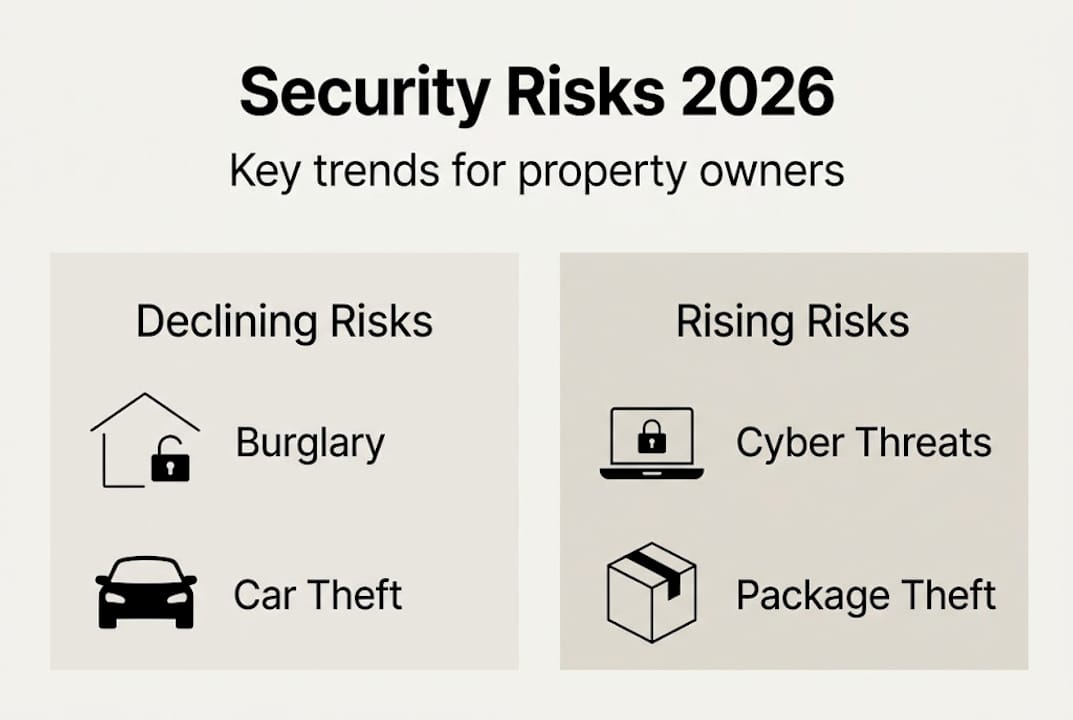
Physical crime is down. Digital crime is surging. Ransomware attacks have roughly doubled in the past two years. Phishing is now the leading attack method against small businesses, with 93% of cyber incidents at small firms involving phishing. For business owners, that’s not a distant IT problem. It’s a cash flow threat.
At the same time, new categories of physical and hybrid threats are emerging. Consider these risk categories that didn’t exist a decade ago:
- Smart home device hacks: Cameras, doorbells, and thermostats are now entry points for bad actors. Smart home vulnerabilities have jumped sharply as more households add connected devices without changing default credentials.
- Work-from-home data exposure: With millions still splitting time between home and office, sensitive business data regularly travels across home networks that lack enterprise-grade protection.
- Package theft: E-commerce growth has made porch piracy a reliable income stream for opportunistic thieves. In high-density neighborhoods, this is now a daily occurrence.
- Aging-in-place monitoring gaps: Older adults living independently are increasingly vulnerable to both physical intrusion and digital scams targeting their financial accounts.
Here’s a snapshot of where the risk balance sits today:
| Threat type | Trend in 2026 | Primary target |
|---|---|---|
| Residential burglary | Declining | Homeowners |
| Package theft | Increasing | Homeowners, renters |
| Ransomware | Increasing sharply | Businesses |
| Phishing attacks | Increasing | Businesses, remote workers |
| Smart device hacking | Emerging threat | Homeowners, businesses |
| Vandalism | Stable | Both |
Regional disparities make this even more complex. A homeowner in a low-crime suburb might face minimal burglary risk but still be exposed to cyber fraud and package theft. A small business in a dense urban area might face all of the above simultaneously. Understanding your cyber vs physical security risk profile is the foundation of any sensible protection strategy.
Perhaps most telling is how criminals themselves have modernized. New threats for homes now include coordinated smash-and-grab operations informed by social media, AI-generated phishing messages that are nearly indistinguishable from real communications, and spoofed contractor calls designed to gain physical access. The old assumption that crime is visible and predictable no longer holds.
“The threat is no longer just someone casing your block. It’s someone on another continent who found your router’s default password on a forum.”
This reality makes smart, layered security planning not just wise but essential. And it’s why understanding the smart home security benefits and risks in tandem gives you a clearer operational picture.
Why perception and prevention matter more than ever
Even when crime stats trend downward nationally, the experience of individual property owners doesn’t follow that curve neatly. A single break-in or ransomware attack is a 100% event for the person it happens to. Statistics don’t absorb the financial hit or the psychological aftermath.
The psychology of risk is real. Studies show that even people in low-crime areas dramatically overestimate their personal exposure after a nearby incident. That heightened state of alertness is uncomfortable, but it can also motivate smart action. The key is channeling that concern into structured prevention rather than reactive panic-buying of disconnected gadgets.
There’s also a compelling financial argument for proactive security. Insurance data shows that monitored security systems, cameras, and reinforced entry points can reduce homeowners’ insurance premiums by up to 15%. For a business with a commercial property policy, the savings can be even more significant. That’s money back in your pocket every single year.
Here’s why proactive security consistently outperforms reactive security:
- Deterrence works before an incident occurs. Visible cameras and signage reduce the likelihood of a break-in attempt. Criminals prefer easier targets.
- Faster response limits damage. Monitored systems that alert authorities in real time reduce average response times, which directly limits theft and property damage.
- Peace of mind has real value. The ability to check your property remotely, receive instant alerts, and know your assets are protected removes a constant low-level stress that affects productivity and quality of life.
- Documentation protects you legally. Footage and access logs have become critical evidence in insurance claims, workplace disputes, and liability cases.
Now compare what proactive and reactive approaches actually look like in practice:
| Approach | Timing | Cost profile | Outcome |
|---|---|---|---|
| Proactive security | Before an incident | Planned, manageable | Deterrence, savings, peace of mind |
| Reactive security | After an incident | Unplanned, often higher | Partial recovery, ongoing vulnerability |
| No security | Ongoing gap | Low upfront, high risk | Full exposure to loss |
The reactive model is tempting because it delays spending. But the math is unforgiving. A single burglary costs homeowners an average of $2,800 in stolen goods, plus damage repair, insurance deductibles, and time lost. A basic monitored security setup runs a fraction of that annually. For businesses, a ransomware event can easily run into tens of thousands of dollars in downtime, ransom, and recovery costs. Investing in security solutions in 2026 before something goes wrong is not pessimism. It’s basic financial planning.
The comparison becomes even clearer when you factor in technology improvements. Modern systems are more reliable, more affordable, and far easier to manage than systems from even five years ago. There’s genuinely no better time to upgrade.
Evolving strategies to protect your property and assets
Knowing the risks and understanding the case for prevention only matters if you take action. Here’s a practical, layered strategy for protecting your home or business in 2026. These steps are organized by category so you can prioritize based on your specific situation.
Physical security steps:
- Audit entry points. Walk every door, window, and gate. Check lock quality, frame integrity, and visibility from the street. Weak door frames cause more break-ins than weak locks.
- Install or upgrade cameras. Position cameras at all entry points, driveways, and blind spots. Use models with night vision and cloud storage so footage is preserved even if a device is stolen or damaged.
- Add motion-activated lighting. Exterior lighting is one of the cheapest and most effective deterrents. Pair it with cameras for maximum effect.
- Reinforce access control. Consider smart locks with audit trails for businesses. For homes, keypad entry eliminates risks from lost or copied keys.
- Explore shutter integration. Smart shutter systems can add a physical barrier to windows and doors that connects to your broader smart home setup, adding a layer of protection without sacrificing convenience.
Digital security steps:
- Change default credentials on every device. Routers, cameras, smart speakers, and doorbells all ship with default usernames and passwords that are publicly listed online. This one step closes a massive vulnerability.
- Segment your home network. Run smart home devices on a separate network from your computers and phones. If a device is compromised, the attacker can’t immediately pivot to your sensitive data.
- Enable two-factor authentication. Every account that holds financial or personal data should require a second form of verification. This stops most phishing-based account takeovers cold.
- Back up critical data regularly. For businesses especially, a ransomware attack loses its power if you have clean, offline backups that can be restored quickly.
Pro Tip: The most commonly overlooked vulnerability in 2026 isn’t a broken lock or outdated antivirus. It’s the gap between physical and digital systems. A security camera that streams to an unprotected cloud account gives an attacker a live view of your property. Always secure the digital layer supporting your physical devices.
Home security best practices make the point clearly: layering physical and digital protection closes gaps that either approach alone leaves open. And if you’re building or upgrading a full system, following a structured security setup workflow helps you avoid the common mistake of patching individual weak points while ignoring systemic vulnerabilities.

Note that while overall crime trends show physical crime declining, cyber incidents including ransomware continue rising steeply. For high-value homes and businesses, physical security remains non-negotiable. The smart move is treating both as equally important.
The business case and personal gains: Security as investment
Let’s talk about money and value. Security isn’t just a cost center. It’s an investment that pays back in measurable, sometimes surprising ways.
Insurance savings are immediate. Installing a monitored alarm system, cameras, or a fire-resistant safe can qualify you for meaningful discounts with most insurers. Over a five-year period, those discounts can easily offset the cost of the equipment itself. And if you never file a claim, you’ve effectively been paid to be prepared.
Resale value gets a boost. Buyers and commercial tenants assign real value to security infrastructure. A home with a modern camera system, smart locks, and a monitored alarm is more attractive than one without. For commercial properties, a demonstrable security posture can be a competitive differentiator when attracting quality tenants or business partners.
Reputation matters for businesses. A data breach or highly publicized break-in is damaging in ways that go beyond the immediate financial loss. Customers, clients, and suppliers lose confidence. Recovery from a reputational hit often costs far more than the initial incident. Security investment is partially a brand protection play.
Pro Tip: When evaluating security add-ons, calculate the payback period before purchasing. Divide the cost of the upgrade by your annual insurance savings plus estimated risk reduction value. Any system that pays back within three years is a strong investment for most residential and commercial settings.
Here’s a quick framework for thinking through security ROI:
| Investment type | Typical annual savings | Risk reduction benefit | Payback period |
|---|---|---|---|
| Monitored alarm system | Up to $150 insurance savings | High deterrence value | 2 to 4 years |
| HD camera system | Up to $100 insurance savings | Documentation, deterrence | 2 to 3 years |
| Smart locks | Minimal insurance savings | Access control, audit trail | 3 to 5 years |
| Fire-resistant safe | Potential insurance savings | Asset protection, recovery | 1 to 3 years |
| Cybersecurity tools | Avoids breach costs | Data protection | Immediate |
Regional risk is still very real. Property crime data shows that even as national rates decline, specific cities and neighborhoods carry victimization rates that far exceed the average. If you’re in one of those areas, your ROI calculation should weight deterrence and response speed even more heavily.
To improve home security effectively, don’t start with products. Start with a risk assessment. Identify your highest-value assets, your most vulnerable access points, and the threats most relevant to your location and lifestyle. Then build your investment around those priorities. And consider that window and exterior upgrades often provide dual returns in both energy efficiency and security.
The uncomfortable truth: Security must be continuous, not a checkbox
Here’s what most security guides won’t tell you: the biggest risk in 2026 isn’t a specific threat. It’s complacency after installation.
We’ve seen it repeatedly. A property owner invests in a solid camera system and alarm setup, feels the relief of being “done,” and then doesn’t review footage, update firmware, or re-examine coverage for two years. In that time, a camera pointing at a fence gets blocked by a tree. A password never gets changed after a staff turnover. An old IoT device reaches end-of-life and stops receiving security patches.
Security is not a one-time event. It’s a discipline. The most resilient home and business owners we’ve seen treat security like they treat financial planning. They schedule regular reviews, adjust their setup as their life and business changes, and stay informed about emerging threats. They don’t wait for an incident to reveal a gap.
The single most overlooked principle in property security is adaptation. Threats evolve. Your setup should too.
Stay protected: Next steps for securing your property in 2026
The risk landscape in 2026 is real, complex, and worth taking seriously. But it’s also manageable when you approach it with the right tools and a clear plan.
At Safes and Security Direct, we stock a wide range of professional-grade solutions built for exactly this environment. From HD surveillance cameras with night vision and cloud backup, to fire-resistant and burglary-resistant safes that protect your most valuable documents and assets, to full security system packages for homes and businesses. Our team understands the layered approach that modern security demands, and our product listings include detailed specifications so you can match the right solution to your actual risk profile. Browse our catalog or reach out for personalized guidance. Protection starts with the right equipment and the decision to act.
Frequently asked questions
Do I still need to upgrade security if property crime is declining?
Yes. While crime rates have dropped nationally, regional hotspots and rising cyber threats mean real vulnerabilities remain for many homeowners and businesses.
What are the top security concerns for homeowners in 2026?
Cyber threats, smart home vulnerabilities, and package theft are the fastest-growing concerns, especially as more households add connected devices and rely on e-commerce delivery.
How does strong security affect insurance rates?
Monitored systems and reinforced entry points can lower your premiums by up to 15%, creating real, ongoing financial return on your security investment.
Are small businesses more vulnerable to cyber attacks?
Yes. 1 in 4 small businesses experience a cyber breach each year, making digital security investment just as critical as physical protection for any commercial operation.
Does security add value to my home or business?
Absolutely. A well-secured property attracts buyers and tenants, supports insurance savings, and protects the long-term value of your most important physical and digital assets.
Recommended
- Home security best practices: protect property in 2026 – Safes and Security Direct
- How to Improve Home Security: Proven Steps for 2026 – Safes and Security Direct
- Why prioritize security solutions for safer homes in 2026 – Safes and Security Direct
- Business Security Needs: Protecting Assets in 2026 – Safes and Security Direct