

Surveillance technology trends 2026: What you need to know
TL;DR:
- AI-powered surveillance systems in 2026 are now operating reliably at scale, enabling active threat detection and rapid response. The market is growing rapidly, driven by AI, cloud technology, and hardware advancements, with hybrid architectures balancing latency, cost, and privacy. Practical applications include autonomous drones, visual gun detection, and integrated access control, transforming security beyond mere recording.
AI-powered surveillance has crossed a threshold most security professionals have been waiting years to see. The surveillance technology trends 2026 brings aren’t incremental upgrades — they represent a genuine operational shift, where AI video analytics now work reliably at scale, edge computing processes threats in milliseconds, and autonomous systems respond faster than any human operator can. Whether you’re securing a warehouse, a retail chain, or a residential property, what’s available today in 2026 is categorically different from what existed three years ago. This guide breaks down exactly what changed, why it matters, and how to act on it.
Table of Contents
- The surge of AI-powered video surveillance
- Market growth and technology drivers reshaping surveillance
- Edge AI vs cloud AI: Balancing latency, cost, and privacy
- Practical applications and emerging innovations in 2026
- Preparing for intelligent video: Infrastructure and maturity models
- Why the middle ground of hybrid surveillance technology wins in 2026
- Explore advanced surveillance solutions at Safes and Security Direct
- Frequently asked questions
Key Takeaways
| Point | Details |
|---|---|
| AI video surveillance maturity | By 2026, AI-powered video analytics reliably detect threats at commercial scale, reducing false alarms and expanding monitoring capabilities. |
| Market growth drivers | The surveillance tech market grows strongly due to AI, cloud integration, biometrics, and emerging VSaaS and computer vision segments. |
| Edge versus cloud AI | Hybrid edge-cloud architectures balance latency, cost, and privacy better than pure cloud or edge, becoming the dominant deployment model. |
| Practical innovations | Advanced AI detectors, drone first responders, and multi-sensor fusion enhance real-world security operations beyond passive recording. |
| Infrastructure readiness | Organizations need to assess AI, cloud, and cybersecurity maturity to embed intelligent video into security workflows effectively. |
The surge of AI-powered video surveillance
The numbers alone tell a compelling story. The AI in video surveillance market is on track to grow from $4.1 billion in 2020 to $9.7 billion by 2026, with commercial-scale detection of unauthorized individuals, license plates, and perimeter breaches now standard functionality. That growth reflects real demand from organizations that have moved past the proof-of-concept phase and into full deployment.
What makes 2026 different isn’t just the market size. It’s the quality of the detections. Early AI surveillance systems generated enough false alerts to make them operationally useless — security teams were drowning in notifications that turned out to be nothing. Today’s systems filter that noise dramatically. AI now identifies not just motion but context: a person lingering near a restricted door, a vehicle parked in a no-stop zone after hours, a bag left unattended in a lobby.
“AI-powered video surveillance enables enterprises to protect assets and improve operational performance beyond just recording footage.”
This is the core shift worth internalizing. Surveillance systems are no longer passive recorders waiting to be reviewed after an incident. They’re active filters that surface only what matters, freeing human operators to focus on response rather than monitoring.
Key capabilities now operating reliably at scale:
- Unauthorized person detection across multi-camera environments with minimal human review
- License plate recognition integrated with access control databases
- Perimeter breach alerts triggered within seconds rather than minutes
- Loitering and behavioral anomaly detection in retail, transit, and corporate settings
If you’re evaluating where your organization fits in this landscape, the top security trends 2026 overview and a review of security system core components are solid starting points before committing to a deployment architecture.
Market growth and technology drivers reshaping surveillance
The broader surveillance market reflects the same momentum. The global surveillance technology market is projected to grow from $173.57 billion in 2025 to $191.91 billion in 2026, a CAGR of 10.6%, driven by AI integration and cloud-based systems. This isn’t speculative growth. It’s backed by real procurement budgets across government, enterprise, retail, and residential sectors.
| Market segment | 2025 value | Projected 2026 value | Growth driver |
|---|---|---|---|
| Global surveillance technology | $173.57B | $191.91B | AI + cloud adoption |
| AI in video surveillance | ~$8.5B | $9.7B | Commercial-scale analytics |
| Computer vision in surveillance | $4.00B | $4.40B | Automated threat detection |
| Global video surveillance (2028 target) | — | $83.3B | VSaaS + video analytics |
The computer vision in surveillance market alone is growing at nearly 10% annually, reaching $4.40 billion in 2026. Computer vision is the engine beneath most AI surveillance applications — it’s what allows a camera to distinguish a person from a shadow, or a weapon from a cell phone. Without mature computer vision, none of the detection capabilities above are possible.
Video Surveillance as a Service (VSaaS), where camera feeds are managed and stored via cloud platforms rather than on-site servers, is also accelerating rapidly. The video surveillance market is expected to reach $83.3 billion by 2028, with VSaaS and video analytics growing fastest within that total. Small and mid-sized businesses benefit most here, because VSaaS removes the need for costly on-premise recording infrastructure.
Key technology drivers behind this growth:
- AI and machine learning applied to threat classification and behavioral analysis
- Cloud infrastructure enabling remote management across distributed sites
- Biometric integration, including facial recognition and gait analysis
- Drone surveillance expanding perimeter coverage beyond fixed camera ranges
- Predictive analytics identifying patterns before incidents occur
If you’re working on improving home security in 2026 or evaluating security solutions for your property, these market shifts directly affect what products are available, how they’re priced, and how capable they are out of the box.
Edge AI vs cloud AI: Balancing latency, cost, and privacy
This is where deployment decisions get consequential. Edge AI processes video directly on the camera or a local device. Cloud AI sends footage to remote servers for analysis. The difference in speed is not subtle.
Edge AI inference achieves 20 to 100 milliseconds of latency, compared to 300 to 800 milliseconds for cloud-based processing. In a threat detection scenario, that gap can determine whether an alert fires before or after a security breach occurs.
| Factor | Edge AI | Cloud AI | Hybrid |
|---|---|---|---|
| Latency | 20–100 ms | 300–800 ms | 20–100 ms (local alerts) |
| Bandwidth cost | Low | High ($75K+/year at scale) | Moderate |
| Privacy compliance | Strong | Challenging | Balanced |
| Analytics depth | Limited | Extensive | Extensive |
| Scalability | Site-level | Enterprise-wide | Both |
Cloud AI does have genuine advantages. Cross-camera reasoning, enterprise-wide pattern analysis, and large-scale data correlation require the compute power and data aggregation that cloud platforms provide. If you need to identify a person who appeared at three different sites across a city, that’s a cloud-level problem.
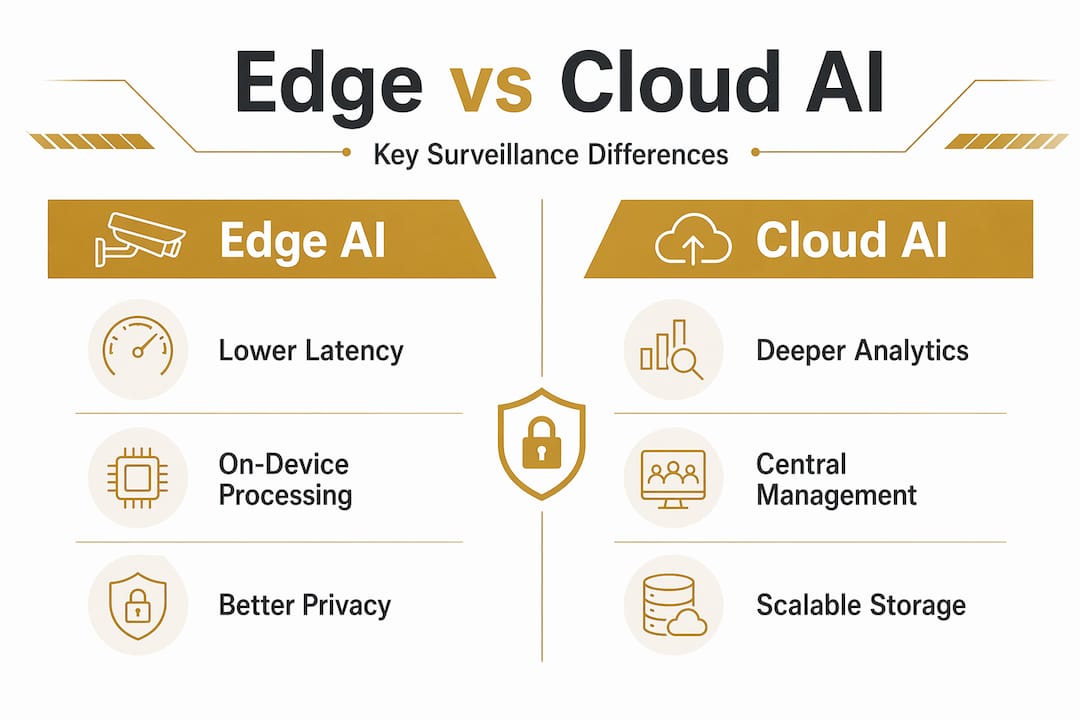
The EU AI Act, which shapes compliance requirements for any organization operating in or selling into European markets in 2026, pushes toward edge processing for privacy reasons. Storing and transmitting biometric data off-premise creates compliance exposure. Edge processing keeps sensitive data local.
Pro Tip: For most commercial deployments, the practical answer is a hybrid architecture. Run object detection and initial classification at the edge for real-time alerts, then route confirmed events to the cloud for deeper analytics, reporting, and long-term storage. This approach handles the latency problem, controls bandwidth costs, and satisfies most privacy regulations simultaneously.
Understanding surveillance camera costs before selecting edge-capable hardware is essential, since cameras with on-board AI processing carry a higher upfront price but often reduce total system costs over time by cutting cloud bandwidth fees.
Practical applications and emerging innovations in 2026
The clearest sign that surveillance tech has matured is where it’s being applied. These aren’t research projects.
-
AI-powered visual gun detection: Systems can now identify threats before shots are fired, with experts suggesting this technology could be mandated in public facilities within the next five to ten years. Several school districts and stadium operators have already deployed it.
-
Drone-as-First-Responder programs: What started as pilot projects has evolved into commercial-scale deployments, with autonomous drones dispatched automatically when cameras trigger specific alerts. Response times that previously took eight to twelve minutes now happen in under ninety seconds in some deployments.
-
Integrated access control and video analytics: Siloed systems are the most common mistake in commercial security deployments. Combining video analytics with access control reduces false alarms and enables automated lockdowns when specific threats are confirmed — no human action required in the critical first moments.
-
Ultra-long-range 4D vision systems: New hardware like SiLC Technologies’ Eyeonic Vista uses silicon photonics and multi-sensor fusion to detect objects beyond one kilometer. This changes perimeter security for airports, energy facilities, and large campuses where traditional cameras max out at a fraction of that range.
Pro Tip: When integrating video analytics with access control, ensure your platforms share a common API layer. The most common implementation failure isn’t hardware — it’s two systems that can’t communicate fast enough to automate a response. Verify integration specs before purchasing.
For reference on layering these capabilities properly, the guide on security system must-haves and home security best practices cover the foundational architecture that makes advanced integrations possible.
Preparing for intelligent video: Infrastructure and maturity models
Knowing what technology exists is only half the challenge. Knowing where your organization stands in its ability to use that technology is the other half.
The Axis Perspectives 2026 report outlines a five-stage intelligent video maturity model that provides a clear framework for assessing readiness:
- Reactive: Cameras record, footage is reviewed after incidents. No analytics.
- Proactive: Motion-based alerts and basic rules filter some events.
- Analytical: AI analytics detect specific objects, behaviors, and anomalies.
- Predictive: Systems identify patterns and flag risks before incidents occur.
- Autonomous: Integrated systems take automated responses without human triggers.
Most commercial organizations in 2026 sit between stages two and three. Very few have reached stages four or five, but the infrastructure decisions made now determine how quickly that transition happens.
What you need to support stages three through five:
- Network bandwidth capable of handling AI-processed video streams across multiple cameras
- Edge-capable hardware with sufficient GPU or NPU (neural processing unit) power for on-device inference
- Cloud integration for data aggregation, reporting, and cross-site analytics
- Cybersecurity posture that treats cameras as network endpoints, not passive hardware. Every connected device is a potential attack vector.
- Data governance policies defining retention, access controls, and compliance obligations for recorded footage
The cybersecurity angle is consistently underestimated. Security cameras with internet connectivity run firmware, communicate via protocols, and store credentials. A compromised camera isn’t just a privacy problem — it’s an entry point into the broader network. Any AI surveillance deployment should include a camera firmware update policy and network segmentation as baseline requirements.
Understanding where you sit on that maturity model is the right first step. The security trends shaping 2026 analysis maps these stages to specific technology investments.
Why the middle ground of hybrid surveillance technology wins in 2026
Here’s the opinion that most vendor pitches won’t tell you: neither pure-cloud nor pure-edge surveillance works well at serious scale. Both have fundamental limitations that only a hybrid approach resolves.
Pure-cloud systems look attractive on paper. Lower upfront hardware costs, centralized management, and access to enterprise-grade analytics. But in practice, the latency problem is real and persistent. A 300 to 800 millisecond delay between a camera detecting movement and a cloud server returning an alert means the threat response is always slightly behind the event. Add bandwidth costs that can exceed $75,000 per year for large deployments, and the economics deteriorate fast.
Pure-edge systems solve the latency and cost problems but hit a ceiling on analytics depth. A single edge device doesn’t have the compute power to correlate behavior across thirty cameras, build long-term behavioral profiles, or generate the kind of management reporting that enterprise security teams need.
The hybrid model isn’t a compromise. It’s a deliberate architecture that assigns tasks to the right layer. Edge handles detection and real-time alerting. Cloud handles correlation, storage, and intelligence. Each layer does what it does best, and together they outperform either in isolation. Serious AI surveillance deployments in 2026 are overwhelmingly hybrid for this reason.
Regulatory pressure reinforces this. The EU AI Act’s data minimization requirements push organizations toward edge processing precisely because transmitting biometric and behavioral data to cloud servers creates compliance liability. The hybrid model satisfies the regulator and the security team. That’s a rare alignment.
Security leaders who insist on pure-cloud because it’s simpler to manage are trading operational performance for convenience. The teams deploying hybrid systems are getting better detection, lower total costs, and stronger regulatory positioning simultaneously.
Explore advanced surveillance solutions at Safes and Security Direct
The trends covered in this article aren’t future projections — they’re available now, in products you can specify, purchase, and deploy this year.

At Safes and Security Direct, we stock surveillance systems built for the AI and edge computing realities of 2026, from cameras with on-board analytics to full hybrid-ready system architectures suited for both residential and commercial applications. Before you select hardware, our detailed surveillance camera pricing guide will help you understand what different capability tiers actually cost. And if you’re building or upgrading a full system, our breakdown of security system components maps the technology directly to the needs of your property. Our team is ready to help you build a layered, future-proof security setup that reflects where the industry is heading.
Frequently asked questions
What is edge AI and why is it important for surveillance in 2026?
Edge AI processes video locally on the camera or a nearby device rather than sending footage to a remote server. This approach delivers 20 to 100 ms latency, dramatically lower than cloud processing, while also reducing bandwidth costs and keeping sensitive biometric data on-premise for better privacy compliance.
How has AI improved video surveillance effectiveness?
Modern AI analytics detect threats and reduce false positives at a level that makes operational monitoring at scale genuinely practical. Instead of flagging every moving object, AI now classifies behaviors, recognizes context, and surfaces only the alerts that warrant human attention.
What market trends are shaping surveillance technology growth in 2026?
The surveillance technology market is growing toward $192 billion in 2026, driven by AI integration, cloud adoption, biometrics, drone surveillance, and predictive analytics. VSaaS and computer vision are among the fastest-growing segments within that total.
Why are hybrid cloud-edge architectures favored for surveillance?
Hybrid systems balance latency, cost, and privacy by combining edge AI’s real-time detection with cloud AI’s analytical depth, covering the widest range of use cases while satisfying regulatory requirements that pure-cloud setups often cannot meet.
What practical innovations are emerging in surveillance technology?
Drone-as-First-Responder programs and autonomous threat detection now operate at commercial scale, while AI-powered visual gun detection is moving toward potential mandates in public facilities. Multi-sensor perimeter systems and access control integration round out the most significant near-term innovations.
Recommended
- Top Security Trends Transforming Safety in 2026 – Safes and Security Direct
- Security system must-haves: 5 core components in 2026 – Safes and Security Direct
- How surveillance technology boosts business security and efficiency – Safes and Security Direct
- Surveillance cameras: what they really do for your security – Safes and Security Direct