

How surveillance technology boosts business security and efficiency
TL;DR:
- Modern surveillance technology enhances security, workflow, and accountability in businesses.
- Proper management and transparency are essential to avoid legal, ethical, and cultural risks.
- Effective programs rely on clear policies, leadership culture, and aligning technology with specific business needs.
Surveillance technology has quietly grown from a simple lock-and-watch security tool into one of the most versatile operational assets a business can deploy. Most managers still picture grainy CCTV footage and little else, but the reality in 2026 is far more nuanced and far more powerful. When applied thoughtfully, these systems protect your assets, sharpen your workflows, and even strengthen accountability across your entire organization. Get it wrong, however, and you risk legal exposure, damaged culture, and a workforce that no longer trusts you.
Table of Contents
- How surveillance technology is transforming businesses
- Benefits of surveillance for modern businesses
- Risks and ethical considerations of surveillance in the workplace
- Best practices for implementing surveillance solutions
- The truth most guides overlook about business surveillance
- Explore advanced business surveillance solutions
- Frequently asked questions
Key Takeaways
| Point | Details |
|---|---|
| Surveillance drives efficiency | Modern systems enhance both security and business operations when used wisely. |
| Transparency is essential | Clear communication and employee involvement increase trust and compliance. |
| Beware ethical pitfalls | Unclear or excessive monitoring risks legal trouble and talent loss. |
| Policy before technology | Establish fair, clear surveillance policies before deploying new tech. |
How surveillance technology is transforming businesses
Modern business surveillance reaches well beyond video cameras mounted on walls. Today’s systems weave together video analytics, access control logs, GPS tracking for vehicles and equipment, and even AI-powered predictive analytics that flag unusual patterns before problems escalate. Understanding the full scope of what these tools can do is the first step toward using them well.
The surveillance camera systems basics are still foundational, but the way businesses are applying those basics has changed dramatically. A retail chain, for example, might use camera data not just to catch shoplifters but to study customer traffic flow, optimize shelf placement, and staff checkout lanes during peak hours. A logistics company might layer GPS tracking with access logs to confirm that drivers follow approved routes and that warehouse personnel only enter authorized zones.
Here is a snapshot of the major surveillance technologies and their business applications:
| Technology | Primary use | Secondary value |
|---|---|---|
| CCTV and video analytics | Security and incident recording | Workflow monitoring, customer behavior |
| Access control logs | Building entry management | Attendance verification, accountability |
| GPS tracking | Fleet and asset location | Route optimization, fuel cost reduction |
| Predictive analytics | Anomaly detection | Demand forecasting, resource planning |
| Network activity monitoring | Cybersecurity | Productivity tracking, compliance |
The operational benefits are real, but so are the edge cases. Function creep, where systems installed for one purpose quietly start doing something else entirely, is one of the most common and costly mistakes businesses make. A camera deployed to monitor a cash register can slowly become a tool to time bathroom breaks, something employees will notice and resent.
The surveillance workflow for business matters as much as the technology itself. A poorly defined workflow means footage goes unreviewed, alerts get ignored, and your investment delivers none of its promised value. Businesses that document exactly who reviews footage, when, and for what purpose see dramatically better results than those that simply install hardware and hope for the best.
Key business applications to consider:
- Theft prevention at entry and exit points, storage areas, and cash handling stations
- Workflow analysis to identify bottlenecks in production or service delivery
- Compliance monitoring for industries with strict safety or regulatory requirements
- Resource allocation based on occupancy data and traffic patterns
- Incident documentation for insurance claims, legal disputes, and safety reviews
Benefits of surveillance for modern businesses
The case for surveillance investment becomes compelling when you look at specific, measurable outcomes rather than vague promises of “better security.” Businesses that design their systems carefully report gains across multiple areas of operation.
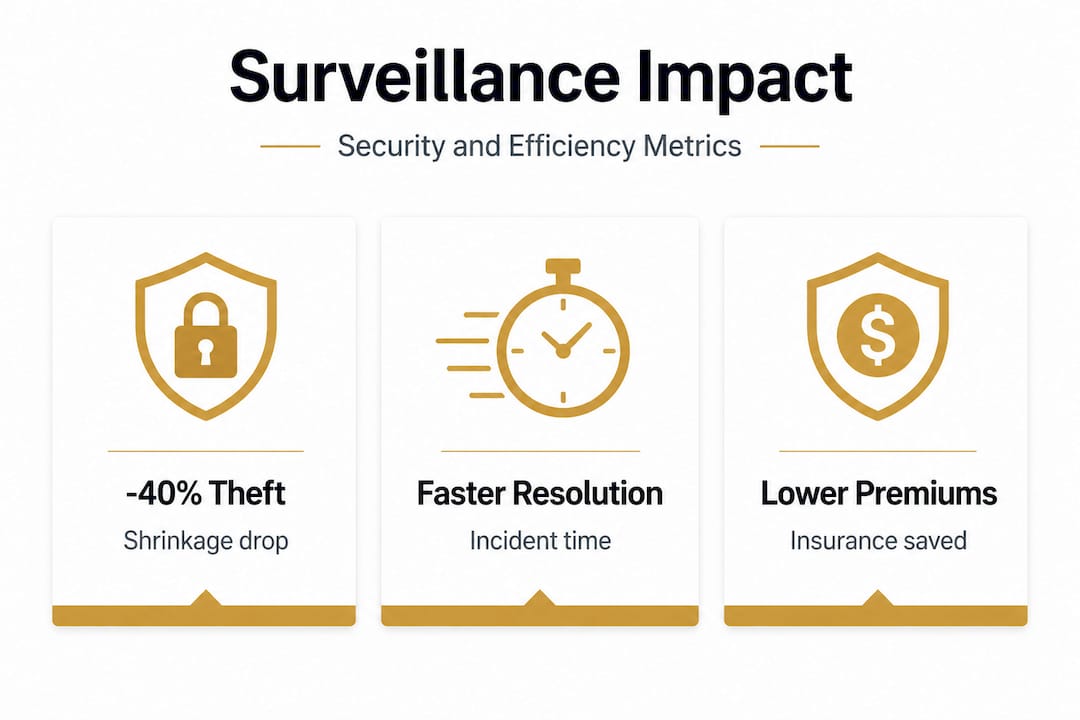
Theft and loss reduction is the most immediate return. Retail businesses in particular see shrinkage, the industry term for inventory lost to theft or error, drop significantly once visible camera systems are in place. The deterrence effect alone pays dividends, because would-be thieves change their behavior when they know they are being recorded.
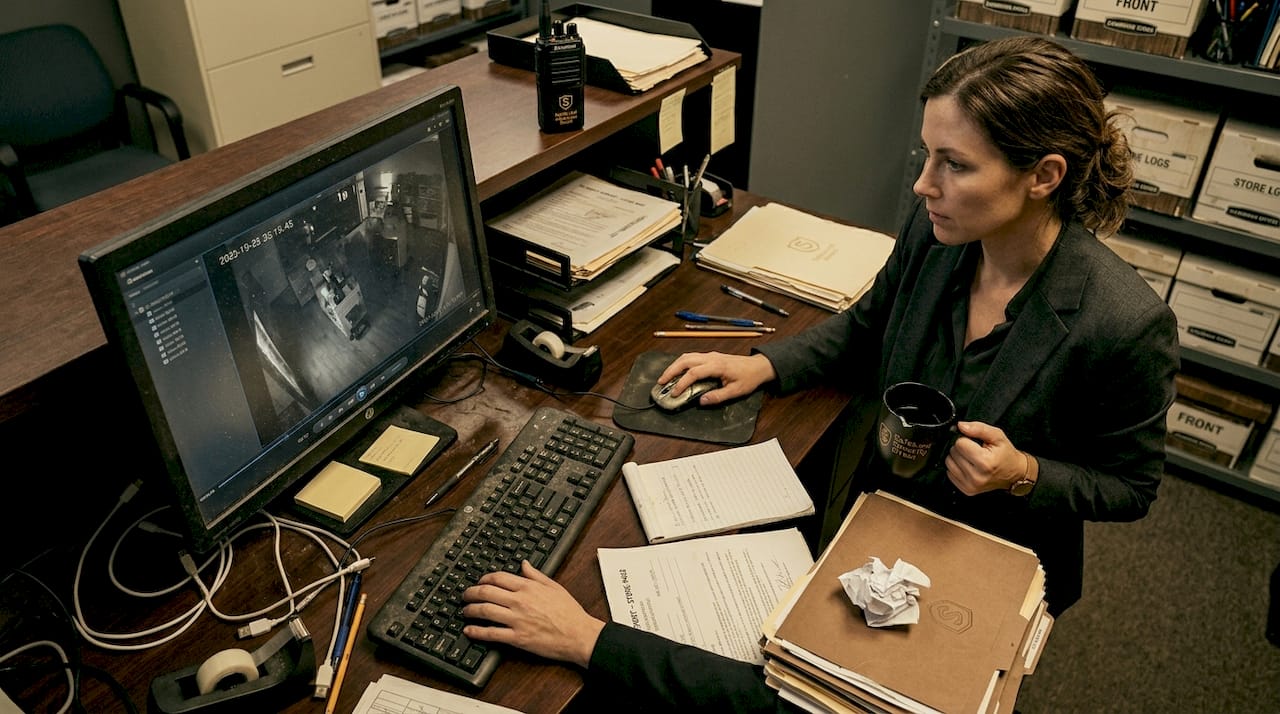
Incident resolution time drops when you have clear footage to review. Instead of spending days interviewing witnesses and piecing together timelines, your team can pull recordings and reach conclusions in hours. This matters enormously for insurance claims, where faster documentation means faster settlement.
Insurance premiums can decrease when insurers see that you have verified, professionally installed surveillance in place. Some carriers offer direct discounts; others factor it into risk scoring. Either way, the long-term cost savings can offset a meaningful portion of your system’s upfront cost.
Process improvement is a benefit that surprises many business owners. Smart monitoring catches problems that managers never see during routine walkthroughs. You might discover that a specific workstation consistently slows your entire production line, or that customer service wait times spike every Tuesday afternoon because of a staffing gap nobody had noticed.
One of the most practical gains is false alarm reduction. Remote monitoring systems that use verified video before dispatching police or security personnel can reduce false alarm rates by up to 97%, which protects your relationship with local law enforcement and eliminates the fines that many jurisdictions now levy for repeated false calls.
However, the benefits come with genuine trade-offs you need to manage. Research on workplace surveillance and privacy consistently highlights privacy erosion, trust loss, and talent attrition as documented risks of poorly managed monitoring programs. Your best performers, employees with options and strong market value, are the ones most likely to leave if they feel surveilled without reason.
Pro Tip: Before selecting your system, involve department heads and even frontline staff in the conversation. Employees who understand why a system is being installed, and who had some input in the process, are far less likely to view it as punitive.
A well-deployed system that is transparent, limited in scope, and clearly explained to staff generates far better business outcomes than a sprawling covert network. Precision matters more than coverage area.
Risks and ethical considerations of surveillance in the workplace
Every operational benefit described above carries a corresponding risk if the system is mismanaged. Business leaders who skip the ethical and legal groundwork often face consequences that far outweigh any efficiency gains they achieved.
Function creep is one of the most well-documented pitfalls. A system installed for efficiency can drift into covert monitoring territory, particularly when AI analytics are added without clear governance. Once employees realize the scope has expanded beyond what they were told, trust collapses fast and rebuilding it is expensive.
Low-accuracy predictive analytics create a specific danger. An AI system that flags an employee as a flight risk or productivity problem based on behavioral patterns is only as good as its training data. When those flags are inaccurate, and they often are, you risk disciplining or losing good employees based on faulty conclusions.
Here is how transparent versus non-transparent surveillance approaches compare in practice:
| Factor | Transparent surveillance | Non-transparent surveillance |
|---|---|---|
| Employee trust | High, when scope is communicated | Low, often permanently damaged |
| Legal risk | Minimal with proper consent | Significant, especially in regulated industries |
| Staff engagement | Maintained or improved | Typically reduced |
| Incident response | Effective with documented process | Legally complicated |
| Turnover impact | Neutral to positive | Often increases attrition |
“The tension between operational oversight and individual liberty is not hypothetical. It plays out every time an employee asks whether the camera above their workstation reports their keystrokes, their movements, or their conversations.” This is why legal insights on workplace monitoring and jurisdictional compliance must come before any deployment decision.
Steps for building a fair and legally sound surveillance policy:
- Define scope clearly. Document exactly what the system monitors, where cameras or sensors are placed, and what data is retained.
- Obtain informed consent. Employees should acknowledge the policy in writing before the system goes live.
- Apply the necessity test. If you cannot justify why a specific monitoring point is necessary for a legitimate business purpose, remove it.
- Limit data retention. Keeping footage for 30 days is standard; holding it indefinitely without purpose creates liability.
- Review regularly. Set a formal review schedule, at least annually, to ensure the system still matches its documented purpose.
- Provide a clear grievance process. Employees should know who to contact if they believe the system has been misused.
These steps are not bureaucratic box-ticking. They are the difference between a surveillance program that strengthens your business and one that triggers regulatory action or litigation.
Best practices for implementing surveillance solutions
To avoid the downsides and maximize rewards, here is how to implement business surveillance the smart way.
Start with a risk audit before you purchase anything. Walk your facility, identify your actual vulnerabilities, and rank them by likelihood and impact. A restaurant chain worries about different risks than a financial services office. Your system should reflect your specific threat profile, not a generic template.
Next, run a legal and compliance check. Privacy laws vary significantly by state and industry. Healthcare, finance, and education all face sector-specific requirements on top of general employment law. Some states require explicit notice to employees; others have specific rules about audio recording in workplaces. Consult legal counsel before deployment.
Pro Tip: Your legal review should cover not just installation but also data storage, access permissions, and what happens to footage when an employee leaves or files a complaint. These downstream scenarios trip up businesses that only check compliance at setup.
Select technology that fits the task. Explore office surveillance solutions that are scalable, integrable with your existing access control or alarm systems, and backed by reliable technical support. Choosing hardware based on price alone often results in systems that fail at critical moments or become obsolete quickly.
When it comes to installation, CCTV placement and setup matters enormously. A camera covering a blind angle that never triggers an incident is wasted resource. Position hardware based on your risk audit, not based on what looks thorough on a floor plan.
Create and distribute your policy before the system goes live. The policy should explain in plain language what is monitored, why, who reviews it, how long data is kept, and what happens if the system captures something unexpected. Staff should read and sign it.
Build feedback loops. After launch, check in with managers and employees at 30, 90, and 180 days. Ask whether the system is doing what it was meant to do, whether there are concerns, and whether any adjustments are needed. Surveillance programs that never get reviewed tend to drift, and drift leads to function creep.
The truth most guides overlook about business surveillance
Most guides give you a checklist and call it done. Install cameras here, write a policy there, consult legal counsel, and you are covered. But in practice, the businesses that get genuine long-term value from surveillance share one quality that checklists cannot manufacture: leadership culture.
We have seen businesses invest in excellent systems, best-in-class surveillance solutions, clear policies, and legal sign-off, and still end up with demoralized teams and no meaningful improvement in security outcomes. Why? Because management treated the system as a substitute for trust rather than a support for it.
Secret surveillance always backfires. It might feel like a way to catch problems without tipping people off, but when employees discover it, and they always do, the damage to morale and retention is severe and long-lasting. The short-term intelligence you gain is never worth the cultural cost.
The most counterintuitive insight from working with businesses across sectors is this: the best surveillance programs are the ones employees barely think about. When a system is transparent, proportionate, and genuinely aligned with business needs rather than management anxiety, it becomes part of the background, like fire alarms and keycard readers. Nobody resents fire alarms because nobody doubts their purpose.
There is also a real danger in the AI-powered surveillance pitch. Vendors increasingly sell platforms promising to predict theft, flag low performers, or detect safety violations before they happen. Some of these tools are genuinely useful; many are not accurate enough to be trusted. When a predictive flag leads to a disciplinary action that turns out to be wrong, you face both a legal problem and a cultural one. Before you buy into algorithmic monitoring, demand documented accuracy rates and independent validation, not just vendor case studies.
The businesses that win with surveillance are the ones solving a clearly defined problem, not the ones buying the most impressive technology available.
Explore advanced business surveillance solutions
Building a surveillance program that actually works for your business requires more than good intentions and a camera budget.

At Safes and Security Direct, we supply professional-grade surveillance systems, cameras, and integrated security products designed for real business environments, not just home use. Whether you are securing a single retail location or managing security across multiple sites, our product range and expert guidance help you match the right technology to your actual risk profile. We understand the balance between operational control and employee trust because we work with business clients who get it wrong and then come to us to get it right. Explore our business security solutions to find equipment that is scalable, compliant-friendly, and built to last.
Frequently asked questions
What types of businesses benefit most from surveillance technology?
Every business with physical premises, inventory, or personnel can benefit, but retail stores, warehouses, offices, and service businesses with mobile workers see the clearest and fastest returns from surveillance investment.
How can I avoid violating employee privacy with surveillance?
Build your program on transparency and consent, document exactly what is monitored and why, and give employees written notice before the system goes live.
Does AI-powered surveillance pose extra risks for my business?
Yes, because predictive analytics with low accuracy can produce false flags that lead to wrongful discipline, employee backlash, and potential legal liability, especially when decisions are made based on automated outputs without human review.
What is “function creep” in surveillance systems?
Function creep occurs when a surveillance system is used beyond its original stated purpose, for example, systems installed for efficiency being repurposed to monitor employee behavior without updated consent or policy documentation.
Should I involve my employees in surveillance implementation?
Yes. Employees who participate in the setup process, understand the purpose of the system, and have access to the policy are far more likely to accept monitoring as legitimate and less likely to experience the trust breakdown that undermines surveillance programs in many businesses.
Recommended
- Streamline your business surveillance workflow for security – Safes and Security Direct
- Office Building Video Surveillance: Enhance Security & Efficiency – Safes and Security Direct
- Optimize Business Security with CCTV Installation – Safes and Security Direct
- Office Building Video Surveillance Solutions – Safes and Security Direct
- How GPS Tracking Boosts Service Business Security