

What Is Secure Payment Processing? 2026 Guide
TL;DR:
- Secure payment processing safeguards sensitive financial data throughout every transaction stage using encryption, tokenization, and authentication. Implementing these technologies reduces fraud, chargebacks, and regulatory fines while enhancing customer trust and long-term savings. Choosing a compliant, technologically advanced provider and maintaining rigorous operational security practices are essential for robust payment protection.
Secure payment processing is defined as the technology and set of practices that protect sensitive financial data during every stage of a transaction, from the moment a customer enters card details to the point funds settle in a merchant’s account. For business owners and finance professionals, understanding how to secure payment processing is not optional. 79% of organizations were targeted by payment fraud, with average breach costs reaching $4.4 million per incident. That figure means a single unprotected transaction flow can cost more than most small businesses earn in years. The core tools behind this protection include encryption, tokenization, fraud detection systems, and compliance frameworks like PCI DSS.
What is secure payment processing and how does it work?
Secure payment processing operates through a chain of interconnected components, each responsible for a specific layer of protection. Understanding this chain helps you identify where your business is exposed and where investment pays off most.
A standard secure transaction moves through five stages:
- Card data capture. The customer enters payment details at checkout. Point-to-point encryption (P2PE) or end-to-end encryption (E2EE) scrambles this data the instant it is captured, before it ever touches your server.
- Gateway transmission. Payment gateways encrypt payment data and securely transmit it between the merchant and the acquiring bank. Providers like Stripe, Square, and PayPal operate as gateways, handling this handoff.
- Authentication. The payment processor verifies the cardholder’s identity using methods like 3-D Secure, CVV checks, or biometric step-up challenges. This step filters out stolen credentials before authorization.
- Fraud detection. Fraud detection systems use machine learning and behavioral analysis to flag suspicious transactions in real time. A transaction from an unusual location combined with a high-value order triggers a review before approval.
- Settlement. The issuing bank approves or declines the transaction. Approved funds move to the merchant account, and tokenized references replace raw card numbers in your records.
Pro Tip: Never let raw card numbers touch your own servers. Use a hosted payment page from your gateway provider so card data flows directly to the processor, keeping your PCI DSS scope as small as possible.
The roles of gateway, processor, and bank are distinct but interdependent. The gateway is the digital equivalent of a point-of-sale terminal. The processor is the back-end operator that routes the transaction between banks. The issuing bank holds the customer’s funds and makes the final authorization call. Weak security at any one point compromises the entire chain.

What are the main benefits of secure payment processing for businesses?
Secure payment processing delivers measurable financial and reputational returns, not just risk reduction. The benefits compound over time, which is why treating security as a cost center rather than an investment is a strategic mistake.
The core advantages for business owners and finance professionals include:
- Lower fraud losses. Tokenized payments show roughly 30% lower online fraud rates and 3 to 4% higher approval rates compared to transactions using raw card numbers. Higher approval rates translate directly to revenue that would otherwise be lost to false declines.
- Fewer chargebacks. Authenticated transactions are harder to dispute fraudulently. Fewer chargebacks mean lower processing fees and less time spent on dispute management.
- Regulatory compliance. PCI DSS compliance is mandatory for any business that processes card data. Non-compliance fines range from $5,000 to $100,000 per month depending on violation severity. Staying compliant avoids those penalties entirely.
- Customer trust and retention. Customers who experience a data breach rarely return. A visible commitment to payment security, such as displaying trust badges and using recognized gateways, reinforces confidence at checkout.
- Long-term cost savings. Businesses investing in secure payment solutions reduce downstream expenses tied to chargebacks, regulatory fines, and reputation damage. The upfront cost of proper security infrastructure is consistently lower than the cost of a single breach.
The reputational dimension is often underestimated. A breach does not just cost money in the immediate term. It triggers customer churn, negative press, and increased scrutiny from payment networks, all of which compound over months and years.
Key security technologies behind secure payment processing
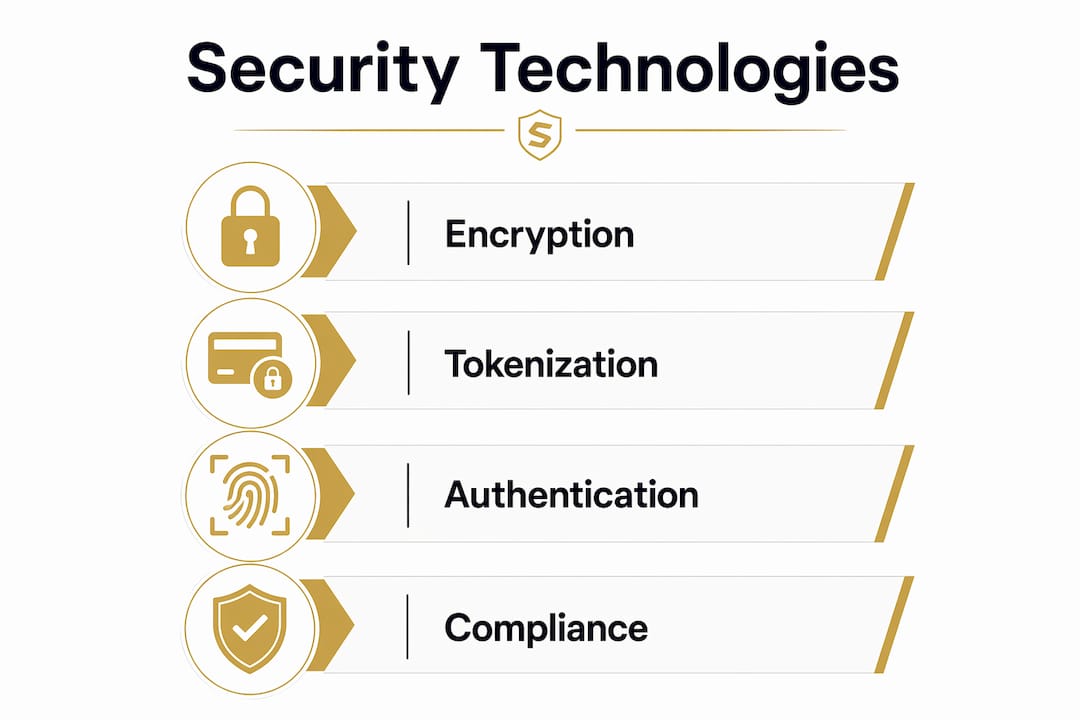
Four technologies form the foundation of any credible payment security architecture. Knowing what each one does, and how they interact, helps you ask the right questions when evaluating providers.
| Technology | What it does | Primary benefit |
|---|---|---|
| SSL/TLS encryption | Scrambles data in transit between browser and server | Prevents interception during transmission |
| Tokenization | Replaces card numbers with non-sensitive tokens | Eliminates raw card data from merchant systems |
| 3-D Secure 2.3.1 | Adds authentication layer at checkout | Reduces fraud while limiting customer friction |
| PCI DSS compliance | Sets security standards for card data handling | Reduces breach risk and avoids regulatory fines |
Encryption scrambles payment data using SSL/TLS protocols, making it unreadable to anyone who intercepts it in transit. Symmetric encryption uses one key for both encryption and decryption, making it fast but requiring secure key management. Asymmetric encryption uses a public key to encrypt and a private key to decrypt, adding a layer of protection for key exchange.
Network tokenization helps merchants avoid storing raw card data entirely, which reduces PCI DSS scope and lowers the risk of a breach exposing usable card numbers. When a token is stolen, it has no value outside the specific merchant system that issued it.
3-D Secure 2.3.1 enables risk-based authentication that challenges only suspicious transactions, rather than adding friction to every purchase. Biometrics and passkeys serve as step-up methods for high-risk transactions, keeping the checkout experience smooth for legitimate customers while blocking fraud attempts.
Pro Tip: Pair network tokenization with a hosted payment page to achieve the smallest possible PCI DSS footprint. This combination means card data never enters your environment, which dramatically simplifies your annual compliance audit.
For businesses looking to align their broader security compliance practices with payment security requirements, the overlap between physical and digital asset protection is larger than most operators realize.
Payment processing security tips every business should follow
Knowing the technologies is only half the work. Applying them consistently through daily operations is where most businesses fall short. These practices address the most common gaps in payment security for small and mid-sized operations.
- Stop storing raw card numbers. Use network tokenization or internal tokenization to offload card data storage to your payment provider. If you do not hold the data, you cannot lose it in a breach.
- Encrypt from the point of capture. Deploy P2PE or E2EE so card data is encrypted before it reaches any system you control. This is the single most effective way to reduce your breach exposure.
- Implement risk-based authentication. Deploy 3-D Secure 2.3.1 with biometric or passkey step-up for transactions that trigger risk signals. Do not apply the same friction to a $12 repeat purchase as you would to a $2,000 first-time order from an unfamiliar device.
- Enable real-time rail controls. Velocity limits and first-payee checks on instant payment systems prevent fraud and scams by capping how quickly funds can move and verifying the recipient before settlement.
- Audit PCI DSS compliance regularly. Do not treat your annual assessment as the only checkpoint. Quarterly internal reviews catch configuration drift before it becomes a violation.
- Restrict administrative access. Use role-based access controls so only authorized staff can view transaction records or modify payment settings. Every unnecessary access point is a potential attack vector.
- Train staff on phishing and social engineering. Most payment fraud starts with a compromised employee credential, not a technical exploit. Regular training on recognizing phishing emails and suspicious requests closes this gap.
For a broader view of how these practices fit into a complete security posture, the 2026 security tips from Safesandsecuritydirect cover both physical and digital vulnerabilities that affect business operations.
How to choose a secure payment provider
Selecting the right payment partner is as important as implementing the right technologies. A provider with weak security practices undermines every internal control you put in place.
Follow this evaluation process when vetting a payment gateway or processor:
- Confirm PCI DSS certification. Ask for the provider’s current Attestation of Compliance (AOC). Any legitimate provider will supply this without hesitation. If they cannot, move on.
- Verify encryption and tokenization standards. Confirm that the provider uses TLS 1.2 or higher for data in transit and offers network tokenization for stored credentials. Providers like Stripe, Adyen, and Braintree publish their security architecture publicly.
- Evaluate fraud detection capabilities. Ask specifically about machine learning-based fraud scoring, velocity checks, and chargeback management tools. A provider that relies solely on static rules will miss sophisticated fraud patterns.
- Assess dispute management support. Chargebacks are inevitable. The question is how quickly and effectively your provider helps you respond. Look for automated evidence collection and dedicated dispute support.
- Test integration against your customer experience. A secure gateway that adds four extra steps to checkout will hurt conversion. Run a test transaction flow and measure where friction appears. The goal is security that customers do not notice.
Payment security now covers the entire transaction journey, including credential collection, payer authentication, and real-time money movement. A provider that only secures one part of that chain leaves the rest exposed. Ask for documentation on how each stage is protected before signing any contract.
Key takeaways
Secure payment processing requires encryption, tokenization, risk-based authentication, and PCI DSS compliance working together to protect every stage of a transaction.
| Point | Details |
|---|---|
| Encryption protects data in transit | SSL/TLS scrambles card data so interception yields nothing usable. |
| Tokenization eliminates raw card storage | Replacing card numbers with tokens removes the most valuable breach target from your systems. |
| Risk-based authentication reduces fraud | 3-D Secure 2.3.1 challenges only suspicious transactions, cutting fraud without hurting conversion. |
| PCI DSS compliance is non-negotiable | Non-compliance fines and breach costs far exceed the cost of maintaining certification. |
| Provider vetting determines your baseline | Your security is only as strong as the weakest link in your payment partner’s infrastructure. |
Why payment security is a business strategy, not just an IT problem
I have spent years watching businesses treat payment security as something the IT department handles once a year before the PCI audit. That framing is the root cause of most preventable breaches I have seen.
The shift that actually changes outcomes is treating payment security as covering the entire transaction journey, not just the backend database. The moment a customer types their card number, the clock starts. Every millisecond between capture and settlement is an opportunity for interception, and most businesses have no visibility into that window.
What I find consistently undervalued is smart authentication. Most operators see any authentication step as a conversion killer and disable it wherever possible. The data says otherwise. Challenging only the transactions that actually look suspicious, using 3-D Secure 2.3.1 with biometric step-up, keeps legitimate customers moving while stopping fraud at the gate. The businesses that implement this correctly see fraud rates drop without any measurable impact on checkout completion.
The cost argument also deserves more honest treatment. Upfront investment in security infrastructure consistently reduces downstream risk from fraud and fines. I have never seen a business that regretted spending on tokenization and proper authentication. I have seen plenty that regretted not doing it after a breach.
Treat payment security as part of your brand promise to customers. When someone hands you their card details, they are extending trust. The businesses that protect that trust build the kind of customer loyalty that no marketing budget can replicate.
— Chetna
Protect your business assets with Safesandsecuritydirect
Physical and digital security are two sides of the same protection strategy for any serious business. Safesandsecuritydirect specializes in professional-grade security solutions that protect the assets behind your financial operations, from fire-resistant and burglary-resistant safes that secure cash and sensitive documents to surveillance systems that monitor your premises around the clock. Whether you are a small business owner protecting daily receipts or a finance professional securing physical records, the right hardware is the foundation of a complete security posture. Explore the full range of business security solutions at Safesandsecuritydirect and build the physical layer that your payment security depends on.
FAQ
What is secure payment processing in simple terms?
Secure payment processing is the use of encryption, tokenization, and authentication to protect card and financial data during every stage of a transaction. The goal is to prevent fraud and unauthorized access from the moment payment details are entered to when funds settle.
How secure is online payment processing today?
Online payment processing is significantly more secure than a decade ago, largely due to PCI DSS compliance requirements and the widespread adoption of tokenization and 3-D Secure authentication. However, 79% of organizations still report being targeted by payment fraud, which means no system is immune without active management.
What are the most secure payment methods for businesses?
Tokenized card payments processed through PCI DSS-certified gateways like Stripe, Adyen, or Braintree represent the most secure standard for business transactions today. Combining tokenization with 3-D Secure authentication and real-time fraud detection provides the strongest available protection.
Why is PCI DSS compliance required for payment security?
PCI DSS sets the minimum security standards for any business that stores, processes, or transmits cardholder data. Non-compliance exposes businesses to fines between $5,000 and $100,000 per month and increases breach risk by leaving known vulnerabilities unaddressed.
How does tokenization improve payment security?
Tokenization replaces a customer’s actual card number with a randomly generated token that has no value outside the specific transaction context. Even if a token is intercepted or stolen, it cannot be used to make fraudulent purchases or reconstruct the original card data.
Recommended
- Business security checklist 2026: protect your SME assets – Safes and Security Direct
- Best Security Tips 2026 for Homes and Businesses – Safes and Security Direct
- Top Security Trends Transforming Safety in 2026 – Safes and Security Direct
- How to create security protocols that protect your business in 2026 – Safes and Security Direct