

What Is Burglary Resistance? A Homeowner's Guide
TL;DR:
- Burglary resistance measures a property’s ability to withstand forced entry, rated by tools and time required. EN 1627 classifies doors and windows into Resistance Classes RC1 through RC6, with higher classes offering greater delay. Layered security strategies combining hardware, lighting, and surveillance significantly increase protection and deter most break-in attempts.
Burglary resistance is defined as a property’s measurable ability to withstand forced entry, rated by how long and with what tools an intruder must work before gaining access. The industry standard for this measurement is EN 1627, a European certification framework that classifies doors, windows, and frames into six Resistance Classes (RC1 through RC6). Each class specifies a minimum delay time and the type of tools an attacker would need to defeat it. For homeowners and business owners, understanding these classifications is the difference between security that looks good and security that actually holds.
What is burglary resistance and how is it measured?
Burglary resistance is the formal term for how well a physical barrier, such as a door, window, or safe, delays a forced entry attempt. The EN 1627 standard is the primary benchmark used across the security industry to define and test this capability. Under EN 1627, resistance classes RC1–RC6 define protection levels based on time delay and the tools required to breach a barrier.

The logic behind the standard is straightforward. Burglars work fast. Typical burglaries last about two and a half minutes, which means any barrier that adds meaningful delay dramatically increases the chance of deterrence. A door rated RC2 forces an attacker to spend at least three minutes using simple tools. That extra time is often enough to cause an opportunist to abandon the attempt entirely.
One critical detail most buyers miss: a certified door system must include the door leaf, frame, and all hardware certified together to earn a valid resistance class rating. Buying a high-rated door leaf and fitting it in a weak frame voids the classification entirely.
What are the burglary resistance classes?
The six EN 1627 Resistance Classes cover everything from a basic residential front door to a vault protecting high-value assets. Each class is defined by the tools an attacker uses and the minimum time the barrier must withstand them.
| Resistance Class | Minimum Delay | Attack Method | Typical Application |
|---|---|---|---|
| RC1 | Body force only | Shoulder barging, kicking | Basic interior doors |
| RC2 | 3 minutes | Simple tools: screwdrivers, wedges | Standard residential entry doors |
| RC3 | 5 minutes | Crowbars, second-class lever tools | Upgraded residential, small retail |
| RC4 | 10 minutes | Power drills, jigsaws | Commercial premises, high-risk homes |
| RC5 | 15 minutes | High-powered electric tools | Banks, jewelry stores, government buildings |
| RC6 | 20+ minutes | Specialized professional tools | Vaults, embassies, critical infrastructure |
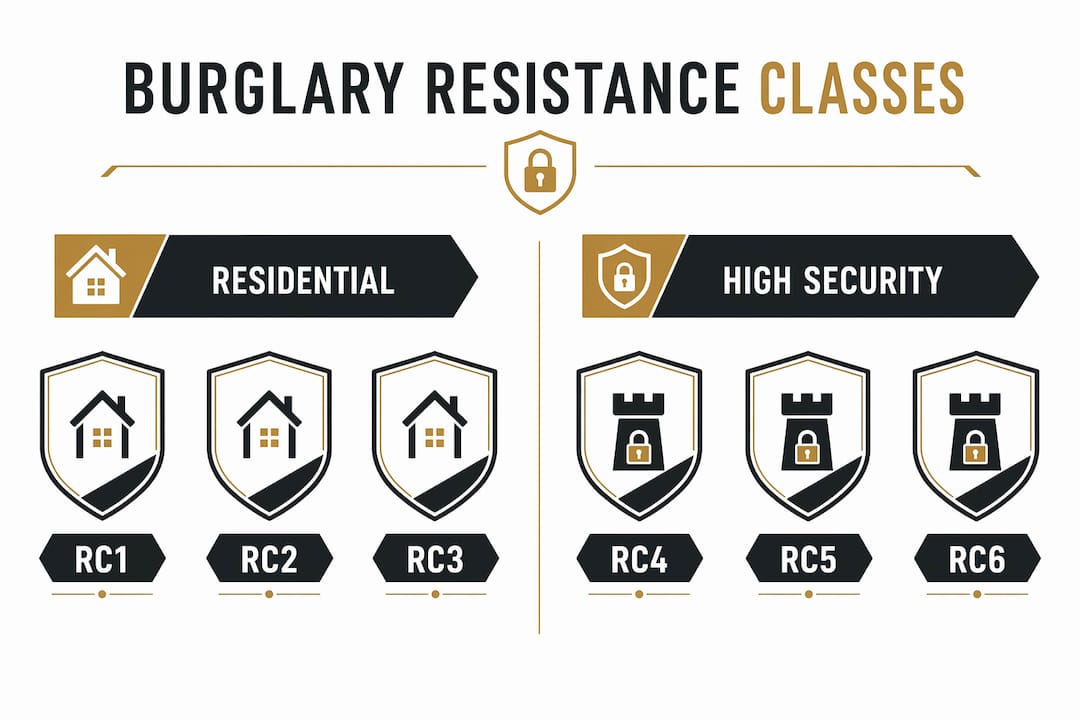
Most residential properties need at least RC2 for doors and windows to meet a baseline standard of protection. RC2 is considered the minimum for homes in moderate-risk areas. Business owners in retail, hospitality, or financial services should look at RC3 or RC4 as a starting point, depending on what they store on site.
RC5 and RC6 are not typical residential territory. These classes require specialist installation and are reserved for environments where the contents justify the cost of professional-grade barriers and the time investment of a determined, skilled attacker.
Why layered security multiplies your protection
Burglary resistance hardware is the foundation of a security plan, not the whole structure. The goal of any good security setup is to introduce friction: delay, noise, and visibility that discourage opportunistic intruders before they even try. Layered security can deter 80–95% of break-in attempts when multiple measures are combined. That number reflects the compounding effect of stacking deterrents.
Here is what a practical layered approach looks like for a home or small business:
- Motion-sensor lighting reduces crime by approximately 36% by eliminating the cover of darkness that opportunists rely on.
- Visible alarm signs cause approximately 60% of offenders to bypass a property entirely, according to surveys of convicted burglars.
- Surveillance cameras placed at entry points create a record and signal active monitoring.
- Perimeter barriers such as upgraded residential fencing add a physical outer layer before an intruder ever reaches your door.
- Simulated occupancy through timed lighting and smart plugs signals that someone is home, which is the single biggest deterrent for opportunists.
Burglars prioritize ease of entry and anonymity. A property that looks occupied, well-lit, and monitored is almost always skipped in favor of an easier target nearby.
Pro Tip: The most overlooked deterrent is also the cheapest. A $15 timer on a living room lamp does more to deter an opportunist than an unmonitored camera with no visible signage.
How to improve burglary resistance at your property
Knowing the standards is useful. Knowing where your property is actually weak is more useful. Most forced entries do not defeat the lock. They defeat the frame around it.
Here are the most impactful upgrades you can make, ranked by effect:
-
Reinforce the door jamb. Using 3-inch screws through the strike plate into the wall stud dramatically increases resistance against kick-ins. Standard half-inch screws fail almost instantly under a single hard kick. Three-inch screws anchor the strike plate into structural wood, not just the door frame molding.
-
Upgrade to a multi-point locking system. A single-point deadbolt locks at one spot. A multi-point system engages the frame at three or more points simultaneously, distributing force across the entire door height.
-
Assess your glazing. Glass panels in or beside doors are a common bypass route. Laminated or glazing resistance class rated glass resists smashing and cutting. Standard single-pane glass offers almost no resistance.
-
Trim shrubs and hedges near entry points. Concealment is a burglar’s best friend. Removing hiding spots near doors and ground-floor windows forces any attacker into plain view of neighbors and passing traffic.
-
Check all secondary entry points. Back doors, garage doors, and basement windows are frequently the weakest points on a property. Many homeowners invest in a high-rated front door and leave a hollow-core back door on a basic latch.
Pro Tip: Proper installation and maintenance of security hardware matter more than the hardware’s price tag. A well-installed RC2 door outperforms a poorly fitted RC4 door every time. Have a qualified installer check your existing hardware before buying anything new.
For a broader checklist of entry-point vulnerabilities, the practical guide for homeowners from Safesandsecuritydirect covers low-cost fixes that deliver real results.
How burglary resistance standards apply to safes
Safes operate under a separate but related set of burglary resistance classifications. The tools and attack methods used against a safe differ significantly from those used against a door. Safe burglary resistance classes specify resistance to drills, grinders, cutting instruments, and prying tools that are specific to attacking a steel enclosure rather than a door frame.
The most widely referenced standards for safes include EN 1143-1, which grades safes from Grade 0 through Grade VI. Higher grades require longer resistance times against more aggressive tool attacks.
| Safe Grade | Resistance Focus | Typical Use Case |
|---|---|---|
| Grade 0 | Basic prying and impact | Home use, low-value storage |
| Grade I | Simple hand tools | Residential, small business cash |
| Grade II | Power tools, short duration | Small retail, office environments |
| Grade III | Extended power tool attack | Jewelry stores, pharmacies |
| Grade IV–VI | Specialist tools, long duration | Banks, high-value commercial vaults |
For most homeowners, a Grade I or Grade II safe provides adequate protection for documents, jewelry, and moderate amounts of cash. Business owners storing significant inventory value or large cash floats should look at Grade III as a minimum. The key distinction from door resistance is that safe ratings account for the enclosure itself, not the installation environment. A Grade II safe bolted to a concrete floor is far harder to defeat than the same safe left freestanding.
For guidance on choosing the right certified option, Safesandsecuritydirect has a detailed breakdown of burglary-resistant safes for urban owners that maps grades to real-world use cases.
Key takeaways
Burglary resistance is most effective when certified hardware, proper installation, and layered deterrents work together as a system rather than as isolated upgrades.
| Point | Details |
|---|---|
| EN 1627 defines the standard | Resistance Classes RC1–RC6 rate doors and windows by delay time and attack method. |
| RC2 is the residential baseline | Most homes need at least RC2 for doors and windows to meet a minimum protection standard. |
| Layered security multiplies deterrence | Combining hardware with lighting, alarms, and cameras can deter 80–95% of break-in attempts. |
| Door jamb is the weakest point | Reinforcing the strike plate with 3-inch screws into wall studs prevents the most common forced entry method. |
| Safe grades differ from door ratings | EN 1143-1 grades safes separately, with Grade I–II suited for most residential and small business needs. |
The part most security articles skip
By Chetna
After years of working in the security space, the pattern I see most often is this: homeowners spend money on the wrong thing first. They buy a smart lock with an app and a fingerprint reader, then leave it installed in a door frame held together by half-inch screws and a hollow-core door. The technology looks impressive. The actual resistance is close to zero.
The uncomfortable truth about burglary resistance is that it is mostly a maintenance and installation problem, not a product problem. Most properties already have hardware that would perform adequately if it were installed correctly and kept in working order. Locks that are not fully engaged, frames that have shifted over years of use, and hinges with loose screws are far more common than people realize.
My honest recommendation: before you spend anything on new hardware, walk your property with fresh eyes. Test every lock. Push every door. Look at every window latch. You will almost certainly find something that costs nothing to fix but meaningfully improves your protection. Then layer up from there. The combination of security layers is what creates a genuinely hard target. No single product does that alone.
— Chetna
Upgrade your property’s security with Safesandsecuritydirect

Safesandsecuritydirect stocks a full range of certified security products designed for homes and businesses at every protection level. From EN 1627-rated door hardware and multi-point locking systems to EN 1143-1 graded safes, every product on the platform is selected for verified performance, not just appearance. Whether you are reinforcing a residential front door or securing a commercial premises against determined attack, the security solutions at Safesandsecuritydirect cover every layer of a complete protection plan. Browse the full catalog to find certified products matched to your resistance class requirements and budget.
FAQ
What does burglary resistance mean for a door?
Burglary resistance for a door is its rated ability to delay forced entry, measured under EN 1627 standards. The rating covers the door leaf, frame, and hardware together as a certified system.
What resistance class do i need for my home?
RC2 is the minimum recommended class for residential entry doors and windows. Higher-risk properties or those in areas with elevated crime rates should consider RC3 or above.
How do burglary resistance classes work for safes?
Safe burglary resistance is graded separately under EN 1143-1, from Grade 0 to Grade VI. Each grade specifies resistance against progressively more aggressive tools and longer attack durations.
Does a high-rated door guarantee i won’t be burgled?
No single product guarantees complete protection. A certified door significantly raises the difficulty of forced entry, but layered deterrents including alarms and lighting are required to maximize overall security.
What is the most common way burglars enter a property?
Kick-ins through the door jamb are the most frequent forced entry method. Reinforcing the strike plate with 3-inch screws anchored into wall studs is the single most cost-effective fix for this vulnerability.
Recommended
- Burglary-Resistant Safe: Protecting Urban Homes – Safes and Security Direct
- Burglary Protection – How It Safeguards Your Home – Safes and Security Direct
- How to prevent break-ins: a practical guide for homeowners – Safes and Security Direct
- 15 essential property security tips for homes and businesses – Safes and Security Direct