

What Is Anti-Tamper Design? A Guide for Engineers
TL;DR:
- Anti-tamper design combines layered prevention, detection, and response techniques to make unauthorized modifications observable, costly, and ultimately futile.
- It relies on hardware roots of trust like TPMs and PUFs, along with multi-layered software protections such as obfuscation, integrity checks, and RASP, for comprehensive security.
Anti-tamper design is defined as a layered set of techniques combining prevention, detection, response, and evidence to deter and mitigate unauthorized access or alteration of hardware, software, or firmware. The goal is not just to block attackers but to make tampering observable, expensive, and ultimately futile. Engineers working on embedded systems, cryptographic hardware, and firmware-dependent products treat anti-tamper design as a core discipline, not an optional add-on. From UEFI Secure Boot to physically unclonable functions (PUFs) and Runtime Application Self-Protection (RASP), the field spans both silicon and software.
What is anti-tamper design and how does it work?
Anti-tamper design is the strategic integration of preventive, detective, and responsive measures engineered to protect critical systems from unauthorized modification. The discipline covers three distinct layers: passive resistance, active detection, and automated response. Each layer addresses a different phase of an attack, and together they form a defense-in-depth architecture that no single technique can replicate alone.

Passive resistance makes a system harder to analyze or modify in the first place. Code obfuscation, for example, modifies binaries to disguise logic without affecting function. It renames variables, alters control flow, and inserts redundant instructions to slow down reverse engineering. This does not stop a determined attacker permanently, but it raises the cost and time required significantly.
Active detection monitors the system at runtime for signs of tampering. Integrity checks compare running code against known-good hashes. Anti-debugging routines detect when a debugger is attached and trigger a controlled failure or lockout. These methods shift the security posture from purely reactive to continuously vigilant.
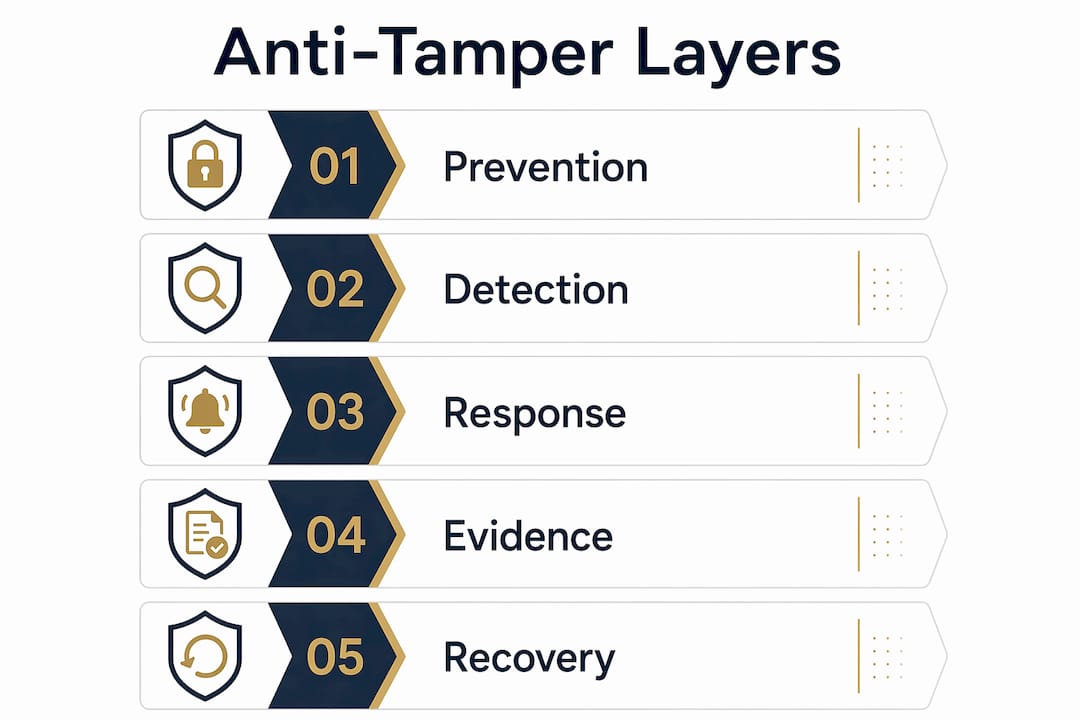
Automated response closes the loop. Once tampering is confirmed, the system takes a predefined action: wiping cryptographic keys, locking the boot sequence, or logging a tamper event for forensic review. This response layer is what separates a hardened system from one that merely tries to hide.
Core hardware components
The hardware side of anti-tamper design relies on several well-established technologies:
- Trusted Platform Modules (TPMs): Store cryptographic keys in tamper-resistant hardware, making key extraction attacks far harder than software-only key storage.
- Physically Unclonable Functions (PUFs): Generate device-unique identifiers from manufacturing variations in silicon. No two PUFs produce the same output, making cloning nearly impossible.
- Secure elements and cryptographic coprocessors: Provide isolated execution environments for sensitive operations, shielding them from the main processor’s attack surface.
- UEFI Secure Boot: Cryptographically verifies signatures for bootloaders and kernel modules at each boot stage, blocking tampered code before it executes.
Pro Tip: Design your hardware root of trust (HRoT) before writing a single line of application firmware. Retrofitting trust anchors into an existing design is significantly more expensive and less reliable than building them in from the start.
Prevention vs. detection: understanding the tradeoffs
No anti-tamper design guarantees absolute security. The field is an arms race where attackers evolve tactics to bypass defenses, and defenders must evolve in parallel. Accepting this reality is the first step toward designing systems that are genuinely resilient rather than falsely confident.
The distinction between passive resistance and active detection matters enormously in practice. Passive measures like obfuscation buy time. Active measures like runtime integrity checks generate signals. Neither is sufficient alone. A system that only obfuscates its code will eventually be reverse engineered. A system that only monitors at runtime can be bypassed by an attacker who modifies the monitoring logic itself.
This is why practitioners anchor trust in immutable hardware roots rather than software verifiers. If the verifier lives in modifiable memory, an attacker can disable it before it fires. A hardware root of trust lives outside the attacker’s reach, providing a fixed reference point that software cannot overwrite.
The following sequence describes how a well-designed chain of trust operates during system startup:
- The immutable boot ROM executes first and verifies the first-stage bootloader’s cryptographic signature.
- The first-stage bootloader verifies the second-stage bootloader, and so on through each firmware layer.
- Each stage only executes if the previous stage’s verification passes, creating a chain-of-trust boot mechanism that blocks rollback attacks and tampered stages.
- If any stage fails verification, the system halts or enters a safe recovery mode rather than continuing with compromised code.
- Tamper events are logged to a secure audit trail, providing forensic evidence even when the attack is ultimately stopped.
“Effective anti-tamper designs ensure no device or data can be altered undetected, focusing on detection and prevention as core principles rather than just restriction or DRM.” — Mercury Systems
Treating anti-tamper as a late-stage addition is one of the most common and costly mistakes in product development. Security bolted on after the fact typically lacks the hardware anchors needed to make detection trustworthy.
What hardware sensors protect embedded systems from tampering?
Physical anti-tamper sensors are the front line of defense for embedded systems, IoT devices, and secure hardware modules. These sensors detect anomalies in the physical environment that indicate an attack is in progress or has already occurred.
| Sensor Type | What It Detects | Typical Response |
|---|---|---|
| Voltage sensors | Power glitching attacks that force logic errors | Key zeroization, system halt |
| Clock sensors | Frequency manipulation to skip instructions | Boot lockdown, tamper log |
| Temperature sensors | Extreme cold or heat used to freeze memory | Alert and controlled shutdown |
| EMFI sensors | Electromagnetic fault injection probes | Immediate key erasure |
| Magnetic field sensors | Magnetic probes used to manipulate memory cells | Tamper flag and lockout |
Anti-tamper sensors detect physical tampering via voltage, clock, temperature, electromagnetic, and magnetic anomalies, then trigger containment actions automatically. Integration with a hardware root of trust enables responses like key zeroization and boot lockdown without any software intervention, which is critical because software-level responses can be bypassed if the attacker has already compromised the OS.
Multi-modal sensor approaches provide layered detection. A single voltage sensor can be fooled by a carefully calibrated glitch attack. Combining voltage, clock, and temperature monitoring forces an attacker to defeat all three simultaneously, which is exponentially harder.
Sensor calibration is one of the most underappreciated challenges in this space. Threshold calibration across process, voltage, and temperature corners is critical to balance detection sensitivity against false positive rates. A sensor tuned too aggressively will trigger during normal operating conditions, causing system failures in the field. A sensor tuned too loosely will miss real attacks. Fault injection testing during validation is the standard method for finding the right balance.
Compliance frameworks including FIPS 140-3 and Common Criteria explicitly require physical tamper detection and response capabilities for certified devices. Meeting these standards is not just a checkbox exercise. It forces design teams to document their sensor coverage, response logic, and test methodology in ways that expose gaps early.
Pro Tip: Run fault injection testing on your sensor thresholds before tape-out, not after. Discovering that your voltage sensor misses a 50ns glitch during silicon validation is far cheaper than discovering it in a deployed product.
How does anti-tamper software protect applications at runtime?
Software anti-tamper mechanisms protect applications through their entire lifecycle, from the build pipeline through deployment and into production. The discipline covers both static hardening applied before deployment and dynamic protection active during execution.
Static protections applied at build time include:
- Code obfuscation: Transforms readable logic into functionally equivalent but analysis-resistant code, complicating reverse engineering without changing behavior.
- White-box cryptography: Stores and operates on keys in fully exposed environments without revealing the key material, protecting secrets even when an attacker has full access to memory.
- Checksum and hash embedding: Embeds integrity values into the binary that the application verifies at startup and periodically at runtime.
- Anti-debugging routines: Detect the presence of debuggers like GDB or WinDbg and trigger a controlled failure before sensitive logic executes.
Dynamic protections active during execution include:
- Runtime Application Self-Protection (RASP): Detects tampering during program execution and triggers shutdown or recovery actions. RASP operates from inside the application, giving it visibility that perimeter defenses lack.
- Integrity monitoring: Continuously compares loaded code segments against known-good hashes, catching in-memory patches applied by attackers after the application starts.
- Anti-repackaging checks: Verify that the application’s signing certificate and package metadata match expected values, blocking modified APKs or redistributed binaries.
The OWASP MASVS-RESILIENCE framework treats anti-tamper as a key component of resilience against reverse engineering and client-side attacks, with specific controls for integrity verification, anti-debugging, and obfuscation. Following MASVS-RESILIENCE gives mobile and embedded application teams a structured checklist rather than an ad hoc approach.
Static Application Security Testing (SAST) tools like Checkmarx and Veracode identify vulnerabilities before deployment. Dynamic Application Security Testing (DAST) tools exercise the running application to find weaknesses that static analysis misses. Neither replaces runtime protection, but both reduce the attack surface that runtime defenses must cover.
The most effective software anti-tamper strategy combines multiple layers: obfuscation to slow analysis, integrity checks to detect modification, RASP to respond at runtime, and white-box cryptography to protect keys even under close scrutiny. Relying on any single technique creates a single point of failure that a skilled attacker will eventually find.
Key takeaways
Anti-tamper design requires hardware roots of trust, multi-layer software protection, and automated sensor-driven responses working together to make tampering observable and expensive rather than merely difficult.
| Point | Details |
|---|---|
| Layer your defenses | Combine passive obfuscation, active runtime checks, and hardware-anchored verification for genuine depth. |
| Anchor trust in hardware | TPMs, PUFs, and secure elements protect keys and verification logic outside attacker-controlled memory. |
| Calibrate sensors carefully | Voltage, clock, and temperature sensor thresholds must be validated through fault injection testing to avoid false positives. |
| Integrate early | Anti-tamper design built into the architecture from day one is more reliable and less costly than retrofitted security. |
| Accept the arms race | No design is permanently secure. Build for detection and response, not just prevention, to stay ahead of evolving attacks. |
Why I think most teams underestimate the hardware side
Most of the engineers I work with arrive focused on software protections. They want to know about obfuscation tools, RASP libraries, and code signing pipelines. Those are all legitimate concerns, but they consistently underweight the hardware side until something goes wrong.
The uncomfortable reality is that software anti-tamper measures are only as trustworthy as the environment they run in. If an attacker can modify the OS, the RASP library, or the integrity check routine itself, your software defenses collapse. A hardware root of trust changes that equation entirely. It gives you a fixed reference point that software cannot touch, and that changes what detection actually means.
I have also seen teams treat sensor calibration as a validation afterthought rather than a design requirement. The result is products that either false-trigger in the field or miss real attacks in testing. Getting threshold calibration right requires fault injection testing across the full operating range, and that work needs to be scoped into the project timeline from the beginning.
The other pattern worth calling out is the tendency to treat compliance certification as the finish line. FIPS 140-3 and Common Criteria certification proves that your design met a defined bar at a point in time. Attackers do not stop innovating after your certificate is issued. Continuous monitoring, periodic threat modeling updates, and a clear process for responding to newly discovered vulnerabilities are what keep a certified product secure over its operational life.
For teams building layered security systems that span both physical and digital domains, the integration between hardware tamper detection and software response logic is where most of the real engineering work lives. Get that integration right, and the rest of the design falls into place.
— Chetna
Protect your assets with trusted security solutions from Safesandsecuritydirect

Safesandsecuritydirect offers a curated range of physical security products designed with tamper resistance and detection at their core. From fire-resistant and burglary-resistant safes with reinforced locking mechanisms to professional-grade surveillance systems that log access events, every product is selected for engineers and security professionals who need solutions that hold up under real-world attack conditions. Whether you are specifying hardware for a commercial installation or hardening a residential setup, the catalog at Safesandsecuritydirect gives you reliable, tested options backed by detailed specifications. Pair physical security hardware with the burglary protection principles covered in the Safesandsecuritydirect knowledge base to build a defense that covers both the digital and physical attack surface.
FAQ
What is anti-tamper design in simple terms?
Anti-tamper design is a set of engineering techniques that prevent, detect, and respond to unauthorized modifications of hardware or software. It combines passive measures like obfuscation with active measures like runtime integrity checks and hardware-enforced verification.
How does anti-tamper software work?
Anti-tamper software uses code obfuscation to complicate reverse engineering, runtime integrity checks to detect in-memory modifications, and RASP to trigger controlled responses when tampering is confirmed. White-box cryptography protects keys even when an attacker has full access to the running process.
What hardware components are used in anti-tamper design?
TPMs, PUFs, secure elements, and cryptographic coprocessors are the primary hardware components. UEFI Secure Boot and chain-of-trust boot mechanisms use these components to verify each firmware stage before execution.
Can anti-tamper design guarantee complete security?
No. Anti-tamper design cannot guarantee absolute security because the field is an ongoing arms race between defenders and attackers. The goal is to make tampering observable and expensive rather than impossible, with detection and response mechanisms that limit damage when prevention fails.
What compliance standards require anti-tamper features?
FIPS 140-3 and Common Criteria both require documented physical tamper detection and response capabilities for certified devices. Meeting these standards forces design teams to validate sensor coverage, response logic, and test methodology before certification.
Recommended
- How to prevent break-ins: a practical guide for homeowners – Safes and Security Direct
- Asset Protection Workflow Guide for Maximum Security – Safes and Security Direct
- How Safes Prevent Theft: Real Protection Explained – Safes and Security Direct
- Top Steelwater Gun Safes: Fireproof & Secure Storage – Safes and Security Direct