

Explaining Safe Ratings: What Every Buyer Must Know
TL;DR:
- Safe ratings measure resistance to specific threats like burglary and fire, but only within controlled test scenarios.
- Matching the rating category to your assets and real-world risks is essential for effective protection, not just chasing higher numbers.
Safe ratings are standardized measures that indicate how well a safe resists specific threats, including burglary and fire, based on rigorous testing by independent certification bodies. Explaining safe ratings clearly matters because the label on a safe’s door determines whether your valuables survive a break-in or a house fire. Ratings issued by organizations like Underwriters Laboratories (UL) and Intertek (ETL) translate complex engineering tests into readable classifications. Understanding what those classifications actually mean, and where they fall short, separates buyers who get real protection from those who pay for a false sense of security.
What are the main types of safe ratings?
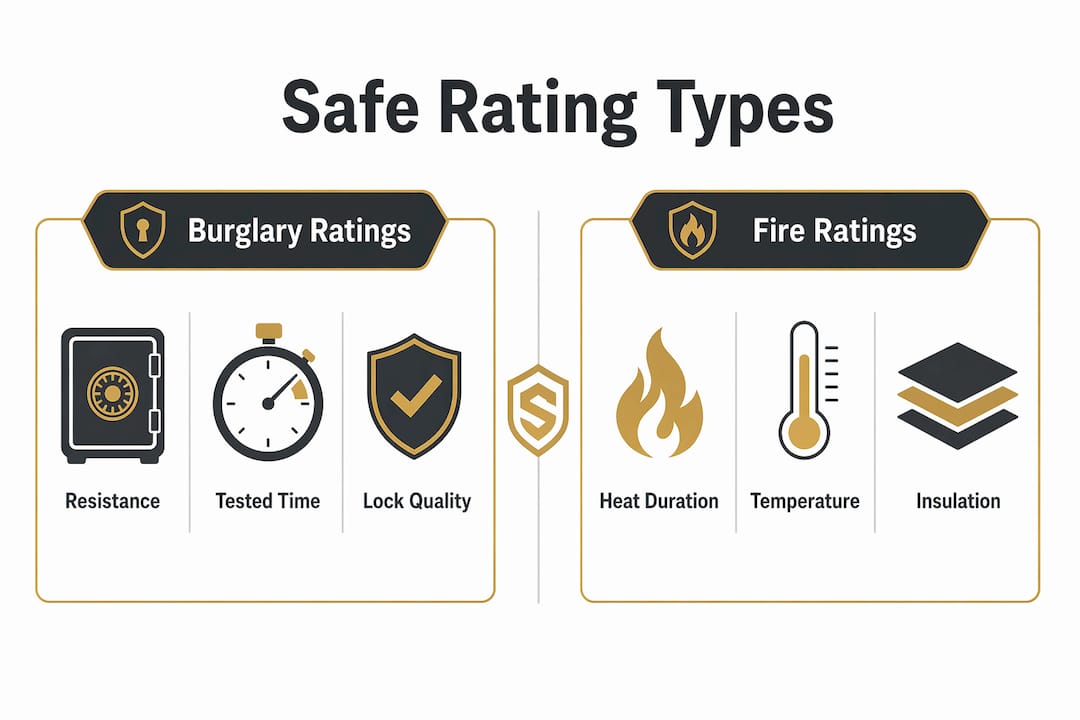
Safe ratings fall into two primary categories: burglary ratings and fire ratings. Each measures a completely different threat, and a high score in one category tells you nothing about performance in the other.
Burglary ratings: construction and resistance
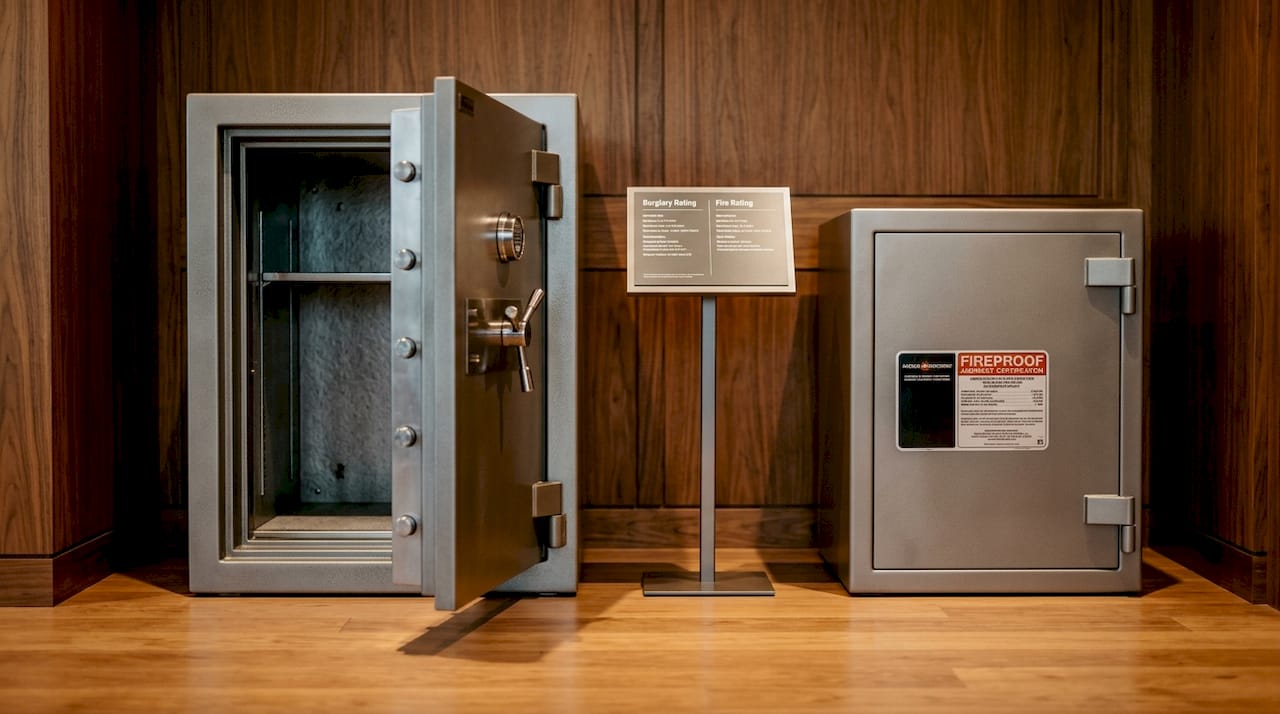
Burglary ratings measure a safe’s physical resistance to forced entry. The most common classifications in the United States run from Class B through high-security TL-rated safes. Class B and C safes differ in steel thickness: a Class C safe uses a 1-inch steel door and half-inch steel body walls, doubling the steel thickness of a Class B model. TL-15 and TL-30 ratings, issued by UL, indicate that a safe withstood a tool attack for 15 or 30 minutes respectively under controlled test conditions. These ratings also specify which tools testers used, typically drills, grinding wheels, and pry bars, so the label carries precise meaning.
Fire ratings: time and temperature
Fire ratings measure how long a safe keeps its interior below a critical temperature threshold during a standardized fire test. A 60-minute fire rating means the safe theoretically maintained content temperatures below the damage threshold for 60 minutes under test conditions. Paper ignites at 451°F, so most fire-rated safes for documents are tested to keep interiors below that point. Digital media and magnetic storage require even lower thresholds, typically below 125°F, which is why media-rated safes carry separate, stricter certifications. Longer ratings, such as 90 or 120 minutes, provide more buffer time for fire departments to respond, but they do not guarantee zero damage.
Side-by-side comparison of common safe ratings
| Rating | Category | Testing Body | Key Criteria |
|---|---|---|---|
| Class B | Burglary | Insurance industry | Steel door under 1 inch thick |
| Class C | Burglary | Insurance industry | 1-inch steel door, 0.5-inch body walls |
| TL-15 | Burglary | UL | Resists tool attack for 15 minutes |
| TL-30 | Burglary | UL | Resists tool attack for 30 minutes |
| 30-Minute Fire | Fire | UL, Intertek (ETL) | Interior stays below 350°F for 30 minutes |
| 60-Minute Fire | Fire | UL, Intertek (ETL) | Interior stays below 350°F for 60 minutes |
| 120-Minute Fire | Fire | UL, Intertek (ETL) | Interior stays below 350°F for 120 minutes |
Key features to look for on any rating label include:
- Certification body: UL, ETL (Intertek), or an insurance-recognized standard
- Test duration: Minutes or hours of resistance under defined conditions
- Steel thickness: Door and body wall specifications for burglary ratings
- Temperature threshold: Interior temperature limit for fire ratings
- Content type: Paper, media, or data-specific protection levels
Common misconceptions about safe ratings
Safe rating labels compress complex testing criteria into a short phrase that can mislead buyers who treat them as absolute guarantees. The rating reflects a single controlled test scenario, not every real-world threat combination you might face. A TL-30 safe tested in a laboratory does not account for a determined thief with unlimited time, specialized equipment, or knowledge of the safe’s weak points.
One of the most persistent misunderstandings is that a higher rating always means a better safe for every situation. A TL-30 safe weighs several hundred pounds and costs significantly more than a 60-minute fire-rated safe. If your primary concern is protecting paper documents in a home office, a quality fire-rated safe from a certified manufacturer may serve you better than an expensive burglary-rated model with no fire protection at all.
Rating systems also vary across organizations and countries. UL standards dominate the North American market, while European safes often carry EN 1143-1 certifications with their own grading scales. These systems are not directly interchangeable, so comparing a UL TL-30 to a European Grade III safe requires understanding both frameworks. Ratings arise from comprehensive risk analysis including hazards, exposure, and product-specific testing, but the final label cannot cover every real-world variation.
Supplementary features like relockers, hard plates, and anti-drill protection add meaningful security that ratings alone do not capture. A safe with a TL-15 rating plus a glass relocker and hardened steel plate may outperform a bare TL-30 in certain attack scenarios.
Pro Tip: Always read the full certification details, not just the headline rating. Ask the manufacturer or retailer for the specific test report number so you can verify the certification is current and applies to the exact model you are purchasing.
How to assess and compare safe ratings when buying
Evaluating safe ratings effectively starts with identifying what you need to protect and the realistic threats you face. A jewelry store owner faces different risks than a homeowner storing a passport and some cash. Matching the rating to the threat is the core of smart safe selection.
Start by listing your assets and their vulnerability. Paper documents need fire protection above all else. Cash and jewelry need burglary resistance. Hard drives and USB drives need media-rated fire protection. Once you know what you are protecting, you can prioritize which rating category matters most and use the fireproof safe selection guide at Safesandsecuritydirect to narrow your options.
Next, check your insurance requirements. Many commercial insurers specify minimum safe ratings for coverage of high-value contents. A business storing more than $10,000 in cash may need a TL-15 or higher rating to qualify for theft coverage. Residential policies sometimes require a UL-listed fire rating for jewelry or collectibles. Confirming these requirements before purchase prevents a costly mismatch between your safe and your policy.
Use these questions when evaluating any safe with a vendor:
- Which certification body issued the rating, and can you provide the test report number?
- Does the rating apply to the door only, or the entire safe body?
- Is the fire rating tested for paper, media, or both?
- What is the steel thickness of the door and body walls?
- Does the safe include relockers, hard plates, or anti-drill protection beyond the base rating?
- Is the certification current, and does it apply to this specific model number?
Pro Tip: Cross-reference the certification number on the manufacturer’s label with the UL Product iQ database or Intertek’s certification directory. Counterfeit or expired certifications are more common than most buyers realize, especially on lower-priced imports.
Safesandsecuritydirect’s guide on certified safe selection walks through this verification process in detail for both home and business buyers.
Comparing popular safe rating standards and their testing criteria
UL is the most recognized certification body for safes in North America, and its ratings carry the most weight with insurers and security professionals. UL’s burglary ratings, including TL-15, TL-30, and the higher TRTL-30x6 (which tests all six sides), use standardized tool sets and timed attacks to assign classifications. The fire ratings use number sequences to indicate protection duration, with the interior temperature and locking mechanism integrity both tested simultaneously.
Intertek’s ETL mark is widely accepted as equivalent to UL for many insurance purposes and follows comparable testing protocols. The key difference is market presence: UL certifications are more universally recognized by North American insurers, while ETL-certified products often carry a lower price point for comparable protection levels.
European EN 1143-1 grades (Grade 0 through Grade XIII) use a resistance unit (RU) system based on attack resistance rather than timed tests. This makes direct comparison with UL ratings difficult without a conversion reference. For buyers in the United States, a UL or ETL certification is the practical standard to prioritize.
| Standard | Region | Rating Type | Test Method | Insurance Recognition |
|---|---|---|---|---|
| UL TL-15 | North America | Burglary | 15-min tool attack | Widely accepted |
| UL TL-30 | North America | Burglary | 30-min tool attack | Widely accepted |
| UL 60-min Fire | North America | Fire | 60-min furnace test | Widely accepted |
| ETL (Intertek) | North America | Fire and burglary | Equivalent to UL protocols | Broadly accepted |
| EN 1143-1 Grade I-III | Europe | Burglary | Resistance unit system | Limited in North America |
The homeowner’s guide to safe certifications at Safesandsecuritydirect provides a practical breakdown of how these standards apply to residential purchases. For businesses with specific insurance mandates, confirming which certification body your insurer recognizes before purchasing is a non-negotiable step.
Key takeaways
Safe ratings are only as useful as your ability to interpret them correctly. Matching the right rating category to your specific threat environment is the single most important step in safe selection.
| Point | Details |
|---|---|
| Ratings measure specific threats | Burglary and fire ratings are separate; a high fire rating says nothing about burglary resistance. |
| Certification body matters | UL and ETL certifications carry the most weight with North American insurers and security professionals. |
| Ratings are not guarantees | Test conditions are controlled scenarios; real-world attacks or fires may differ significantly. |
| Match rating to asset type | Paper needs fire protection below 350°F; digital media requires below 125°F; cash needs burglary resistance. |
| Verify certifications directly | Cross-check the certification number with UL Product iQ or Intertek’s directory before purchasing. |
Why I think most buyers read safe ratings backwards
Most people shopping for a safe look at the rating number first and work backward to justify the purchase. They see “TL-30” or “120-minute fire rating” and assume the higher number means better protection across the board. That instinct is understandable, but it produces bad decisions more often than good ones.
After years of working with security products and watching buyers make this mistake repeatedly, my honest view is that the rating category matters far more than the rating level. A 30-minute fire-rated safe from a UL-certified manufacturer protects paper documents better than an unrated “fireproof box” with impressive marketing. A Class C burglary-rated safe with a quality relocker stops most opportunistic thieves more reliably than an expensive TL-15 safe with a compromised locking mechanism.
The analogy to vehicle safety ratings is instructive. The IIHS and NHTSA use distinct rating systems, including star ratings and letter grades, and consumers who understand both systems make better purchase decisions than those who only look at the star count. Safe ratings work the same way. The label is a starting point, not a conclusion.
Technology is changing what ratings can capture. Biometric locks, tamper-alert systems, and GPS tracking add layers of security that no current rating standard measures. A safe with a modest TL-15 rating plus real-time tamper alerts may be more practically secure for a small business than a TL-30 safe with no monitoring. Ratings reflect the past state of testing methodology. Your security plan should reflect the present state of available threats and tools.
— Chetna
Find certified safes with trusted ratings at Safesandsecuritydirect
Safesandsecuritydirect stocks a broad selection of UL-certified and ETL-certified safes for both home and business buyers, covering fire-rated, burglary-rated, and combination models across multiple price points. Every product listing includes the certification details, steel specifications, and fire rating duration so you can match the safe to your specific needs without guesswork.
Whether you are protecting documents, jewelry, cash, or digital media, the team at Safesandsecuritydirect can help you identify the right rating combination for your threat environment. Browse the full range of certified security safes and use the on-site filters to sort by certification body, fire rating duration, and burglary classification. Expert support is available for both individual buyers and commercial clients with insurance-specific requirements.
FAQ
What does a safe’s fire rating actually mean?
A fire rating indicates the number of minutes a safe can keep its interior below a critical temperature threshold during a standardized fire test. It is a measure of test performance, not a guarantee of zero damage in every real fire scenario.
What is the difference between a TL-15 and TL-30 safe?
Both ratings are issued by Underwriters Laboratories and measure resistance to tool attacks. A TL-30 safe withstood a 30-minute tool attack versus 15 minutes for a TL-15, and TL-30 models typically feature heavier steel construction and more complex locking mechanisms.
Do I need both a fire rating and a burglary rating?
Most buyers benefit from a combination rating, since fire and burglary are separate threats with separate certifications. The right balance depends on your assets: businesses storing cash typically prioritize burglary ratings, while home offices protecting documents prioritize fire ratings.
How do I verify that a safe’s certification is genuine?
Cross-reference the certification number printed on the safe’s label with the UL Product iQ database or Intertek’s online certification directory. Ratings can be conditional and model-specific, so confirming the exact model number is listed under the certification is the only reliable verification method.
Does a higher safe rating always mean better protection?
A higher rating within the same category means longer or stronger resistance under test conditions, but it does not mean better protection for every use case. Matching the rating type to your specific threat, whether fire, burglary, or both, matters more than chasing the highest number available.
Recommended
- How to choose the right certified safe for your needs – Safes and Security Direct
- What is a fire-resistant safe? Protect valuables now – Safes and Security Direct
- The homeowner’s guide to safe certifications explained – Safes and Security Direct
- 8 clear signs you need a home safe and how to choose – Safes and Security Direct