

Vault Security Practices: Top 10 Methods for 2026
TL;DR:
- Effective vault security integrates layered controls such as strict access management, robust encryption, and operational hardening to protect assets comprehensively. Proper procedures like multi-factor authentication, regular secret rotation, and physical and digital policy integration are essential for safeguarding sensitive information. Operational practices, including environment hardening and routine recovery testing, are often more critical than cryptographic measures alone in preventing breaches.
Vault security practices are a set of deliberate controls and measures designed to safeguard stored assets by ensuring confidentiality, integrity, availability, access accountability, and operational resilience. Whether you manage a physical safe at home or a digital secrets vault like HashiCorp Vault or Azure Key Vault in a business environment, the principles overlap more than most people realize. Both demand layered defenses: strong access control, encryption, operational hardening, and continuous monitoring. This article breaks down the ten most effective vault security methods so you can protect what matters most.
1. Apply strong vault security practices starting with access control
The first line of defense in any vault security model is controlling who gets in. Vault’s security model guarantees confidentiality, integrity, availability, accountability, authentication, and auditability for all operations. That guarantee only holds when access control is configured correctly from day one.
Multi-factor authentication (MFA) is the standard for preventing unauthorized access. Requiring a second verification factor means a stolen password alone cannot open the vault. Role-based access control (RBAC) takes this further by enforcing the principle of least privilege: each user or service account receives only the permissions required for their specific function, nothing more.
- Enable MFA for every user account with vault access, including administrators
- Assign roles based on job function, not convenience
- Configure account lockout after a defined number of failed login attempts to block brute force attacks
- Audit role assignments quarterly and remove stale permissions immediately
Pro Tip: Avoid root tokens beyond initial setup. Revoke root tokens when not needed and manage vault configuration as code so every permission change is tracked and reversible.
2. Encrypt data in transit and at rest with proven protocols
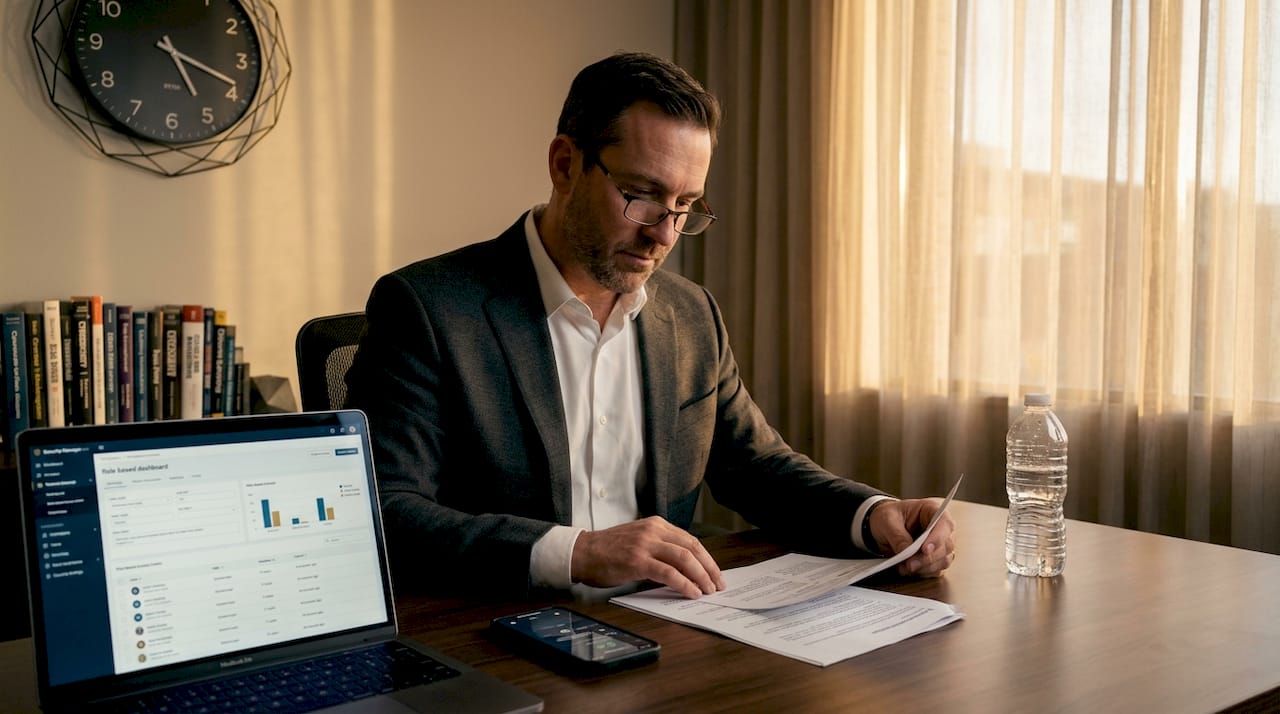
Encryption is the technical backbone of secure vault management. Without it, physical or network access to vault infrastructure translates directly into data exposure. End-to-end TLS is required for every network connection, including links between vault components and external storage backends.
For data at rest, AES-256 in GCM mode is the current standard. GCM mode provides both encryption and authentication, meaning tampering with stored data is detectable. This matters because an attacker who cannot decrypt data may still attempt to corrupt it.
Hardware Security Modules (HSMs) and cloud Key Management Services (KMS) represent the gold standard for protecting root keys. Using an HSM or cloud KMS to encrypt your root key means the most sensitive cryptographic material never exists in software memory in an unprotected state. Cloud credentials used for KMS access must never be stored in cleartext. Use platform identity solutions such as AWS IAM roles or Azure Managed Identities instead.
Key encryption checklist:
- TLS enabled on all vault listener addresses, including internal cluster traffic
- HSTS configured in vault’s custom response headers
- AES-256 GCM for data at rest
- HSM or cloud KMS for root key protection
- No cleartext credentials anywhere in the configuration
3. Harden the vault server OS and runtime environment
Operational security failures at the OS and runtime layers are often the root cause of vault compromises, even when the data itself is encrypted. Hardening the environment the vault runs in is just as critical as configuring the vault software correctly.
Run Vault as a dedicated unprivileged service account rather than root or Administrator. If an attacker exploits a vulnerability in the vault process, a non-root service account limits what they can do next. This single configuration change removes a significant privilege escalation path.
The following steps form the core OS hardening checklist:
- Disable swap on vault servers to prevent sensitive memory contents from being paged to disk, where they could be recovered after a crash or shutdown
- Disable core dumps for the same reason: crash artifacts can contain encryption keys in plaintext
- Apply strict firewall rules that allow only necessary inbound and outbound connections to vault ports
- Configure SELinux or AppArmor policies to restrict what the vault process can access at the kernel level
- Run Vault on bare metal or dedicated virtual machines in single tenancy to eliminate cross-process compromise risks from shared infrastructure
Pro Tip: Treat vault servers as appliances, not general-purpose machines. No other workloads, no shared SSH keys, no developer tools installed. The smaller the attack surface, the fewer the entry points.
4. Secure the unseal process with distributed key management
The unseal operation is the most sensitive moment in a vault’s lifecycle. Vault starts sealed; unsealing requires reconstructing the root key through a quorum of key shares using Shamir’s Secret Sharing. This cryptographic technique splits the root key into multiple shards, requiring a defined minimum number of shards to reconstruct it. No single person holds enough material to unseal the vault alone.
This design is intentional. The unseal operation should be secured by multiple personnel with strict operational procedures, not relying on single custodians. Distributing key shards across different trusted individuals in different locations prevents both insider threats and physical coercion scenarios.
Storing unseal key shards without additional encryption is a common mistake. Wrap each shard with PGP encryption tied to the individual custodian’s key. This way, even if a shard is physically stolen, it cannot be used without the custodian’s private key.
Auto-unseal via a trusted cloud KMS reduces manual handling risk but introduces a different concern. Auto-unseal requires strict control of the auto-unseal token’s permissions and environment. If the token used for auto-unseal is over-permissioned or stored insecurely, the convenience of automation becomes a vulnerability. Limit that token to the minimum permissions required and rotate it on a defined schedule.
Quarterly unseal drills keep operators sharp and verify that key shards are still accessible and functional. Discovering a lost shard during a planned drill is recoverable. Discovering it during an unplanned outage is not.
5. Enable audit logging and monitor for anomalies
Audit logs are the forensic record of everything that happens inside a vault. Enabling audit device logs captures a detailed history of vault operations, including who accessed what, when, and from where. These logs hash sensitive content automatically, so the audit trail does not itself become a data exposure risk.
Restricting access to audit logs is non-negotiable. If an attacker can modify or delete logs, they can erase evidence of their activity. Store logs on a separate, write-protected system and integrate them with a SIEM platform such as Splunk or Microsoft Sentinel for real-time anomaly detection.
Monitor for these specific patterns:
- Access attempts outside normal business hours
- Repeated failed authentication from the same IP address
- Bulk secret reads by a single account in a short window
- Access from geographic locations inconsistent with your user base
Anomaly detection is only useful if someone acts on the alerts. Assign ownership of vault monitoring to a named individual or team, and define escalation procedures before an incident occurs.
6. Rotate secrets on a defined schedule
Secret rotation is one of the most underused vault safety tips in practice, despite being one of the highest-impact controls available. Azure Key Vault recommends secret rotation windows of 60 to 90 days and supports automated rotation with zero downtime. A credential that rotates every 60 days limits the window of exposure if it is ever compromised.
Manual rotation is error-prone and rarely happens on schedule. Automation tools built into HashiCorp Vault’s dynamic secrets engine generate short-lived credentials on demand, eliminating the concept of a long-lived static password entirely. A database credential that expires in one hour cannot be stolen and reused the next day.
| Rotation approach | Credential lifespan | Risk level |
|---|---|---|
| No rotation | Indefinite | Critical |
| Manual rotation | 180+ days (in practice) | High |
| Scheduled automated rotation | 60 to 90 days | Medium |
| Dynamic secrets (on-demand) | Minutes to hours | Low |
Limit vault scope to cryptographic secrets and credentials. Avoid storing general configuration data in vaults, because it increases the number of items requiring lifecycle management and dilutes the security focus of the vault itself.
7. Separate key ownership with a key management engine
Vault’s key management secrets engine separates key ownership from key purpose. Distributing keys with limited capabilities to target KMS providers limits the blast radius of a compromised workload. If one service’s key is exposed, it cannot be used to decrypt data belonging to a different service.
This principle applies to physical vaults too. A business with multiple departments should not share a single vault combination or key. Separate access credentials by department, log each access event, and revoke credentials immediately when an employee changes roles or leaves the organization.
The practical implementation for digital vaults involves creating separate secret paths for each application or team, assigning policies that restrict each path to its designated owner, and auditing cross-path access attempts as potential indicators of compromise.
8. Restrict network access to vault infrastructure
Network segmentation is a foundational vault security protocol that prevents lateral movement after an initial breach. Vault servers should sit in a dedicated network segment with no direct internet exposure. All access should route through a bastion host or VPN with MFA enforced at the network layer.
Firewall rules should follow a default-deny posture: block everything, then explicitly allow only the traffic vault requires. This includes inbound API requests from authorized application servers, cluster communication between vault nodes, and outbound connections to storage backends and KMS endpoints. Everything else is blocked.
For businesses managing physical vault security, the equivalent principle is controlling physical proximity. A vault accessible from a public corridor is fundamentally less secure than one located in a dedicated, access-controlled room. The network segmentation principle and the physical placement principle are the same idea expressed in different environments.
9. Test your vault recovery procedures regularly
A vault that cannot be recovered after a failure is not a security asset. It is a liability. Recovery testing is the practice of verifying that backup procedures, key material, and operational runbooks actually work before they are needed under pressure.
Recovery tests should cover three scenarios: planned maintenance unsealing, unplanned outage recovery, and full disaster recovery from backup. Each scenario requires different personnel, different key material, and different procedures. Testing all three annually at minimum, and the first two quarterly, builds the operational muscle memory that prevents catastrophic mistakes during real incidents.
Document every recovery test with timestamps, participants, and outcomes. These records serve as both training material and evidence of due diligence for compliance audits under frameworks like SOC 2, ISO 27001, or PCI DSS.
10. Integrate physical and digital vault security into one policy
Physical and digital vault security are not separate disciplines. A business that encrypts its digital secrets but leaves its physical safe in an unlocked office has a gap that no software control can close. Protecting valuables in office environments requires the same layered thinking as securing a digital secrets vault.
A unified vault security policy covers physical access controls (who has keys or combinations), digital access controls (who has credentials and roles), environmental protections (fire resistance, flood protection, tamper detection), and incident response procedures for both physical and digital breaches.
Review the policy annually and after any security incident. The threat environment changes, personnel change, and the assets being protected change. A policy written in 2023 may not address the risks present in 2026.
Key takeaways
Effective vault security requires layered controls across access, encryption, operations, and monitoring because no single measure provides adequate protection on its own.
| Point | Details |
|---|---|
| Access control is the foundation | MFA and RBAC must be configured before any other vault security measure. |
| Encryption requires hardware backing | Use HSMs or cloud KMS for root key protection, not software-only solutions. |
| OS hardening prevents runtime compromise | Disable swap, disable core dumps, and run vault as an unprivileged account. |
| Unseal procedures need multiple custodians | Shamir’s Secret Sharing distributes risk; quarterly drills verify readiness. |
| Secret rotation limits exposure windows | Automate rotation on 60 to 90 day cycles or use dynamic short-lived credentials. |
Why operational hardening deserves more attention than it gets
Most conversations about vault security focus on encryption algorithms and access policies. Those matter. But in my experience reviewing vault deployments across both home and business environments, the failures almost never happen at the cryptographic layer. They happen at the operational layer.
A vault running as root because “it was easier to set up that way.” Swap left enabled because no one knew it was a risk. Unseal keys stored in a shared password manager with no individual accountability. These are not exotic attack scenarios. They are the configurations I see regularly, and they undermine every other security control in place.
The counterintuitive truth about vault security is that the most sophisticated cryptographic setup in the world provides weak protection if the server it runs on is misconfigured. Operational hardening is unglamorous work. It does not show up in marketing materials or compliance checkboxes. But it is the difference between a vault that holds under pressure and one that fails the moment an attacker looks closely.
For individuals and small business operators, the priority order is clear: get access control right first, then encryption, then operational hardening. For larger organizations, all three need to happen in parallel, with formal policies and regular testing to verify they are working as designed. The benefits of physical vaults for home and business use follow the same logic: a quality product poorly placed and poorly managed offers far less protection than a simpler product that is correctly integrated into a security plan.
— Chetna
Protect your assets with the right physical vault
Digital security protocols and physical vault protection work best together. Safesandsecuritydirect offers a broad selection of fire-resistant, burglary-resistant, and wall safes built for both home and business use. Whether you are securing documents, cash, firearms, or irreplaceable valuables, the right physical vault is the foundation every security strategy needs.
Safesandsecuritydirect carries professional-grade safes engineered to meet real-world threat scenarios, from residential break-ins to commercial theft attempts. For those requiring advanced protection beyond standard safes, military-grade security solutions integrate physical and AI-driven controls for high-value environments. Browse the full range at Safesandsecuritydirect and match the right vault to your specific security requirements.
FAQ
What are the most critical vault security practices?
Access control, encryption, and OS hardening form the three most critical layers. MFA, RBAC, TLS in transit, AES-256 at rest, and running vault as an unprivileged service account address the majority of real-world attack vectors.
How often should vault secrets be rotated?
Azure Key Vault recommends rotation windows of 60 to 90 days for manually managed secrets. Dynamic secrets engines that generate on-demand credentials with lifespans measured in minutes or hours provide stronger protection than any scheduled rotation policy.
What is Shamir’s Secret Sharing in vault unsealing?
Shamir’s Secret Sharing splits the vault root key into multiple shards, requiring a defined quorum of shards to reconstruct it. No single person holds enough material to unseal the vault alone, which prevents both insider threats and single-point-of-failure scenarios.
Should physical and digital vault security be managed separately?
No. A unified policy covering both physical access controls and digital credential management closes gaps that separate policies leave open. An attacker who gains physical access to a server bypasses most digital controls entirely.
How do I know if my vault has been compromised?
Audit logs are the primary detection tool. Monitor for access attempts outside normal hours, bulk secret reads by a single account, repeated authentication failures, and access from unexpected geographic locations. Integrate vault logs with a SIEM platform for real-time alerting.
Recommended
- Home security best practices: protect property in 2026 – Safes and Security Direct
- Industry Security Best Practices: Protect Property and Reduce Risk – Safes and Security Direct
- Top security best practices for property managers 2026 – Safes and Security Direct
- How to Improve Home Security: Proven Steps for 2026 – Safes and Security Direct