

What Is Surveillance Analytics? A Practical Guide
TL;DR:
- Surveillance analytics uses AI and computer vision to transform passive video into real-time, actionable security data. It employs edge, cloud, or hybrid processing architectures, with proper tuning and governance crucial for effective deployment. Integrating analytics with broader security systems enhances threat detection, operational efficiency, and privacy compliance.
Surveillance analytics is defined as the automated processing of video surveillance streams using artificial intelligence to extract structured metadata, real-time alerts, and actionable insights from raw footage. Where a traditional camera simply records, a surveillance analytics system actively interprets what it sees. Platforms like Pelco and Milestone Systems have built entire product lines around this capability, turning passive cameras into decision-support tools. The technology applies computer vision, machine learning, and rule-based algorithms to detect objects, people, behaviors, and anomalies the moment they occur. For homes and businesses alike, this shift from passive recording to active analysis is the defining advancement in modern security.
What is surveillance analytics and how does it work?
Surveillance analytics, also called intelligent video analytics (IVA), processes live and recorded video through layered algorithms that identify and classify what appears on screen. The system does not simply watch. It generates structured metadata about every detected object, person, or event, making footage searchable and actionable rather than a passive archive you scroll through after an incident.

The core processing pipeline works in three stages. First, computer vision models detect and classify objects within each video frame. Second, behavioral algorithms evaluate whether detected activity matches predefined rules, such as a person entering a restricted zone after hours. Third, the system generates an alert with a visual indicator, often a bounding box around the subject, and logs the event as indexed metadata. This is how anomalous rule violations become immediate, specific notifications rather than buried moments in hours of footage.
Where the processing happens matters as much as how it works. Surveillance analytics runs on three architectures:
- Edge processing: Analytics run directly on the camera or a local server. This delivers the lowest latency and works even when internet connectivity fails, making it ideal for retail stores, warehouses, and remote properties.
- Cloud processing: Footage is sent to centralized servers for analysis. This model scales easily across dozens of locations and supports more complex AI models, but it depends on reliable bandwidth.
- Hybrid processing: Edge and cloud models combine to balance real-time local alerts with centralized reporting and storage.
Pro Tip: If your site has unreliable internet or strict data residency requirements, prioritize edge-based analytics. Cloud models are better suited for multi-site businesses that need unified dashboards and centralized reporting.
What are the main applications and benefits of surveillance analytics?
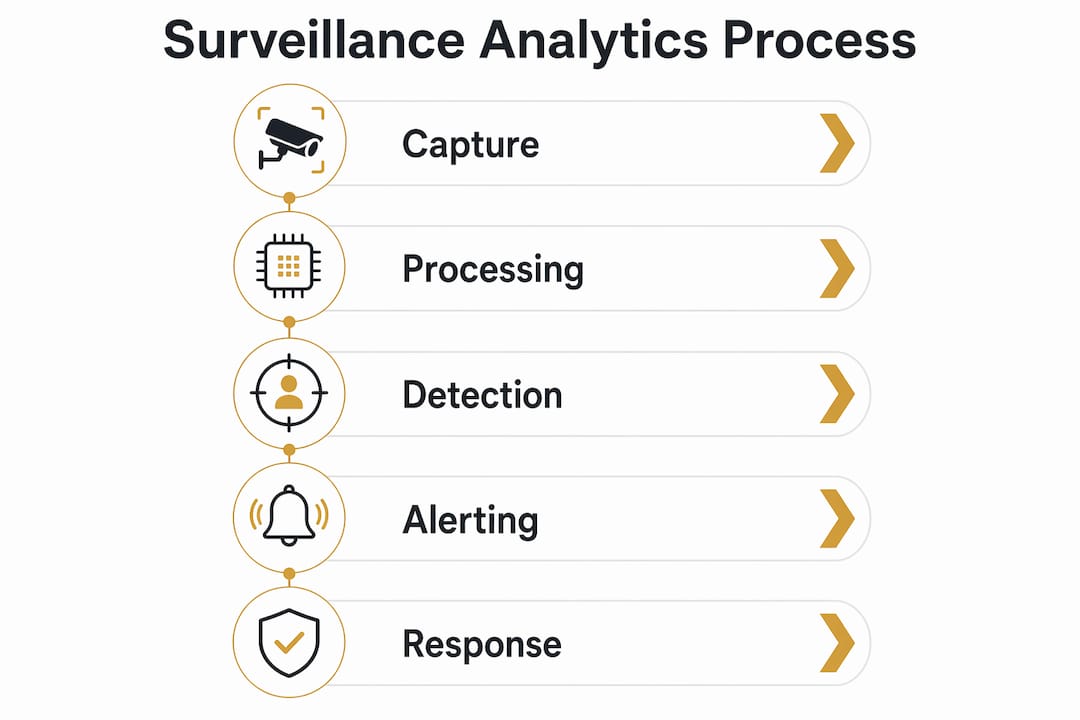
The practical value of surveillance analytics spans security, operations, and business intelligence. For security teams, the most direct benefit is faster, more precise threat detection. For business operators, the same technology surfaces operational data that would otherwise require dedicated staff to collect manually.
On the security side, the most common applications include:
- Intrusion detection: Alerts trigger when a person enters a defined zone outside permitted hours.
- Loitering detection: The system flags individuals who remain in a sensitive area beyond a set time threshold.
- Restricted area violations: Cameras covering server rooms, loading docks, or executive floors alert security the moment an unauthorized person crosses the boundary.
- PPE compliance monitoring: In manufacturing and construction environments, analytics detect whether workers are wearing required safety equipment like hard hats or high-visibility vests.
The operational and business intelligence applications are equally significant. Retailers use crowd flow analytics to optimize store layouts and staffing. Facility managers use occupancy data to reduce energy costs. Risk managers use incident logs to identify repeat vulnerability patterns across multiple sites. Surveillance analytics accelerates incident response by automatically sorting multi-day footage and surfacing only the events that match defined criteria, cutting investigation time from hours to minutes.
Integration with alarm systems and access control platforms multiplies these benefits further. When a badge reader flags an unauthorized access attempt and the analytics system simultaneously detects a person in that zone, the combined alert carries far more weight than either signal alone. You can read more about how surveillance cameras boost security when paired with analytics-driven workflows.
What privacy and data governance considerations matter most?
Surveillance analytics processes personal data by definition. Facial recognition, behavioral profiling, and movement tracking all generate records that identify or could identify individuals. Deploying these capabilities without a governance framework creates legal exposure and erodes trust with employees, customers, and the public.
The Security Industry Association recommends that organizations conduct Privacy Impact Assessments at every phase of a surveillance analytics deployment: design, deployment, and active use. A PIA forces you to document what data you collect, why you collect it, who can access it, and how long you retain it. That documentation is the foundation of any defensible compliance position under regulations like GDPR, CCPA, or state-level biometric privacy laws.
Privacy-by-design principles translate into concrete system choices. The NIST framework recommends that organizations map analytic outputs to personal data flows and limit identifiable data processing to only what the use case genuinely requires. In practice, this means:
- Disabling facial recognition in areas where it adds no security value
- Setting automatic data retention limits so footage is deleted after a defined period
- Restricting access to analytics dashboards and event logs to authorized personnel only
- Anonymizing or blurring individuals in footage used for operational analytics rather than security investigations
Pro Tip: Before deploying any facial recognition or behavioral analysis feature, document the specific threat or operational need it addresses. If you cannot articulate a clear justification, the feature creates risk without proportionate benefit.
Privacy concerns are valid and should be addressed early, with formal risk assessments guiding system design rather than being retrofitted after deployment. This approach protects the organization and builds the internal trust that makes surveillance programs sustainable long-term.
How to choose and implement surveillance analytics effectively
Choosing the right surveillance analytics system starts with mapping your actual security and operational workflows before evaluating any product. The technology should fit your processes. You should not redesign your processes to fit the technology.
Follow this sequence when implementing:
- Define your use cases first. List the specific threats or operational gaps you want to address. Intrusion detection for a warehouse after hours is a different requirement than crowd flow analysis for a retail floor.
- Match analytics rules to real site conditions. A rule that triggers on any motion in a parking lot will generate hundreds of false alerts per day. Rules tuned by time window, object type, zone size, and movement threshold produce alerts worth acting on.
- Evaluate processing architecture against your infrastructure. Use the comparison below to match deployment model to operational need.
- Require metadata indexing and event-linked clips. The best systems augment manual review by linking every alert to the specific video clip that triggered it. This lets investigators jump directly to relevant footage without scrubbing through hours of recording.
- Plan for tuning cycles. No analytics configuration is correct on day one. Schedule monthly reviews of alert volume and false positive rates for the first three months, then quarterly after that.
| Deployment model | Best for | Key trade-off |
|---|---|---|
| Edge processing | Single sites, low bandwidth, real-time alerts | Limited AI model complexity |
| Cloud processing | Multi-site businesses, centralized reporting | Requires reliable, high-bandwidth connectivity |
| Hybrid processing | Enterprises needing both real-time and centralized data | Higher setup and integration cost |
Alert fatigue is the most common reason surveillance analytics implementations fail. When a system generates too many irrelevant notifications, operators stop responding to all of them, including the real ones. Analytics rules tailored to workflows are the single most important factor in maintaining operator trust and system effectiveness. If you are new to camera systems, the beginners guide to surveillance cameras from Safesandsecuritydirect covers the foundational concepts before you layer analytics on top.
How does surveillance analytics integrate with broader security systems?
Surveillance analytics does not operate in isolation. Its greatest value comes from acting as an intelligent layer over a Video Management System (VMS), feeding structured data into the broader security and operational technology stack.
A VMS like those supported by Milestone Systems or Pelco serves as the central hub for camera feeds, recording, and playback. Surveillance analytics sits above this layer, processing feeds and generating event metadata that the VMS indexes. Security teams access this through dashboards that display live alerts, event timelines, and searchable clip libraries rather than raw video walls.
The integration points that multiply effectiveness include:
- Alarm systems: An analytics event can trigger a physical alarm, a notification to a monitoring center, or an automated lockdown sequence without requiring human intervention.
- Access control platforms: Correlating badge reader data with camera analytics creates a combined audit trail that is far harder to defeat than either system alone.
- Physical Security Information Management (PSIM) platforms: PSIM software aggregates data from analytics, access control, alarms, and environmental sensors into a single operator interface, reducing response time and decision complexity.
- Business intelligence tools: Operational analytics data, such as foot traffic counts and dwell time metrics, can feed directly into retail analytics platforms or facility management dashboards.
The result is a security and operations infrastructure where relevant events are located automatically across multi-day footage, investigations are faster, and the data generated by cameras serves purposes beyond after-the-fact review. For businesses managing multiple locations, this integration layer is what makes enterprise-scale surveillance manageable without proportionally scaling headcount. Exploring surveillance technology trends in 2026 shows how these integrations are becoming standard rather than premium features.
Key takeaways
Surveillance analytics converts passive video recording into an active, searchable intelligence layer that improves security response times and operational decision-making when configured correctly.
| Point | Details |
|---|---|
| Core definition | Surveillance analytics uses AI and computer vision to extract structured metadata and real-time alerts from video feeds. |
| Deployment architecture | Edge, cloud, and hybrid models each suit different operational needs; match the model to your infrastructure before buying. |
| Alert tuning is critical | Rules calibrated to time, zone, object type, and threshold prevent alert fatigue and keep operators engaged. |
| Privacy governance is non-negotiable | Conduct a Privacy Impact Assessment at design, deployment, and use phases to manage legal and reputational risk. |
| Integration multiplies value | Connecting analytics to VMS, access control, and alarm systems creates a unified security layer that no single tool achieves alone. |
The implementation gap nobody talks about
I have seen organizations invest heavily in surveillance analytics platforms and then underuse them within six months. The cameras are running. The AI is processing. The alerts are firing. But nobody is acting on them because the rules were never tuned after go-live, and the alert volume became noise.
The technology is genuinely capable. What fails is the assumption that configuration is a one-time task. Surveillance analytics is more like a living system than a product you install and forget. The organizations that get real value from it treat alert tuning as an ongoing operational discipline, not an IT project with a completion date.
I am also skeptical of deployments that lead with facial recognition before establishing the basics. Loitering detection, zone violation alerts, and object classification deliver measurable security improvements with far lower privacy risk and far simpler governance requirements. Start there. Prove the value. Then evaluate whether more complex features are justified by a specific, documented need.
The future of this technology is genuinely promising. AI models are becoming more accurate at distinguishing real threats from environmental noise like shadows, animals, and weather. Privacy-preserving architectures that process video locally without transmitting identifiable data are maturing fast. For individuals and businesses considering adoption, the right time to start is now, but the right way to start is with clear use cases, realistic expectations, and a governance framework in place from day one.
— Chetna
Upgrade your security with Safesandsecuritydirect

Safesandsecuritydirect carries a curated range of professional-grade surveillance cameras and security systems designed to support analytics-driven security for homes and businesses of every size. Whether you are setting up your first camera system or expanding an existing network, the product selection at Safesandsecuritydirect covers the hardware side of the equation, from analytics-capable IP cameras to complete system bundles. Pair the right camera hardware with the implementation principles covered in this guide, and you have a security setup that works actively rather than just recording passively. Browse the full range and find the system that fits your site.
FAQ
What is the surveillance analytics definition in simple terms?
Surveillance analytics is the use of AI and computer vision to automatically analyze video feeds and generate structured alerts and metadata, rather than simply recording footage for later review.
How does surveillance analytics differ from standard video recording?
Standard recording captures footage passively. Surveillance analytics actively processes that footage in real time, detecting specific objects, behaviors, and rule violations and alerting operators immediately.
What are the most common applications of surveillance analytics for businesses?
The most common business applications include intrusion detection, loitering alerts, restricted area monitoring, PPE compliance checks, and crowd flow analysis for operational planning.
How do you prevent false alarms in a surveillance analytics system?
False alarms are reduced by tuning analytics rules to specific time windows, zones, object types, and movement thresholds. Regular review cycles after deployment keep alert quality high as site conditions change.
Is surveillance analytics legal to use in commercial environments?
Surveillance analytics is legal in most commercial environments, but deployments involving facial recognition or behavioral profiling require Privacy Impact Assessments and must comply with applicable data protection regulations like GDPR or CCPA.
Recommended
- Surveillance technology trends 2026: What you need to know – Safes and Security Direct
- Streamline your business surveillance workflow for security – Safes and Security Direct
- Essential Guide to Security Surveillance Camera Systems for Beginners – Safes and Security Direct
- How surveillance technology boosts business security and efficiency – Safes and Security Direct