

The Role of Monitoring Centers in Modern Security
TL;DR:
- Monitoring centers provide continuous, coordinated security, fire, and IT system protection through trained operators and automated alerts. They verify incidents, prioritize responses, and connect emergency services efficiently, enhancing safety and operational continuity. Certification, clear protocols, and integrated technology are essential for effective, reliable monitoring services.
A monitoring center is a centralized facility staffed by trained professionals who continuously observe security, fire, IT, or operational systems to detect and respond to incidents instantly. The role of monitoring centers extends far beyond watching camera feeds. These facilities serve as the operational backbone of modern security, connecting detection devices, trained operators, and emergency responders into a single coordinated system. Organizations like Underwriters Laboratories (UL) and The Monitoring Association (TMA) set the standards that define how these centers are built and run. Whether you are protecting a home, a retail business, or a data center, understanding how monitoring centers function helps you make smarter security decisions.
How do monitoring centers operate to detect and respond to incidents?
Monitoring centers run 24/7/365, providing uninterrupted surveillance of security and IT systems even when buildings are completely empty. That continuous coverage is the foundation of their value. A single gap in oversight is all an intruder or system failure needs.
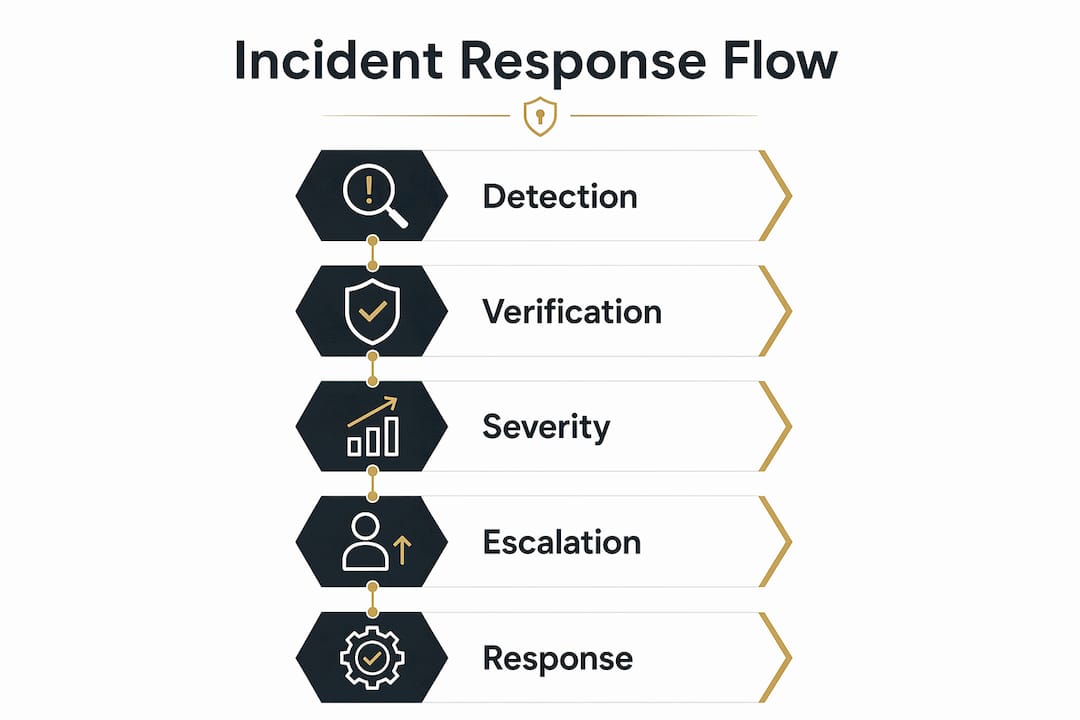
When a sensor triggers, the process moves fast. Detection devices transmit alarm signals automatically to the monitoring center without requiring a person on-site to make a phone call. Fire alarm signals travel directly from detection devices to emergency responders within seconds, bypassing the delays of manual 911 calls entirely. That speed difference can mean the gap between a contained incident and a catastrophic one.
Once a signal arrives, trained operators do not simply forward it. They verify the alert first. Verification filters out false alarms, which account for a significant share of all alarm activations. Operators cross-reference video feeds, contact on-site personnel, and apply judgment before escalating. This human layer prevents emergency services from being flooded with nuisance calls.
To manage the volume and variety of incoming alerts, monitoring centers use structured triage systems:
- Sev1 (Critical): Immediate dispatch required. Active fire, confirmed intrusion, medical emergency.
- Sev2 (High): Rapid response needed. Unverified intrusion, system failure with safety implications.
- Sev3 (Medium): Investigate and monitor. Repeated sensor faults, unusual access patterns.
- Sev4 (Low): Log and defer. Routine system notifications, scheduled maintenance alerts.
Tiered severity classification systems like Sev1 to Sev4 prevent both over-reaction and under-reaction. A center that treats every alert as critical burns out its operators and wastes emergency resources. One that under-prioritizes misses real threats.
Pro Tip: Ask your monitoring provider to share their escalation runbook before you sign a contract. A well-defined runbook specifies exactly who gets called, in what order, and what actions are taken for each incident type. Centers without clear runbooks introduce dangerous delays when seconds matter.
What are the different types of monitoring centers?
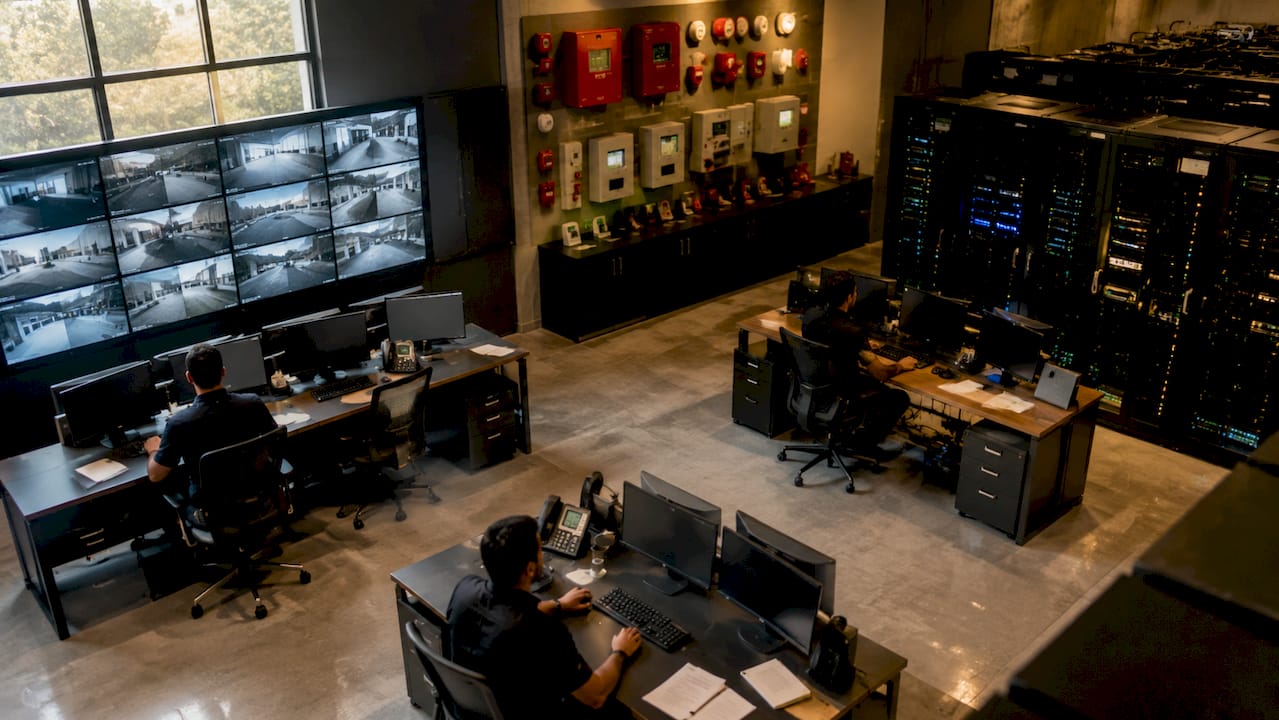
Not all monitoring centers serve the same purpose. Three primary types handle the majority of professional monitoring work, each with a distinct focus and toolset.
| Type | Primary Focus | Core Tools | Response Target |
|---|---|---|---|
| Security Operations Center (SOC) | Physical and cyber security | CCTV, access control, intrusion detection | Law enforcement, on-site security |
| Fire Alarm Monitoring Center | Fire detection and life safety | Smoke detectors, heat sensors, sprinkler systems | Fire department, building management |
| Network Operations Center (NOC) | IT infrastructure and uptime | Network monitors, server dashboards, log analyzers | IT teams, service providers |
Security Operations Centers (SOCs)
A SOC integrates physical security tools including cameras, access control readers, and motion sensors into a unified monitoring environment. Operators watch for unauthorized access, suspicious behavior, and perimeter breaches. SOCs often serve large commercial properties, hospitals, universities, and government facilities where physical threats require coordinated human response.
Fire alarm monitoring centers
Fire alarm monitoring centers focus exclusively on life safety. They receive signals from smoke detectors, heat sensors, and sprinkler systems, then dispatch fire departments within seconds. The automated signal path removes human error from the notification chain. For businesses with compliance requirements under NFPA 72 or local fire codes, professional fire alarm monitoring is not optional.
Network Operations Centers (NOCs)
A NOC monitors IT infrastructure around the clock. Operators track server health, network bandwidth, application performance, and cybersecurity alerts. When a critical system goes offline or a breach is detected, the NOC initiates the response chain. Many enterprises run SOCs and NOCs in parallel, with the two teams coordinating when a cyber incident has physical security implications.
Some large organizations combine all three functions into a single unified operations center. That integration allows faster cross-domain response when, for example, a network intrusion coincides with an unauthorized physical access attempt.
How have monitoring centers evolved with AI and IoT?
The monitoring center of a decade ago was largely reactive. An alarm rang, an operator called the police, and the incident was logged. Today’s centers operate differently. Monitoring centers have evolved into data-rich ecosystems where AI and IoT sensors enable proactive business intelligence beyond traditional security. That shift changes the entire value proposition.
AI-powered video analytics now flag anomalies before a human operator would notice them. A camera system can detect a person loitering near a restricted entrance, identify an unattended bag in a public space, or recognize a vehicle that has circled a parking lot multiple times. These detections arrive as prioritized alerts, not raw footage. Operators spend their time making decisions, not scanning screens.
IoT sensors extend monitoring beyond physical security into operational domains:
- Pharmaceutical companies use temperature and humidity sensors monitored by central stations to protect drug storage compliance.
- Retailers track foot traffic patterns and inventory movement through integrated sensor networks.
- Data centers monitor power draw, cooling performance, and equipment vibration to predict hardware failures before they occur.
“The true value of a monitoring center lies in the coordination layer where trained operators interpret data, filter false positives, and provide context for field responders.” — Citadel Security
That coordination layer is what separates a monitoring center from a simple automated alert system. Technology generates the data. Trained operators give it meaning. A fire suppression system can activate automatically, but a monitoring center operator can simultaneously notify building occupants, coordinate with the fire department, and alert facility management. No algorithm handles that chain of decisions as well as a skilled human.
National monitoring centers take this further, coordinating telecom providers, ISPs, law enforcement, and cyber resources to manage complex transnational threats. They represent the highest tier of monitoring center effectiveness, where centralized visibility enables active incident management across entire sectors.
What are the practical benefits of monitoring centers for homes and businesses?
The benefits of monitoring centers translate directly into measurable outcomes for both residential and commercial users.
Faster emergency response is the most immediate benefit. Automated signal transmission means fire departments and police receive notification in seconds, not minutes. For fires especially, that speed determines whether a building is salvageable.
Continuous protection when no one is present addresses one of the most common security gaps. Homes are most vulnerable when unoccupied. Businesses face the highest break-in risk overnight and on weekends. A monitored alarm system provides coverage precisely when self-monitoring fails.
False alarm reduction protects your relationship with local emergency services. Unverified alarms waste police and fire resources, and some jurisdictions fine repeat offenders. Remote security monitoring cuts false alarms by 97% through video verification before dispatch. That number reflects how much of the alarm burden is unnecessary without a verification layer.
Operational continuity for businesses extends beyond security. NOC monitoring catches server failures and network outages before customers notice. SOC monitoring deters theft and reduces shrinkage. Both functions protect revenue and reputation.
Compliance support matters for regulated industries. Healthcare facilities, financial institutions, and pharmaceutical companies often face legal requirements for monitored security and environmental systems. A certified monitoring center provides the documentation trail those audits demand.
Pro Tip: When selecting a monitoring provider, verify their UL or TMA certification. Third-party certifications confirm that a center meets standards for system redundancy, physical security, and operational protocols. Also ask whether monitoring is handled in-house or outsourced to a wholesale central station, since outsourced monitoring affects accountability and response reliability.
Key Takeaways
Monitoring centers deliver their full value only when technology, trained operators, and clear escalation protocols work together as a single system.
| Point | Details |
|---|---|
| 24/7 coverage is non-negotiable | Monitoring centers operate continuously, protecting sites even when no one is physically present. |
| Human operators add irreplaceable value | AI and sensors generate alerts, but trained operators verify, interpret, and coordinate the actual response. |
| Tiered alert systems prevent errors | Sev1–Sev4 classification ensures critical incidents get immediate action while low-priority alerts are handled appropriately. |
| Certification signals quality | UL or TMA certification confirms a center meets standards for redundancy, compliance, and operational reliability. |
| Know who is actually monitoring you | Many alarm companies outsource monitoring; confirm the identity and credentials of the actual monitoring provider. |
Why I think most people underestimate what monitoring centers actually do
Most homeowners and small business owners think of a monitoring center as a call center that phones the police when an alarm goes off. That mental model is about ten years out of date.
What I find genuinely interesting about modern monitoring centers is how much of their value is invisible to the end user. The false alarms that never became a police dispatch. The server failure that got caught at 2 a.m. before it cascaded into a full outage. The pharmaceutical cold storage unit that drifted two degrees and triggered a corrective action before product was lost. None of those outcomes show up on a report. They just quietly protect you.
The piece most people overlook is the escalation protocol. I have seen well-funded security setups fail not because the technology was wrong, but because nobody had defined what to do when the alert fired. A monitoring center without a tested runbook is just an expensive notification system. The centers that actually perform under pressure are the ones where every operator knows exactly what step three looks like at 3 a.m. on a holiday weekend.
The trend worth watching is the convergence of physical and cyber monitoring. As more physical security devices connect to IP networks, the line between a SOC and a NOC is disappearing. The organizations that recognize monitoring centers as strategic operational hubs rather than a line item on an insurance checklist will be the ones best positioned for what comes next.
— Chetna
Protect what matters with the right security setup

Understanding monitoring center functions is the first step. The second is making sure your security hardware is built to connect with professional monitoring services reliably. Safesandsecuritydirect carries a full range of surveillance cameras, alarm systems, and access control products designed for both residential and commercial use. Every product in the catalog is selected for compatibility with professional monitoring setups, so your detection layer performs the way monitoring centers expect it to. Explore the full range of security solutions at Safesandsecuritydirect and build a system that works around the clock, whether you are home or not.
FAQ
What is the primary role of monitoring centers?
A monitoring center continuously observes security, fire, IT, or operational systems and coordinates emergency response when an incident is detected. Trained operators verify alerts, filter false alarms, and dispatch the appropriate responders within seconds.
How do monitoring centers reduce false alarms?
Operators use video verification and cross-referencing tools to confirm whether an alert represents a real threat before contacting emergency services. This verification process cuts false alarms dramatically compared to unmonitored systems.
What is the difference between a SOC and a NOC?
A Security Operations Center (SOC) focuses on physical security threats including intrusion, access control, and surveillance. A Network Operations Center (NOC) monitors IT infrastructure for outages, performance issues, and cyber threats. Large organizations often run both in coordination.
How do I know if a monitoring center is certified?
Look for UL (Underwriters Laboratories) or TMA (The Monitoring Association) certification. These credentials confirm the center meets established standards for system redundancy, physical security, and operational protocols.
Should I ask if my alarm company outsources monitoring?
Yes. Many alarm companies use wholesale central stations for the actual monitoring work. Knowing who monitors your system matters for accountability, response speed, and understanding the communication chain during an emergency.
Recommended
- Why remote security monitoring cuts false alarms by 97% – Safes and Security Direct
- Essential Guide to Security Surveillance Camera Systems for Beginners – Safes and Security Direct
- How surveillance technology boosts business security and efficiency – Safes and Security Direct
- What Is a Monitored Alarm System? Your 2026 Guide – Safes and Security Direct