

The Role of CCTV in Business Security and Operations
TL;DR:
- CCTV is the most widely used business security tool, combining deterrence, evidence gathering, and operational insights. Its effectiveness relies on active monitoring, legal compliance, and proper technical configuration, not just hardware investment. Regular review, staff training, and system maintenance are essential to maximize its security and operational value.
Closed-circuit television (CCTV) is the most widely deployed physical security technology in commercial environments, serving as both a crime deterrent and an operational management tool. The role of CCTV in business extends far beyond recording footage. It protects staff, supports insurance claims, enables real-time incident response, and creates a documented record that holds legal weight. For business owners and managers, understanding how surveillance systems work, where they deliver measurable value, and what compliance obligations they carry is the foundation of any serious security strategy.
How does CCTV help prevent crime and improve business security?
CCTV deters crime most effectively in structured, high-opportunity environments. A 2019 meta-analysis covering 40 years of CCTV studies found a statistically significant but modest crime prevention effect, with the strongest results in car parks and controlled access areas compared to open city centers. That finding matters because it tells you where to prioritize your investment. A camera covering a loading dock or staff parking area delivers more measurable deterrence than one pointed at a busy public entrance.
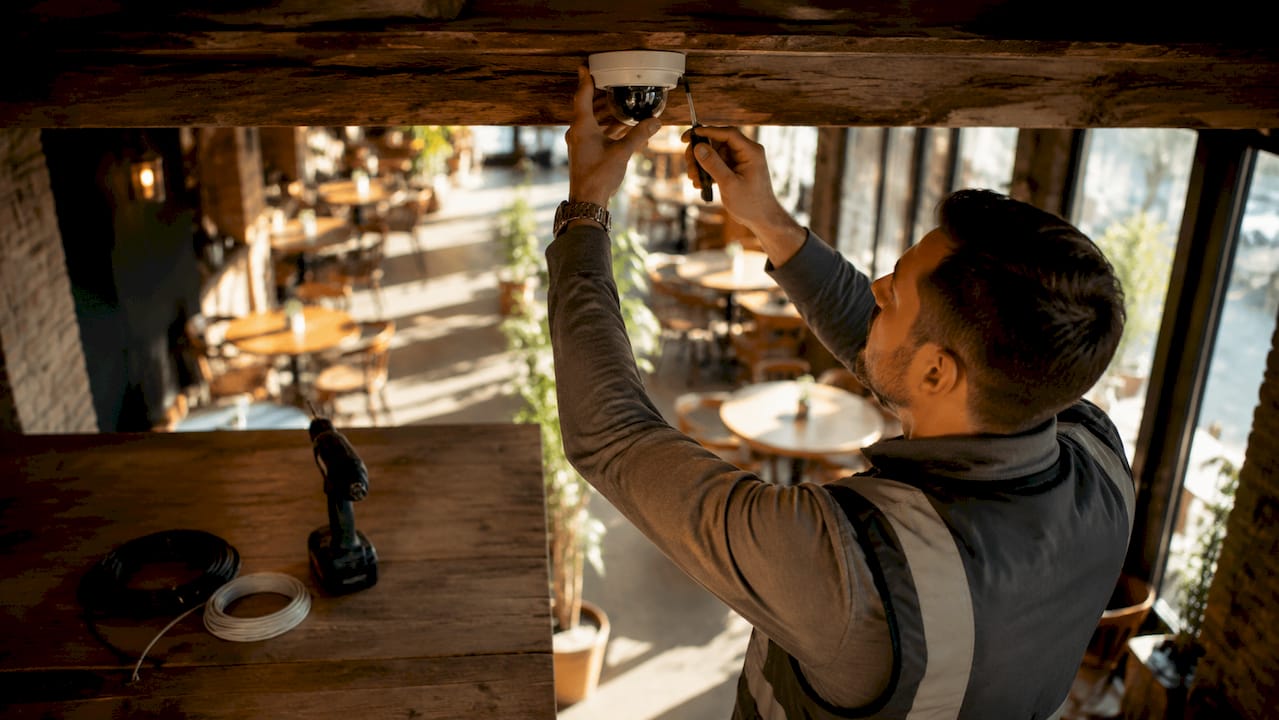
The distinction between passive recording and active monitoring is where most businesses lose value. A camera that records but is never watched does not stop a crime in progress. Active, live-monitored CCTV integrated with alarms enables real-time incident action and supports legal duties of care. When a camera feed is tied to an alarm system and monitored by trained staff or a professional monitoring center, the deterrence effect multiplies and response times drop significantly.
CCTV also plays a direct role in criminal investigations. The City of London Police have credited 4K resolution cameras with measurable crime reduction results, specifically because high-resolution footage gives investigators usable evidence rather than blurry images that cannot identify a suspect. High-quality footage also strengthens insurance claims, which is a practical financial benefit that many business owners overlook until they need it.
Key security benefits of CCTV for businesses include:
- Deterrence: Visible cameras reduce opportunistic theft, vandalism, and unauthorized access, particularly in retail and logistics environments.
- Incident documentation: Recorded footage provides a timestamped account of events that supports police investigations and legal proceedings.
- Insurance support: Verified footage reduces claim disputes and can lower premiums when insurers see documented security measures in place.
- Staff protection: Cameras in customer-facing areas protect employees from false accusations and document aggressive customer behavior.
Pro Tip: Place cameras at entry and exit points, cash handling areas, and high-value stock zones first. These locations generate the highest-return footage for both deterrence and evidence purposes.
What operational benefits does CCTV offer beyond security?
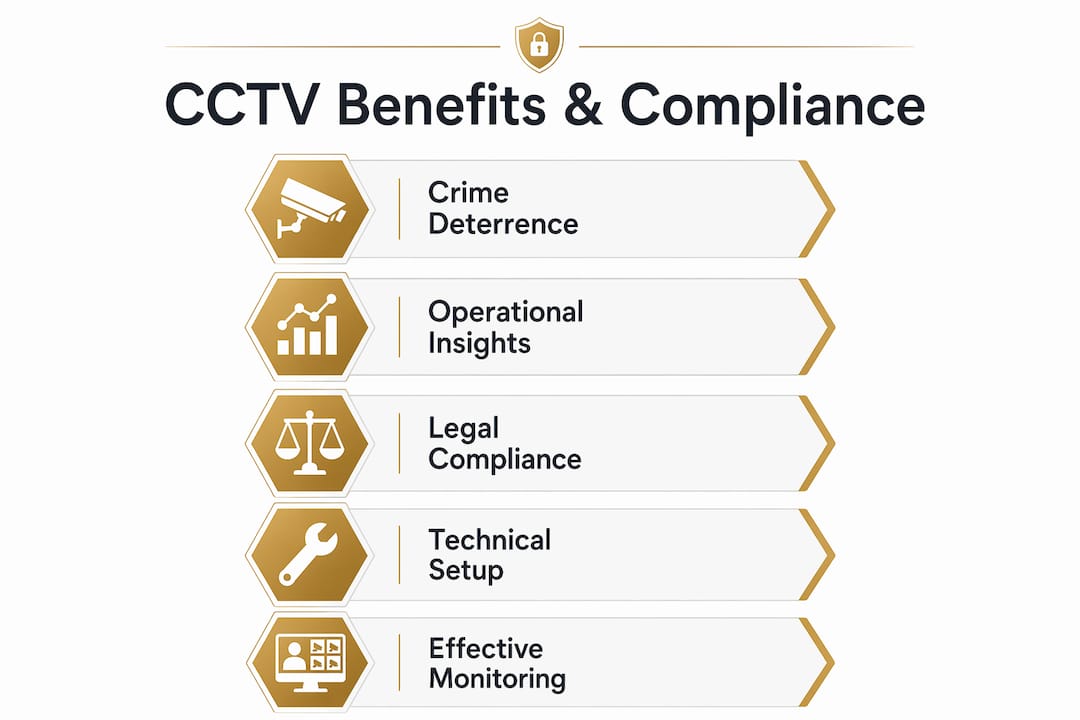
The importance of surveillance cameras in business operations goes well beyond stopping crime. CCTV gives managers visibility into how their business actually runs, not just how they think it runs. That gap between perception and reality is where operational improvements are found.
Here are four operational areas where CCTV delivers measurable business value:
-
Real-time incident response. Panic-linked cameras in retail or hospitality environments allow security staff to see exactly what is happening the moment an alarm triggers. This removes guesswork and allows a proportionate, targeted response instead of a blanket lockdown.
-
Staff safety monitoring. In warehouses, manufacturing floors, and late-night retail settings, cameras allow managers to verify that safety protocols are being followed. When an incident occurs, footage provides an objective record that protects both the employee and the employer.
-
Operational efficiency. In retail environments, camera footage reveals customer flow patterns, queue lengths, and understaffed periods. Managers at chains like Marks & Spencer and Tesco have used this data to adjust staffing schedules and store layouts based on actual behavior rather than estimates.
-
Integration with access control and alarms. Modern CCTV systems connect directly with access control panels and intruder alarms. When a door is forced open outside business hours, the system can simultaneously trigger an alarm, lock adjacent doors, and push a live camera feed to a security operator’s screen.
CCTV integrated with alarms and access control creates a security ecosystem rather than a collection of isolated tools. That integration is what separates a professional security setup from a basic camera installation.
How must businesses ensure legal compliance when using CCTV?
CCTV footage is classified as personal data under the UK GDPR and the Data Protection Act 2018. That classification carries real obligations. Businesses using CCTV must establish a lawful basis for processing, typically legitimate interests, and implement safeguards including visible signage and documented retention policies. Skipping these steps does not just create regulatory risk. It can undermine the admissibility of your footage in court.
The Information Commissioner’s Office (ICO) sets clear expectations for UK businesses. Subject access requests related to CCTV footage must be responded to within one month, and businesses must maintain documented governance covering signage, retention schedules, and data access controls. Failing to meet these standards exposes you to ICO enforcement action, which can include fines and mandatory audits.
Common compliance mistakes businesses make with CCTV:
- No signage: Cameras must be clearly signed with the operator’s name and contact details. Covert surveillance in most business settings is unlawful.
- Excessive retention: Keeping footage longer than necessary without justification breaches the data minimization principle. Most businesses retain footage for 30 days, though higher-risk environments may justify longer periods.
- No documented policy: Non-compliant CCTV use exposes businesses to privacy risks, employee relations issues, and ICO enforcement actions. A written CCTV policy is not optional.
- Uncontrolled access: Footage should only be accessible to authorized personnel. Shared login credentials or unrestricted access to recording systems is a common and easily avoidable failure.
| Compliance requirement | What it means in practice |
|---|---|
| Lawful basis | Document legitimate interests assessment before deploying cameras |
| Signage | Post visible signs at all camera locations with operator contact details |
| Retention policy | Set automatic deletion schedules, typically 30 days for standard business use |
| Subject access requests | Respond within one month; have a workflow ready before you receive a request |
| Staff communication | Inform employees about CCTV use in employment contracts and staff handbooks |
A comprehensive CCTV compliance program treats governance as a repeatable process, not a one-time setup task. Review your policies annually and whenever you add new cameras or change how footage is used.
Which technical factors maximize CCTV effectiveness?
The CCTV impact on business productivity and security depends heavily on how well the system is configured, not just what hardware you buy. Technical factors like codec, frame rate, resolution, and export formats significantly affect whether footage is usable as evidence. A camera recording at low resolution in a proprietary format may capture an incident but produce footage that investigators cannot use.
Before deploying any system, test the following:
| Technical factor | Recommended standard | Why it matters |
|---|---|---|
| Resolution | 1080p minimum; 4K for entry points | Facial and plate identification requires detail |
| Frame rate | 15-25 fps for standard areas | Low frame rates create gaps in incident timelines |
| Codec | H.264 or H.265 | Widely compatible with police and court systems |
| Export format | MP4 or AVI | Proprietary formats can be unreadable without vendor software |
| Storage retention | 30 days minimum | Matches ICO guidance and insurance requirements |
Camera placement is equally critical. Cover entry and exit points, cash registers, server rooms, and any area where high-value assets are stored or handled. For retail environments, overhead wide-angle cameras at entrances and aisle-level cameras near high-theft product categories give the best coverage. For offices, focus on reception areas, server rooms, and emergency exits.
CCTV effectiveness relies on human factors such as monitoring strategies, staff training, and integration into security workflows, beyond hardware capabilities alone. A well-placed 4K camera monitored by trained staff outperforms a poorly managed system with twice the hardware budget. Train staff on what to report, how to access footage, and when to escalate. Document those protocols so they survive staff turnover.
Pro Tip: Before signing off on any CCTV installation, export a test clip and attempt to open it on a standard computer without the vendor’s software. If you cannot open it, neither can a police investigator.
You can find detailed guidance on avoiding installation mistakes that undermine system performance before you commit to a layout.
Key takeaways
CCTV delivers the strongest return when active monitoring, legal compliance, and technical configuration are treated as equal priorities alongside hardware selection.
| Point | Details |
|---|---|
| Deterrence is location-dependent | CCTV works best in structured environments like car parks and entry points, not open public areas. |
| Active monitoring multiplies value | Passive recording alone does not stop incidents; live-monitored systems with alarm integration do. |
| Compliance is non-negotiable | UK GDPR requires lawful basis, signage, retention policies, and subject access request workflows. |
| Technical configuration determines evidence quality | Resolution, codec, and export format must be validated before deployment, not after an incident. |
| Human factors drive outcomes | Staff training and documented protocols determine whether a CCTV system actually performs. |
Why most CCTV systems underperform, and what to do about it
I have seen businesses spend significant money on camera hardware and then treat the system as finished the moment installation is complete. That is the single most common reason CCTV fails to deliver. The cameras work. The system does not.
What I have observed consistently is that the businesses getting real value from surveillance are the ones that treat CCTV as an operational discipline, not a one-time purchase. They have someone responsible for reviewing footage after incidents. They test exports quarterly. They update their signage when they add cameras. They brief new staff on the policy during onboarding. None of that is technically complex. All of it is routinely skipped.
The other misconception worth addressing directly is that more cameras equal more security. A retail client I spoke with had 24 cameras across a mid-sized store. Fourteen of them had outdated firmware, three had storage that had been full for weeks, and none of the staff knew how to export footage. One well-placed, properly maintained camera with a trained operator behind it would have served them better.
CCTV effectiveness depends on human factors more than hardware specs. Invest in the process as seriously as you invest in the equipment. Write the policy. Train the people. Test the system. That is what separates a security asset from an expensive decoration on the ceiling.
— Chetna
Upgrade your business security with the right CCTV system

Choosing the right surveillance system for your business means matching camera specifications, coverage zones, and monitoring capabilities to your actual risk profile. Safesandsecuritydirect stocks a range of professional-grade security cameras suited to retail, office, and industrial environments, with options that integrate directly with alarm and access control systems. Whether you are setting up CCTV for the first time or replacing an outdated system, the product range covers everything from entry-level HD cameras to 4K multi-camera setups. Explore the full selection at Safesandsecuritydirect and find a system built for your business, not just your budget.
FAQ
What is the main role of CCTV in a business?
CCTV serves as a deterrent against theft and unauthorized access, provides documented evidence for police and insurance claims, and supports real-time incident management when integrated with alarms and monitoring systems.
Does CCTV actually reduce crime in business environments?
A 40-year meta-analysis confirms CCTV reduces crime in structured environments like car parks and controlled access areas. The effect is strongest against opportunistic, rational crimes rather than spontaneous or violent incidents.
What are the GDPR requirements for business CCTV in the UK?
Businesses must establish a lawful basis for CCTV use, display clear signage, set documented retention periods, and respond to subject access requests within one month, as required by the ICO under the UK GDPR and Data Protection Act 2018.
How long should businesses keep CCTV footage?
Most businesses retain footage for 30 days, which aligns with ICO guidance and standard insurance requirements. Higher-risk environments may justify longer retention, but any extension must be documented and justified under the data minimization principle.
What makes CCTV footage usable as legal evidence?
Footage usability depends on resolution, frame rate, codec, and export format. Footage recorded in proprietary formats or at low resolution may be inadmissible or unusable by investigators, which is why technical validation before deployment is critical.
Recommended
- How surveillance technology boosts business security and efficiency – Safes and Security Direct
- Why surveillance cameras protect your property and why it matters – Safes and Security Direct
- Optimize Business Security with CCTV Installation – Safes and Security Direct
- How CCTV protects your home and business effectively – Safes and Security Direct