

Fire-Resistant Safe Checklist: What to Check Before Buying
TL;DR:
- A certified fire-resistant safe with UL or ETL ratings protects valuables from fire and water threats over designated durations. Selecting the correct size, weight, lock type, and additional features ensures optimal security and long-term performance. Regular inspections and proper placement extend a safe’s effectiveness during emergencies and over time.
A fire-resistant safe is a specialized storage unit that maintains interior temperatures below critical thresholds during a fire, protecting documents, digital media, and valuables for a rated duration. Not every safe labeled “fireproof” delivers equal protection. The industry standard term is “fire-resistant,” and the difference between a certified unit and an uncertified one can mean the difference between recovering your passport and finding ash. This fire-resistant safe checklist covers every criterion you need, from UL ratings and lock types to water resistance and long-term maintenance, so you buy with confidence rather than regret.
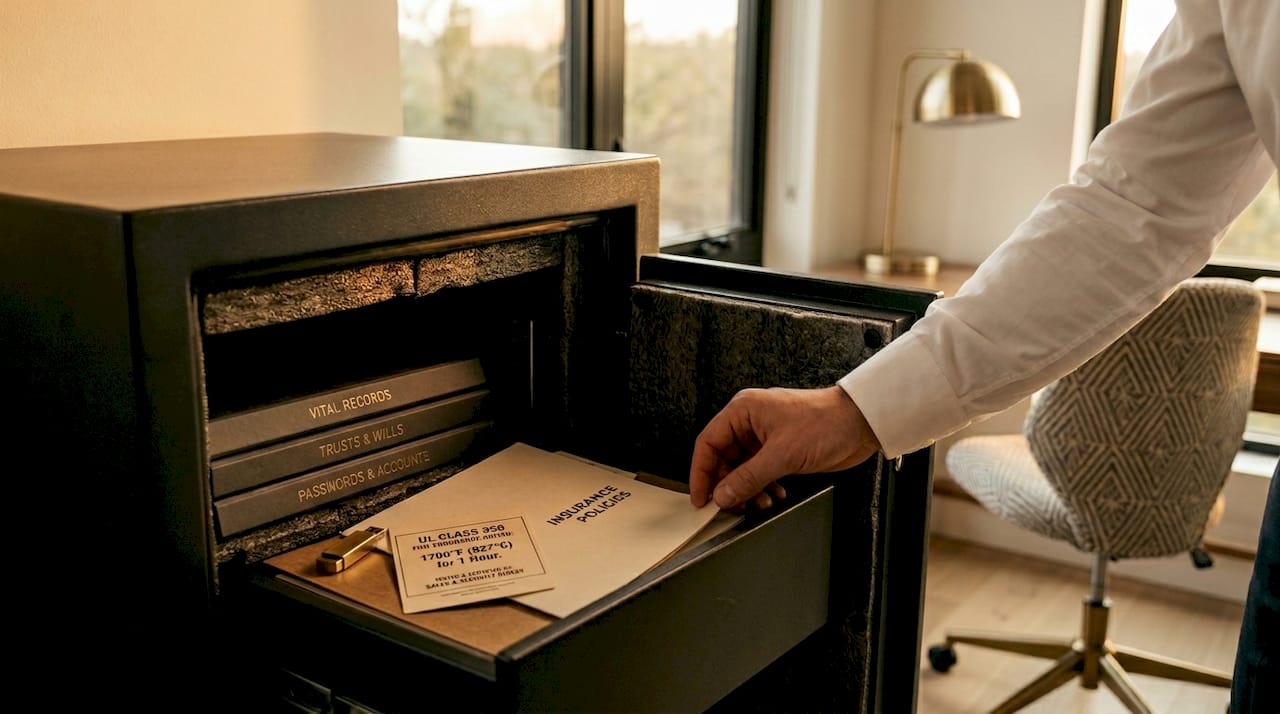
1. What fire ratings and certifications should you look for?
Fire ratings are the single most important factor in any fireproof safe buying guide. The UL 72 standard is the benchmark used by independent testing labs like UL (Underwriters Laboratories) and ETL/Intertek to classify safes by the maximum internal temperature they maintain during a fire.
The two classes you will encounter most often are:
- UL Class 350: Keeps interior below 350°F for 1 to 2 hours, which protects paper documents since paper ignites at around 451°F.
- UL Class 125: Designed for digital media. USB drives and hard drives are damaged at temperatures above 125°F, making a standard paper safe completely inadequate for electronics.
- Duration ratings: Safes are rated for 30 minutes, 1 hour, or 2 hours. A 1-hour fire rating suffices for most homes since typical house fires are controlled within 20 to 45 minutes. Rural properties with slower fire response times should target 2-hour ratings.
- Certification source: Only trust safes certified by independent labs like UL or ETL/Intertek. Certified safes pass rigorous testing that unverified “fireproof” marketing claims do not.
One common mistake is buying a safe that contains only a fire-resistant envelope or liner rather than a fully tested unit. The entire safe must carry the certification, not just a component inside it.
Pro Tip: Look for the UL or ETL certification mark physically printed on the safe’s door or body. If the certification only appears in the marketing brochure and not on the product itself, treat that claim with skepticism.
2. How size, weight, and lock type affect your decision
Choosing the right physical configuration is where many buyers go wrong. A safe that is too small forces you to leave valuables unprotected, while one that is too heavy for your floor structure creates a different problem entirely.
Safe sizes range from compact portable units around 0.15 cubic feet, suitable for a few documents and a hard drive, up to large floor safes exceeding 5 cubic feet for business records, firearms, and bulk storage. For most homeowners, a 1 to 2 cubic foot unit covers passports, birth certificates, insurance documents, and a backup drive. Business owners storing client files or cash drawers should size up significantly.
Weight is a theft deterrent in itself. Safes over 300 pounds deter theft significantly, but they may stress standard flooring. Place heavy units over load-bearing walls or use a plywood platform to distribute weight. Safes under 100 pounds can be removed by two people in under a minute, so bolt them to the floor or wall regardless of size.
Lock types each carry trade-offs worth understanding before you buy:
- Key locks: Simple and reliable, but a lost key is a serious vulnerability.
- Combination dial: No batteries required and highly durable, but slower to open under stress.
- Digital keypad: Fast access and easy to reprogram, but requires battery maintenance.
- Biometric: Fastest access, though fingerprint readers can fail with wet or dirty hands.
Pro Tip: If you choose a digital keypad lock, keep a backup key in a separate secure location. Battery failure at the wrong moment is a real scenario, not a theoretical one.
3. Additional protection features beyond fire resistance
Fire resistance alone does not cover every threat your safe will face. Water damage from firefighting efforts, flooding, or burst sprinkler systems can destroy documents that survived the flames. This is where your fire safety storage tips need to extend beyond temperature ratings.
Water resistance claims vary widely across products. Some safes resist standing water 5 to 8 inches deep for limited periods, while others are rated for up to 72 hours of submersion. That gap matters enormously if your home has a sprinkler system or sits in a flood-prone area. The key rule: check the specific water depth and duration ratings against your actual risk, not just the word “waterproof” on the box.
Additional features worth evaluating include:
- Impact resistance: Some safes are drop-tested to simulate a floor collapse during a fire. This matters for multi-story homes where the safe could fall through a burning floor.
- Pry resistance: Look for solid steel construction with anti-pry door bars. Fire-resistant insulation materials are often softer and easier to breach without reinforced steel.
- Interior organization: Adjustable shelving, document trays, and media compartments keep contents organized and reduce the risk of damage from items shifting.
- Alarm integration: Higher-end models from brands like SentrySafe and Honeywell include tamper alerts that connect to home security systems.
For business owners storing hard drives, USB backups, or photographic negatives, a dedicated media safe with a Class 125 rating is non-negotiable. A standard document safe will protect your paper files while destroying every digital backup inside it.
4. How to verify claims and maintain your safe over time
Buying a certified safe is step one. Keeping it effective over years of use is step two, and most owners skip it entirely. A fire safe maintenance checklist should be part of your annual home or business security review.
Follow these steps to validate your purchase and maintain performance:
- Verify certification at purchase. Check the physical certification mark on the safe body, not just the product listing. Cross-reference the model number on the UL or ETL database online before buying.
- Choose the right installation location. Avoid placing safes near fireplaces, furnaces, or exterior walls that face wildfire risk. Consult the wildfire homeowner checklist if you live in a high-risk fire zone.
- Inspect seals and locks annually. Check door seals for cracking or compression loss. Test lock function on both the primary and backup mechanisms. Lubricate keyed locks with a dry graphite lubricant, not oil, which attracts dust.
- Replace batteries on schedule. Digital keypad safes should have batteries replaced every 12 months regardless of the low-battery indicator. Do not wait for the warning.
- Inspect after any fire or flood event. After any fire exposure, even minor, have the safe professionally inspected before reuse. Insulating materials can crack or degrade invisibly, and a safe that looks intact may offer no protection in a second event.
- Plan for replacement. Fire safes degrade over time and should be replaced after 20 to 25 years, or immediately after significant fire or water damage.
Pro Tip: Photograph the contents of your safe annually and store that image in a cloud service like Google Drive or iCloud. If the safe fails, you will have a documented record for insurance claims.
5. Comparison: fire-resistant safe types and ideal use scenarios
Choosing the right safe type depends on what you are protecting, where you live, and how quickly you need access. This table summarizes the most common options covered in any solid fireproof safe buying guide.
| Safe type | Best for | Fire rating class | Water resistance | Theft deterrence |
|---|---|---|---|---|
| Document safe (floor) | Home paper records, passports | UL Class 350, 1-2 hr | Often included, check specs | High if bolted |
| Media safe | USB drives, hard drives, film | UL Class 125 | Varies by model | Moderate |
| Portable fire chest | Renters, small apartments | Class 350, 30-60 min | Limited | Low (light weight) |
| Wall safe with fire rating | Business offices, discreet storage | Class 350, 1 hr | Rarely included | Moderate |
| Gun safe with fire rating | Firearms plus documents | Class 350, 30-60 min | Rare | High (heavy steel) |
For urban homeowners with standard fire response times, a UL Class 350 floor safe rated for 1 hour covers most needs. Rural homeowners should target 2-hour ratings and add water resistance given longer response times. Business owners storing digital backups alongside paper records need a Class 125 media safe or a combination unit that meets both thresholds. Renters who cannot bolt a safe to the floor should choose a heavier unit, at least 100 pounds, and consider a certified safe selection guide to match their specific living situation.
Key takeaways
A fire-resistant safe protects valuables only when it carries verified UL or ETL certification, matches the temperature class for your stored items, and receives annual maintenance to preserve its rated performance.
| Point | Details |
|---|---|
| Match rating to contents | Use Class 350 for paper and Class 125 for digital media. |
| Verify certification independently | Check the UL or ETL mark on the physical safe, not just the product listing. |
| Weight deters theft | Safes over 300 lbs resist removal; bolt lighter units to the floor. |
| Water resistance is conditional | Confirm specific depth and duration ratings against your local flood or sprinkler risk. |
| Inspect and replace on schedule | Annual seal checks and replacement after 20 to 25 years maintain rated protection. |
What I’ve learned from watching homeowners get this wrong
By Chetna
Most people buy a fire-resistant safe once and never think about it again. That is the real vulnerability. I have seen homeowners store USB drives in a Class 350 document safe, confident their backups were protected, only to discover that the internal temperature during a fire exceeded 125°F and destroyed every drive. The safe did exactly what it was certified to do. It just was not the right safe for the job.
The other mistake I see constantly is trusting marketing language over certification marks. Phrases like “fireproof construction” and “fire-resistant materials” are not the same as a UL 72 certification. One is a claim; the other is a tested result. If you are spending money on a safe, spend 10 minutes cross-referencing the model number on the UL product database before checkout.
Placement matters more than most buyers realize. A safe stored next to a gas furnace or in an attached garage faces heat exposure before a fire even starts. Put it in a climate-controlled interior room, away from heat sources, and bolt it down regardless of weight.
My honest recommendation: budget at least as much for your safe as you would for a quality home appliance. A $50 fire chest from a big-box store is not protecting your irreplaceable documents. The best fireproof safes for home use carry independent certification, weigh enough to deter casual theft, and come with water resistance specs you can actually verify.
— Chetna
Protect your valuables with certified fire-resistant safes from Safesandsecuritydirect
Safesandsecuritydirect carries a broad selection of UL and ETL-certified fire-resistant safes built for homes and businesses. Every product listing includes the fire rating class, duration, water resistance specs, and lock type so you can match the safe to your checklist criteria without guesswork.
Whether you need a Class 125 media safe for digital backups or a heavy-duty floor safe for business records, the team at Safesandsecuritydirect can help you find the right fit. Browse the full range of fire-resistant safes at Safesandsecuritydirect and buy with the confidence that comes from verified certification and clear product specs.
FAQ
What does UL Class 350 mean on a fire-resistant safe?
UL Class 350 means the safe keeps its interior below 350°F for the rated duration, typically 1 or 2 hours, which protects paper documents from igniting. It does not protect digital media, which requires a Class 125 rating.
How do I know if a safe’s fire rating is legitimate?
Look for the UL or ETL certification mark printed directly on the safe body, then verify the model number in the UL product database online. Marketing claims on packaging alone are not sufficient proof of certification.
Can I store USB drives in a standard fireproof document safe?
No. Standard document safes rated UL Class 350 allow internal temperatures above 125°F, which destroys USB drives, hard drives, and other digital media. Use a Class 125-rated media safe for any electronic storage.
How often should I inspect my fire-resistant safe?
Inspect seals, locks, and insulation annually, and replace batteries in electronic locks every 12 months. Have the safe professionally inspected after any fire or flood exposure, even if it appears undamaged.
What is the difference between a portable fire chest and a floor safe?
A portable fire chest is lightweight and affordable but offers minimal theft deterrence since two people can carry it out quickly. A floor safe is heavier, often bolted in place, and provides significantly stronger combined fire and theft protection.
Recommended
- How to choose the right certified safe for your needs – Safes and Security Direct
- Fireproof Safe Selection Guide for Secure Home Protection – Safes and Security Direct
- What is a fire-resistant safe? Protect valuables now – Safes and Security Direct
- Buying Guide For Fire Resistant Home Safe in the United States – Safes and Security Direct