

7 key benefits of wall safes for homes and businesses
TL;DR:
- Wall safes provide discreet Concealment that significantly lowers burglar success rates, blending into interior decor.
- They offer quick, everyday access for essential items while remaining hidden from potential intruders, enhancing security.
Protecting your most valuable possessions and sensitive documents at home or work is harder than most people realize. A locked drawer or a basic filing cabinet might feel secure, but determined thieves typically locate these in under two minutes. Wall safes offer a fundamentally different approach: they combine concealment with accessibility, sitting quietly behind artwork or furniture while keeping your cash, jewelry, passports, and critical paperwork genuinely out of reach. Once you understand the full range of benefits, you’ll see why wall safes are one of the most practical and underused security tools available.
Table of Contents
- Why wall safes? Core benefits you can’t ignore
- 1. Enhanced concealment: Keeping valuables out of sight and mind
- 2. Everyday accessibility: Secure, yet practical storage
- 3. Protection against fire and tampering
- 4. Customizable and space-saving security for any property
- Our perspective: The most overlooked layer in a security plan
- Find the right wall safe at Safes and Security Direct
- Frequently asked questions
Key Takeaways
| Point | Details |
|---|---|
| Concealment advantage | Wall safes stay hidden, making your valuables much less likely to be targeted. |
| Everyday convenience | They offer secure storage that’s easy to access for commonly used items. |
| Fire and tamper protection | Many wall safes offer fire resistance and are tougher to break into than portable lockboxes. |
| Space-saving design | Wall safes don’t take up floor space, keeping your rooms uncluttered and secure. |
Why wall safes? Core benefits you can’t ignore
Wall safes are exactly what they sound like: security containers mounted directly inside a wall cavity, flush with the surface, usually hidden behind a painting, mirror, or panel. They differ from floor safes, which are embedded in concrete, and from freestanding safes, which sit on the ground and can sometimes be physically removed.
The core advantage is that concealment changes burglar search psychology and dramatically reduces break-in success rates. A thief working fast, which is almost always the case, targets the obvious: open desks, nightstand drawers, the master bedroom closet shelf. A wall safe behind a framed print doesn’t register as a target.
Here’s a quick comparison of wall safes versus other common storage options:
| Feature | Wall safe | Freestanding safe | Lockbox/drawer |
|---|---|---|---|
| Concealment level | High | Low | Very low |
| Floor space used | None | Moderate to large | Small to moderate |
| Removal risk | Very low | Moderate | High |
| Fire protection (typical) | Moderate | Moderate to high | Low |
| Best use case | Frequent access items | Heavy valuables | Temporary storage |
Wall safes work best for items you access regularly: cash reserves, spare keys, passports, jewelry, and important documents. They are less suited for extremely heavy items like large coin collections or oversized binders.
Key advantages at a glance:
- No floor space required
- Hidden from view with simple decor
- Quick to open and close for daily use
- Extremely difficult to remove without specialized tools
- Available in a wide range of sizes and locking mechanisms
For a full breakdown, our wall safes overview explains the different models and what each one is built for. You can also explore the hidden protection benefits of this style of secure storage.
Pro Tip: Never install a wall safe in the most predictable locations, such as the master bedroom or home office. Guest rooms, hallways, or behind built-in shelving in a living area are far less obvious choices that significantly reduce discovery risk.
1. Enhanced concealment: Keeping valuables out of sight and mind
With the core benefits framed, let’s dig into the single biggest psychological advantage wall safes deliver: genuine invisibility to an intruder.
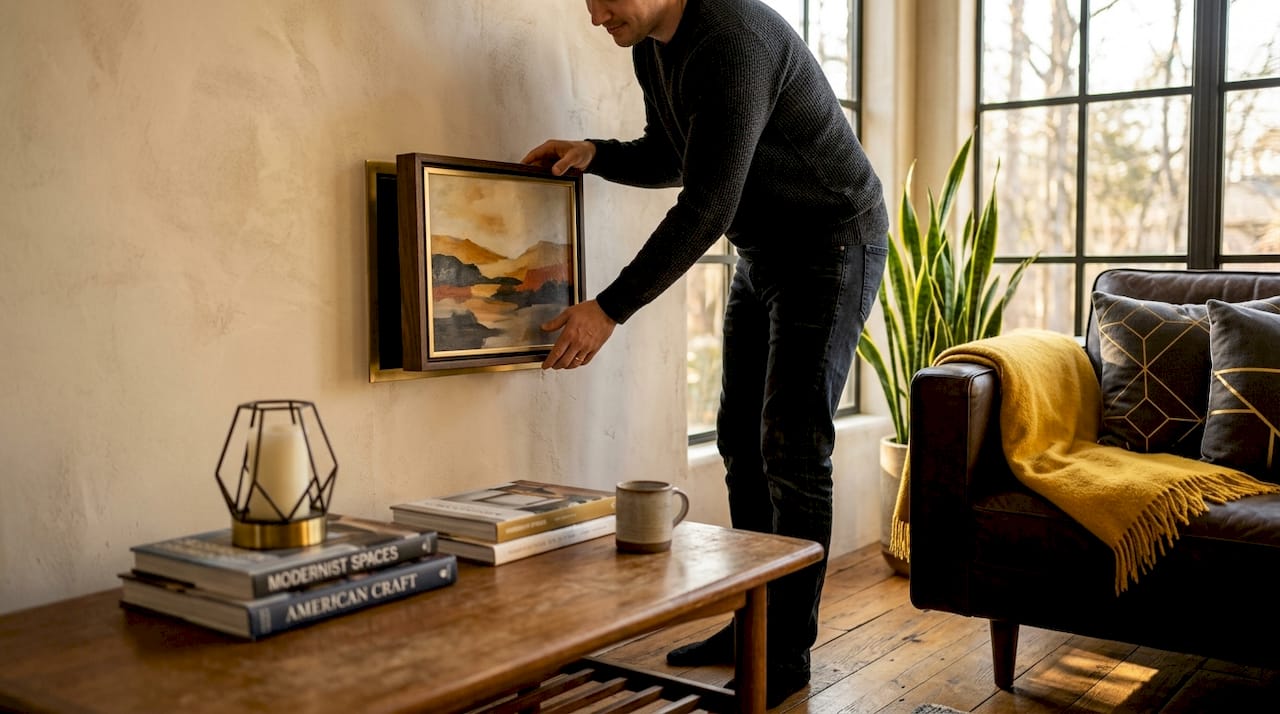
Burglars typically spend fewer than 10 minutes inside a property before leaving to avoid detection. In that window, they rely on visual cues to locate valuables quickly. A freestanding safe is a clear signal. A large portable lockbox is another. But a wall cavity concealed behind a decorative mirror? That requires time and knowledge they usually don’t have.
The most effective concealment strategies include:
- Hanging framed artwork at standard eye level with the safe recessed behind it
- Using full-length mirrors on bedroom or bathroom walls to cover the safe door
- Installing the safe behind removable wall panels in a home office or study
- Positioning it inside a closet, behind hanging clothes, at chest height
- Placing it behind a bookshelf in a room where you store documents
When placement is truly unpredictable, even a discovered break-in often results in the safe being overlooked entirely. This isn’t wishful thinking. Research into burglary behavior consistently shows that criminals skip concealed options when time pressure is high.
“A concealed wall safe blends into its environment so effectively that it often goes unnoticed even when a burglar has already entered the room. The visual trigger that typically draws attention to a safe simply isn’t there.”
Following proper wall safe installation tips is critical here. The installation location you choose on day one determines how concealed your safe remains for years. Take the time to think beyond the obvious rooms and walls.
2. Everyday accessibility: Secure, yet practical storage
Security shouldn’t mean inconvenience. One of the most underappreciated strengths of wall safes is how smoothly they fit into daily routines without creating friction.
Wall safes are ideal for items you need to access more frequently, unlike floor or concrete safes that are better suited to long-term, heavy-duty storage. If you need to retrieve your passport every time you travel, or pull out cash for weekly business operations, a wall safe keeps that process fast and clean.
Consider these everyday use scenarios:
- Home users storing passports, spare car keys, prescription medications, and jewelry they rotate regularly can open and close a wall safe in seconds, with no need to move furniture or work a heavy combination mechanism.
- Small business owners keeping a daily cash float, client contracts, or a backup set of building access keys benefit from a wall safe in a back office or staff-only area, giving authorized personnel fast access without exposing the contents to the general workspace.
- Property managers and landlords often use wall safes to secure master keys, lease agreements, and deposit records in a location that’s accessible to them but invisible to tenants and contractors.
- Home office workers dealing with sensitive client data, signed contracts, or financial records can keep these documents immediately at hand without leaving them in a filing cabinet that offers no real protection.
The locking mechanisms on modern wall safes have also improved considerably. Electronic keypad models open in under three seconds with a memorized PIN. Biometric models recognize a fingerprint and release the latch instantly. You don’t sacrifice speed for security.
For specific product guidance, our selection of the best wall safes for homes walks through models rated for both accessibility and fire protection so you can find the right balance.
Pro Tip: Keep the contents of your wall safe organized with small labeled pouches or zip bags. When you open the safe in a rush, you’ll find exactly what you need without emptying everything onto a shelf.
3. Protection against fire and tampering
Theft isn’t the only threat to your valuables. Fires destroy irreplaceable documents, cash, and personal items in minutes. Tampering and forced entry are risks for any fixed safe. Wall safes, when chosen carefully, address both.
Fireproof wall safes add crucial insurance for documents and cash and should be selected according to the specific fire risk profile of your home or office. A residential fire burns at roughly 1,100 degrees Fahrenheit on average. Documents begin to char at around 450 degrees, and cash starts to degrade even earlier. A certified fire-resistant wall safe with a UL or ETL rating can maintain an internal temperature below 350 degrees Fahrenheit for a defined period, typically 30 minutes to 2 hours.
Here’s how common wall safe protection levels compare:
| Protection type | Entry-level model | Mid-range model | Premium model |
|---|---|---|---|
| Fire resistance | 30 min at 1,200°F | 60 min at 1,400°F | 120 min at 1,700°F |
| Tamper resistance | Basic steel | Reinforced locking bolts | Anti-drill, anti-pry plates |
| Pry gap resistance | Minimal | 1/4-inch steel door | Concealed anti-pry hinges |
| Locking mechanism | Key or basic dial | Electronic keypad | Biometric + backup key |
Beyond fire, wall safes are actually more tamper-resistant than many people assume. Because they are mounted between wall studs and anchored with bolts, removing one requires significant noise, time, and tools. A portable lockbox can be grabbed in seconds. A freestanding safe can sometimes be tilted and dragged. A wall safe can’t.
Tamper-resistant features to look for include:
- Anti-drill plates behind the locking mechanism to defeat power tools
- Hardened steel bolts that extend into the wall frame when locked
- Anti-pry door edges that resist crowbars and flat tools
- Concealed hinges that can’t be targeted from outside the safe
Our breakdown of wall safe pros and cons covers exactly where these models shine and where you might need to complement them with additional security layers.
4. Customizable and space-saving security for any property
Protecting your assets shouldn’t mean sacrificing square footage or accepting a safe that clashes with your interior design. Wall safes solve this elegantly.
Wall safes are ideal for small valuables and easy to fit in offices or homes with tight space. Because they occupy wall cavity space rather than floor area, a wall safe has zero footprint. In a studio apartment, a compact urban office, or a retail back room, that matters enormously.
The practical space advantages include:
- Zero floor impact means furniture placement and room flow stay exactly as planned
- Vertical wall integration makes the safe completely invisible when covered
- Modular sizing allows you to choose a unit that fits between standard 16-inch stud spacing or wider cavity options for bigger items
- Multiple room compatibility means you can install one in a bedroom, hallway, home office, retail stockroom, or server room without architectural compromise
- Stackable installation is possible in some configurations, where two units are mounted one above the other in a larger cavity for separate access by different household members
For businesses specifically, the benefits multiply. A small retailer can mount a wall safe in the back office to secure daily takings and staff access cards. A medical practice can store prescription pads, controlled substance records, or patient financial documents out of patient view entirely. A hotel or vacation rental property can install a wall safe in each room, offering guests secure storage without the operator needing to manage individual room safes as bulky furniture.
Wall safes also work beautifully in multi-use residential spaces, where a single room might serve as both a guest bedroom and a home office. Because the safe is invisible, it doesn’t signal its presence to overnight guests.
Explore our guide to choosing hidden wall safes for residential settings, or our dedicated resource on wall safes for businesses if you’re evaluating commercial applications.
Pro Tip: In multi-use spaces like combined offices and guest rooms, choose a deeper wall safe model (8 inches or more of interior depth) so you can store hanging file folders and standard document envelopes flat, without folding or crushing them.
Our perspective: The most overlooked layer in a security plan
Most homeowners and business owners approach security from the outside in. They install cameras, upgrade door locks, add alarm systems, and feel finished. The interior of the property, specifically where valuables actually live, often gets minimal attention.
Here’s what years of working with customers across both residential and commercial security tells us: a visible safe is almost as risky as no safe at all. It broadcasts exactly what you’re protecting and invites a targeted effort. An intruder who spots a freestanding safe now has a clear objective. An intruder who sees a painting on a wall has no reason to stop.
Wall safes represent a fundamentally different philosophy. Instead of relying entirely on strength to deter theft, they rely on invisibility first, and strength second. That layered approach is what serious security professionals call defense in depth. You don’t put all your protection in one obvious place.
The counterintuitive truth is that the best security tool is often the one your adversary doesn’t know exists. Expensive, highly rated freestanding safes absolutely have their place for large valuables or long-term storage. But for day-to-day protection of documents, cash, and items you need regularly, a well-placed wall safe that nobody knows is there often outperforms a locked steel cabinet that announces itself to every visitor.
We’d also push back on the assumption that wall safes are only for high-net-worth homeowners. A renter protecting a laptop, a small business owner securing a cash drawer, or a parent keeping prescription medications away from teenagers all benefit from this technology at a very accessible price point.
Find the right wall safe at Safes and Security Direct
Selecting the right wall safe means matching your concealment goals, access habits, fire risk, and space constraints to a model built for exactly those conditions.
At Safes and Security Direct, we stock a carefully curated range of wall safes for homes and businesses, from compact electronic keypad models to fire-rated units with biometric access. Every product listing includes detailed specifications on fire ratings, bolt configuration, interior dimensions, and installation requirements so you can make a confident, informed choice. Whether you need a single unit for a home office or a multi-unit solution for a commercial property, our team is here to help you get it right. Browse our full wall safe collection at safesandsecuritydirect.com today.
Frequently asked questions
Are wall safes easy to install yourself?
Many wall safes are designed for DIY installation between standard studs, but professional fitting significantly improves both the structural integrity of the mount and the quality of concealment.
What items should not be stored in a wall safe?
Avoid highly flammable substances or very bulky items in wall safes. For maximum resilience, choose floor or burglary-rated safes when dealing with extremely heavy valuables or items that require long-term, high-security storage.
Can wall safes protect documents from fire damage?
Many wall safes offer fire-resistant features, but you should always verify the model’s certified fire rating before storing irreplaceable documents. Look for UL-listed fireproof protection to be certain.
Do burglars typically find wall safes?
Burglars under time pressure are far less likely to discover a properly concealed wall safe compared to visible or portable alternatives. Concealment reduces burglar detection rates by eliminating the visual signals that typically draw attention to valuables during a break-in.
Recommended
- Wall safes explained: secure storage for home & work – Safes and Security Direct
- 7 Key Types of Business Safes Every Owner Should Know – Safes and Security Direct
- 7 Key Benefits of Smart Safes for Secure Asset Protection – Safes and Security Direct
- 7 Types of Burglary-Resistant Safes Every Owner Should Know – Safes and Security Direct