

How to Choose a Business Safe: 2026 Buyer's Guide
TL;DR:
- Choosing a business safe requires assessing specific risks and selecting UL or ETL certified models for optimal protection. Proper installation, such as bolting to concrete and strategic placement, is essential to maximize security and meet insurance requirements. Matching lock types to workflow and planning for future capacity ensures safe access and long-term business safety.
A business safe is a certified security container designed to protect cash, documents, digital media, and valuables from theft, fire, or unauthorized access. Knowing how to choose a business safe correctly means matching the right protection level to your specific risks, not simply buying the heaviest box you can find. The industry uses standards set by Underwriters Laboratories (UL) and ETL to grade safes objectively, and those ratings are the only reliable benchmark you should trust. This guide walks you through every decision point: assessing your valuables, reading certifications, selecting a lock type, and planning installation.
How to choose a business safe: assessing your security needs first
The foundation of every smart safe purchase is a formal risk assessment, not a product brochure. Before you compare models, you need a clear picture of what you are protecting, how much it is worth, and what threats your specific location faces.
Start by categorizing your assets into four groups:
- Cash and negotiable instruments (daily float, petty cash, checks)
- Paper documents (contracts, employee records, tax filings)
- Digital media (USB drives, backup hard drives, SD cards)
- High-value items (jewelry, collectibles, equipment keys)
Each category has different protection requirements. Paper documents need a fire-rated safe that keeps internal temperature below 350°F. Digital media is far more sensitive and requires a safe rated below 125°F internally, because hard drives and USB drives fail at temperatures that paper survives easily.
Once you know what you are protecting, apply the insurance 10x rule: calculate your valuables as ten times the safe’s stated cash rating, then add a 25 to 30 percent capacity buffer for growth. A safe rated for $10,000 in cash is appropriate for up to $100,000 in jewelry or negotiable instruments. That buffer matters because businesses consistently underestimate how quickly their storage needs expand.
Your insurance provider’s requirements are non-negotiable in this process. Many commercial policies specify minimum safe ratings, lock types, or installation methods as conditions of coverage. Ignoring those requirements does not just leave you underprotected. It can void a claim entirely.
Pro Tip: Contact your insurer before you purchase. Ask specifically what UL or ETL rating they require and whether the safe must be bolted to the floor. Getting this in writing saves you from buying a safe that does not satisfy your policy.
Planning for at least 50% more capacity than your current needs prevents costly upgrades as your business grows. A safe that fits perfectly today will feel cramped within two or three years if your business adds staff, inventory, or cash handling volume.
What do UL and ETL certifications actually mean?
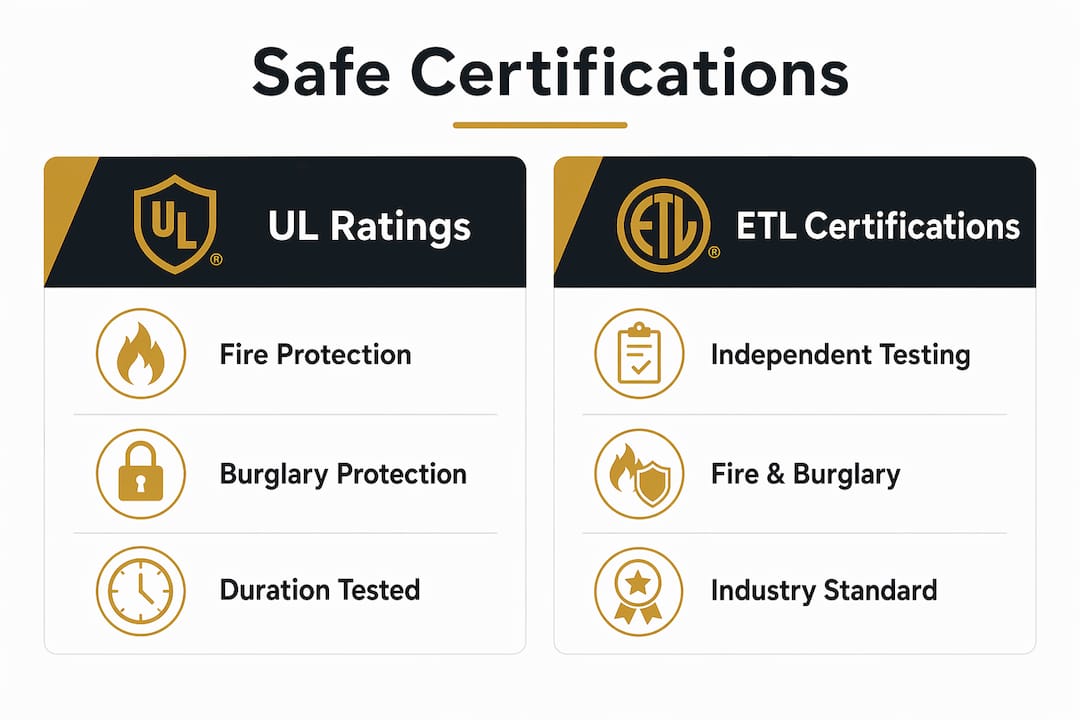
Certifications are the single most important factor in a commercial safe selection checklist, and they are also the most misunderstood. The terms “fireproof” and “theft-proof” are marketing language. UL and ETL ratings are engineering facts.
Relying on marketing or unverified claims leads to inadequate choices. A safe labeled “fireproof” with no third-party certification has never been tested in a controlled fire scenario. It may protect your documents. It may not. You have no way to know.
Here is how the main ratings break down:
| Rating | Protection type | Internal temp limit | Duration |
|---|---|---|---|
| UL Class 350 | Paper documents | 350°F | 1 hour minimum |
| UL Class 125 | Digital media and film | 125°F | 1 hour minimum |
| UL Class 72 | Magnetic media | 72°F | 1 hour minimum |
| UL TL-15 | Burglary resistance | N/A | 15 min tool attack |
| UL TL-30 | Burglary resistance | N/A | 30 min tool attack |
UL Class 350 fire ratings certify that the safe maintains an internal temperature below 350°F for at least one hour, which is the threshold for paper ignition. If you store USB drives or backup hard drives alongside paper files, you need UL Class 125 at minimum, because digital media fails well before paper burns.
Burglary ratings work differently. A TL-15 rating means a safe withstood a 15-minute attack by a trained technician using power tools. TL-30 doubles that time. For most retail businesses, TL-15 is adequate. For jewelry stores, financial offices, or businesses holding significant cash overnight, TL-30 is the appropriate floor.
“The most common mistake businesses make is buying a fire safe and assuming it also resists burglary. Fire safes under $300 can be pried open in under two minutes with basic tools. Fire protection and burglary resistance are separate engineering problems that require separate certifications.”
Buying separate safes for fire and burglary protection is often more effective and economical than searching for a single unit that does both. A UL Class 350 fire safe for documents plus a UL TL-15 burglary safe for cash covers both threats without the premium cost of a combined unit. Check the safe ratings breakdown from Safesandsecuritydirect for a detailed look at how these certifications apply to specific models.
Which lock type is right for your business?
Lock selection is where most business safe buying guides give generic advice. The right lock depends on how many people need access, how often the safe opens, and what your backup plan is if the primary lock fails.
The three main options each have real trade-offs:
- Mechanical combination locks are slow to open (30 to 60 seconds for an experienced user) but require zero maintenance and have no battery dependency. They are the most reliable option for low-frequency access, such as a weekly cash deposit or document archive.
- Electronic keypad locks provide fast access, typically under 10 seconds, and allow you to set multiple user codes. The trade-off is battery dependency. Most electronic locks need battery changes every 12 to 18 months, and a dead battery at the wrong moment creates real operational problems.
- Biometric locks offer the fastest access of all three types, but biometric locks can fail if fingers are dirty or wet. In a kitchen, warehouse, or retail environment where hands are frequently wet or soiled, biometric reliability drops significantly.
For businesses with multiple staff members who need access, electronic keypads with individual user codes are the practical choice. You can add or delete codes without a locksmith, which matters when employees leave. For high-security applications, dual-lock configurations requiring both a keypad code and a physical key add a meaningful layer of protection.
Pro Tip: Always verify that your chosen lock has a backup override option, either a physical key or a manufacturer reset protocol. An electronic lock with no backup access method can lock you out of your own safe permanently if the electronics fail.
For retail environments with frequent cash deposits, drop safes with B-Rated doors and multiple user access control are the recognized standard. Their design allows staff to deposit cash without opening the main compartment, which directly reduces internal theft risk. Explore the types of safes for businesses that Safesandsecuritydirect covers, including deposit and drop safe configurations suited to retail operations.
Where and how should you install a business safe?
A certified safe installed poorly is only marginally better than no safe at all. Installation decisions directly affect whether a safe deters theft or simply delays it.
The core installation rules for any commercial environment are:
- Bolt to concrete or solid flooring. Unbolted safes under 500 lbs can be removed by two people with basic equipment. Anchoring eliminates that risk entirely.
- Avoid exterior walls. Exterior walls are the easiest point of attack for anyone with power tools and a vehicle. Interior placement forces attackers to work deeper inside your building.
- Position near CCTV coverage. A camera pointed at the safe does not stop a determined thief, but it creates evidence and acts as a visible deterrent. Physical security like bolting and camera coverage is as important as the safe’s specifications.
- Keep the safe out of customer sight lines. Visibility invites targeting. A safe in a back office or locked storage room is harder to locate and harder to access than one visible from a sales floor.
- Verify access routes before delivery. Planning installation includes verifying the safe fits through all doorways, stairwells, and space constraints to avoid costly returns. Measure every doorway, hallway corner, and stairwell on the delivery path before you order.
Professional installation by a certified locksmith or security technician is worth the cost. They will anchor the safe correctly, verify the lock calibration, and document the installation in a way that satisfies most insurance requirements.
Common mistakes to avoid when selecting a business safe
Even experienced buyers make errors that undermine their investment. These are the most frequent ones:
- Treating a fire safe as a burglary safe. Fire-rated safes prioritize insulation over steel thickness. A UL Class 350 fire safe is not a burglary deterrent. If you need both protections, buy both ratings or a dual-certified unit.
- Underestimating capacity. Businesses routinely fill a safe within 18 months and then face the cost of buying a second unit. Buying larger upfront is almost always cheaper.
- Ignoring certification requirements. Purchasing a safe without verifying UL or ETL certification against your insurance policy requirements can void coverage on a claim.
- Poor installation. An unbolted safe, or one placed in a visible, accessible location, negates much of the protection the safe itself provides.
- Choosing the wrong lock for your workflow. A biometric lock in a food service environment or a mechanical lock in a high-traffic retail store creates daily friction that leads staff to bypass security protocols entirely.
Key takeaways
Choosing the right business safe requires matching certified protection levels to your specific assets, threats, and workflow rather than buying on price or brand recognition alone.
| Point | Details |
|---|---|
| Start with a risk assessment | Identify asset types, values, and threats before comparing any safe models. |
| Match certifications to assets | Use UL Class 350 for paper, UL Class 125 for digital media, and TL-15 or TL-30 for burglary resistance. |
| Apply the 10x insurance rule | Value your safe’s capacity at ten times the cash rating and add a 25 to 30 percent buffer. |
| Choose locks by workflow | Electronic keypads suit multi-user access; mechanical locks suit low-frequency, high-reliability needs. |
| Install correctly | Bolt to concrete, position away from exterior walls, and verify delivery routes before ordering. |
What I have learned from watching businesses get this wrong
Most businesses that end up with the wrong safe made the same mistake: they started with a budget and worked backward. They found a price point, picked the heaviest-looking safe in that range, and assumed the marketing copy was accurate. That approach fails in predictable ways.
The businesses I have seen get this right always start with the risk assessment. They know exactly what they are protecting, what their insurer requires, and what their daily workflow looks like before they look at a single product page. That sequence matters more than any individual feature.
The insight that surprises most business owners is the workflow piece. A retail manager who needs to make cash drops six times a day has completely different needs than an accountant who opens a safe once a week to file documents. The accountant can use a mechanical lock with no problem. The retail manager needs a drop safe with individual user codes and a deposit slot, because anything slower creates pressure to skip the protocol entirely.
I am also skeptical of any safe marketed as “fireproof” without a UL or ETL certification number printed on the unit. That word has no legal definition in the security industry. It is a marketing claim, not an engineering standard. If a supplier cannot give you the specific UL class and test duration, the safe has not been independently tested.
One more thing: plan for 50 percent more capacity than you think you need today. The cost difference between a safe that fits your current inventory and one with room to grow is usually a few hundred dollars. The cost of buying a second safe two years from now, including delivery and installation, is almost always higher.
— Chetna
Find the right certified safe for your business at Safesandsecuritydirect
Safesandsecuritydirect carries a full range of UL-certified fire safes, TL-rated burglary safes, and deposit safes built for commercial environments. Whether you are protecting daily cash receipts, sensitive client documents, or digital backup media, the catalog at Safesandsecuritydirect includes models matched to every business size and risk profile. Each listing includes certification details, interior dimensions, and weight specifications so you can verify compliance with your insurance requirements before you buy. If you are unsure which model fits your workflow, the product descriptions and filtering tools make it straightforward to narrow your options by rating, lock type, and capacity.
FAQ
What is the most important feature in a business safe?
Third-party certification from UL or ETL is the single most important feature. It confirms the safe has been independently tested for fire resistance, burglary resistance, or both, rather than relying on unverified manufacturer claims.
How do I determine what safe size my business needs?
Apply the 10x insurance rule: your safe’s cash rating multiplied by ten should cover your total valuables. Add a 25 to 30 percent capacity buffer and plan for at least 50 percent more interior space than your current inventory requires.
Can one safe protect against both fire and burglary?
Some dual-certified safes carry both fire and burglary ratings, but they are expensive. Buying a separate UL Class 350 fire safe for documents and a UL TL-15 burglary safe for cash is often more cost-effective and provides stronger protection in each category.
What lock type is best for a retail business?
Electronic keypad locks with individual user codes are the standard for retail environments because they allow fast access and easy code management when staff changes. Drop safes with deposit slots add another layer by letting employees deposit cash without accessing the main compartment.
Does a safe need to be bolted down to be effective?
Yes. Any safe under 500 lbs that is not anchored to the floor or wall can be physically removed by two people. Bolting to concrete is a baseline requirement for most commercial insurance policies and is the minimum standard for effective installation.
Recommended
- 6 Essential Types of Safes for Business Owners to Know – Safes and Security Direct
- Explaining Safe Ratings: What Every Buyer Must Know – Safes and Security Direct
- How to choose the right certified safe for your needs – Safes and Security Direct
- Top 6 businesssafes.com Alternatives 2026 – Safes and Security Direct